
Study on material infeed in DSD sorting plants : Bag Opening considerably reduces the risk of fire
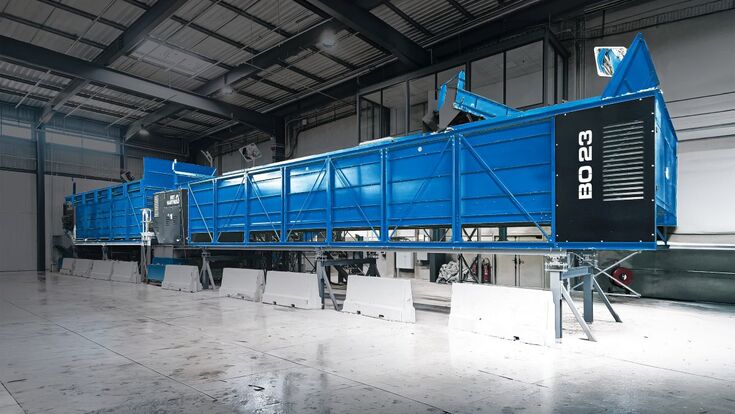
BRT HARTNER has sold over 800 BO bag openers worldwide – to date, there has not been a single reported case in which the machine is said to have caused a fire.
- © EggersmannConsiderable reduction in the average number of fire incidents
The analysis showed that bag openers caused hardly any damage to incorrectly fed lithium-ion batteries, which is why dangerous heat build-up occurs less frequently. Data from a total of eleven sorting plants for lightweight packaging operated with material from the Dual System Germany (DSD) were analysed for this purpose – four of the plants use bag openers, whilst the other seven employ pre-shredding at the start of the mechanical processing. At the four facilities with bag openers, there were a maximum of 3 to 4 instances of heat detection per month during three-shift operation. In contrast, at six of the other facilities, the figure was twenty times higher, with an average of 3 detections per day. The seventh plant proved to be incomparable with the others due to the nature of its household and residual waste collection. “Our BRT HARTNER BO Bag Openers are designed to gently tear open and empty the bags,” explains Steffen Simonsen. He is Area Sales Manager at BRT HARTNER and acted as second examiner for the thesis. “The material itself is deliberately handled in such a way that it is passed on to the subsequent sorting processes as intact as possible.” He sees clear added value here, particularly for plant operators who have invested in cost-intensive X-ray systems or optical sorters for the targeted removal of rechargeable and non-rechargeable batteries: “These systems are placed after the pretreatment – which means that, without gentle bag opening, there is already a high fire risk before the rechargeable and non-rechargeable batteries can even be sorted out by the machines. Only by installing a bag opener before the sorting can genuine efficiency and maximum safety be achieved here.”
Comparison of feed units in light packaging sorting plants
As the title suggests, the bachelor thesis of Röll actually deals with a general ‘comparison of infeed units in light packaging sorting plants’ (German: Vergleich von Aufgabeeinheiten in Sortieranlagen von Leichtverpackungen) and was supervised by Prof. Dr.-Ing. Sören Weinrich as the principal examiner. Röll carried out the data collection during an internship at BRT HARTNER. The company had also initiated the research project: “The topic is socially relevant, as the fires jeopardise waste disposal safety and thus our infrastructure. We had therefore hoped that the FH Münster would take up the matter and we were keen to see the results. With over 800 bag openers sold worldwide, we are still not aware of a single case in which one of these machines has caused a fire in a plant,” explains Simonsen. Furthermore, the company had previously been approached by a DSD plant operator in Germany who pointed out that, since the introduction of automatic temperature detection and the systematic documentation of measured events, a significant discrepancy had become apparent between plants using bag-opening and those using pre-shredding. The company then contacted the University of Applied Sciences for a more detailed investigation. Simonsen explains that this step was taken to improve customer advice: “We offer both bag openers and pre-shredders. Both technologies have their own application-specific advantages. Mr Röll’s work has provided us with a great deal of valuable information, which we will incorporate into our future customer consultations. We are very grateful to him for his objective analysis.”
Fires: a growing problem for the industry
In recent years, the number of fires within the recycling sector has risen rapidly worldwide. According to the status report on the German circular economy published by the Federal Association for Secondary Raw Materials and Waste Management (German: Bundesverband Sekundärrohstoffe und Entsorgung e. V. (bvse)) and the Federal Association of German Waste Management, Water and Circular Economy (German: Bundesverband der Deutschen Entsorgungs-, Wasser- und Kreislaufwirtschaft e. V. (BDE)) estimate that there are around 30 fires per day in Germany alone.1 Next to the immediate danger to the staff this trend places an enormous economic burden on the sector: waste collection centres and facilities are brought to a standstill following fires, batches are destroyed by the flames, delivery failures make planning difficult and transport companies refuse to accept certain goods. For many, however, the greatest challenge is rising insurance costs. This is triggered by the steadily growing volumes of lithium-ion batteries and accumulators being put into circulation, which in turn is accompanied by a corresponding increase in incorrect disposal.