
€100 million for Austria’s raw material future : ARA sets new standards in plastics recycling
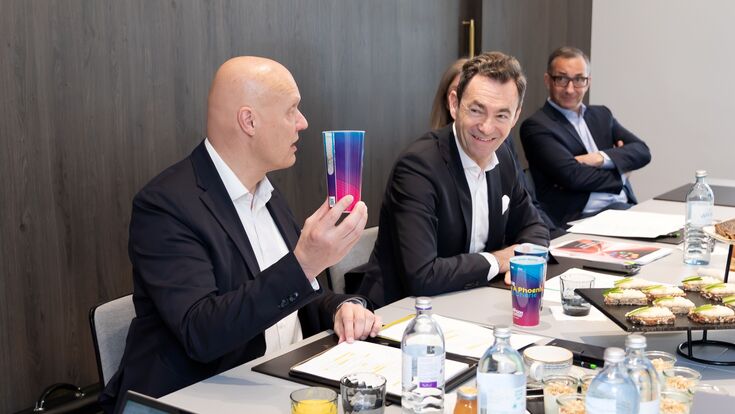
ARA Executive Board member Thomas Eck and ARA Executive Board spokesperson Harald Hauke
- © ARA AG/APA-Fotoservice/Jana MadzigonAltstoff Recycling Austria AG (ARA) is driving forward the transformation of the Austrian circular economy into a central pillar of industrial policy. With a substantial investment package totalling €100 million together with partners through to the end of 2026, the market leader is securing valuable secondary raw materials for the country as a business location. Amid regulatory uncertainty arising from the EU Packaging Regulation (PPWR), ARA has reached a genuine milestone: the ambitious EU recycling rate of 50% for plastic packaging was successfully achieved in the household sector in 2025.
In the face of stagnant economic growth and stringent regulatory requirements, ARA emphasises the strategic importance of the circular economy. "The circular economy has long been an essential pillar of industrial policy, strengthening competitiveness through the securing of raw materials. In an environment of uncertainty and high energy costs, resource efficiency is a decisive factor in economic viability," explains ARA Management Board Spokesman Harald Hauke. "At ARA, we are positioning ourselves ever more broadly as a full-service provider in the circular economy, and we are investing where Austria's industrial capability needs to be expanded." Establishing the circular economy as a key technology within industrial strategy, he adds, underlines its potential for national raw material sovereignty.
€100 million for Austria's raw material independence
To ensure the supply of high-quality secondary raw materials to industry, ARA has substantially expanded its infrastructure. In 2025 alone, it was therefore able to provide 607,000 tonnes of secondary raw materials, including 103,000 tonnes of lightweight packaging and metals, 320,000 tonnes of paper and 184,000 tonnes of glass.
The foundation is formed by two major projects in the plastics sector:
TriPlast: The high-tech sorting facility in Upper Austria, with an investment of more than €60 million, is the centrepiece of sorting for plastic and metal packaging.
Sort4cycle: Together with partners, ARA is investing €40 million in this new facility (ground-breaking in April 2026), which from 2027 will deploy the UPCYCLE process developed and patented by ARA on a large scale, in order to recover sorting residues that were previously not recyclable as material.
"By the end of 2026, we will therefore have invested more than €100 million in the plastics sector alone, securing secondary raw materials for industry and strengthening Austria as a business location," Hauke emphasises.
EU's 50% recycling rate for plastic packaging achieved
At the press briefing, ARA Management Board member Thomas Eck announced that the 50% rate for plastic packaging from the household sector had been reached. Despite the introduction of the single-use deposit scheme, collection in 2025 recorded an increase of 7% for packaging in the yellow bag or yellow bin that is not subject to the single-use deposit. Vienna stood out in particular with a 14% increase in net volume, followed by the federal provinces of Tyrol at 10% and Vorarlberg at 8%. "Separate packaging collection has to be simple in order to work. By expanding kerbside collection, we now reach 2.2 million households directly at their doorstep. Austrians have trusted our system for over 30 years. This well-established awareness, combined with the simple, joint collection of packaging in the yellow bin or yellow bag, is the decisive lever for our success," says Eck.
An appeal to policymakers: rectify the "design flaw" in EU legislation
Despite these successes, ARA is voicing clear criticism of the sequencing of the EU regulations (PPWR). While collection and recycling rates are already in force, binding design guidelines and recycled-content quotas will not follow until years later. "It is a design flaw to have first set recycling rates while then waiting years before manufacturers are required to use the material," says Hauke. ARA sees itself here as an "advocate" for the domestic economy and is calling for closer alignment of the targets, as well as clarity on the legal acts planned by the European Commission. At the same time, ARA is in close dialogue with Austrian companies and has substantially expanded its advisory services around the PPWR – for instance through more personal consultations, on site or as webinars. With 17 PPWR events in 2025 and 2026, it has so far reached around 2,000 participants from industry and retail.
Innovation in the "supreme discipline": research into food-grade recyclates
To further improve the quality of secondary raw materials, ARA – as a full-service provider in the circular economy – is pursuing targeted collaborations with research and industry. The focus is on producing food-grade recyclates. Together with partners, ARA is working on pilot projects such as the reusable cup for this year's Eurovision Song Contest, in order to meet the extremely high safety requirements for food packaging, which can currently only be ensured through chemical recycling. Eck emphasises: "Food-grade recyclates produced through the mechanical processing of polyolefins and polystyrene are the supreme discipline of recycling and our goal. We want to secure the highest qualities, so that today's packaging can once again become safe food packaging tomorrow."
Textile recycling: realism rather than "gold plating"
Another forward-looking topic is mandatory textile recycling from 2028. Here, ARA warns against bureaucratic hurdles and calls for simple solutions, such as the use of existing economic systems. "We are calling for pragmatic, workable requirements from the legislator – realism rather than gold plating, pragmatism rather than busywork," explains Eck. ARA argues that the mistakes made in the legislation on plastics recycling should not be repeated with textile recycling. Furthermore, the forthcoming EPR system (Extended Producer Responsibility) for textiles should draw on existing, efficient structures within the economy, in order to keep costs for taxpayers low. ARA is already carrying out important technological pioneering work: initial sorting trials are showing promising results. The challenge, however, lies above all in the recycling itself, and at the same time in creating viable markets for the recovered fibres.
Economic viability as the compass, and separating waste for the cycle
ARA will continue to drive innovation forward, but stresses the need for economically viable solutions. "We need sensible legal frameworks, and despite all the technological progress, active participation by consumers remains crucial," Hauke concludes. "Only if valuable residual materials are separated correctly can we recycle them. If they end up in residual waste, they are lost to the cycle for ever."
