
Solid Recovered Fuel : Pellenc ST’s expertise serving the largest SRF plant in Spain
The European industrial waste management market is expected to reach USD 63.27 billion by 2031, growing at an estimated compound annual rate of 6%. This growth is driven by strengthening regulatory frameworks, accelerating technological innovation and an increasing emphasis on sustainable waste treatment solutions.
In this context, major European operators are making strategic investments. One example is the German company PreZero, which has decided to build the largest Solid Recovered Fuel (SRF) production facility in Spain. SRF is a highly efficient energy resource for generating heat and electricity. Using SRF fully aligns with strategies aimed at reducing the share of fossil fuels in the energy mix, as encouraged by public authorities.
Located in the heart of Zona Franca in Barcelona, the new facility is considered one of the most advanced in Spain for producing SRF from non-recyclable industrial waste. It marks a strategic milestone in the transition towards a circular economy. The site will soon be complemented by Barcelona’s first biomethane unit, Bioenergy, which will enable the direct injection of renewable gas into the natural gas grid. With a total investment exceeding €42 million and the creation of over 85 direct jobs, these two projects aim to convert industrial waste into alternative energy and renewable gas.
A European showcase for energy recovery
The PreZero plant is designed for continuous operation, 24 hours a day, 365 days a year. It has a processing capacity of around 30 tonnes of non-recyclable waste per hour, equating to almost 200,000 tonnes per year. This continuous production enables significant output volumes, with up to 70,000 tonnes of SRF produced each year alongside the recovery of over 40,000 tonnes of recyclable materials.
SRF, produced from a blend that complies with European standards (plastics, textiles and paper), is primarily intended for use in energy-intensive industries, particularly cement plants and facilities for the production of thermal energy.
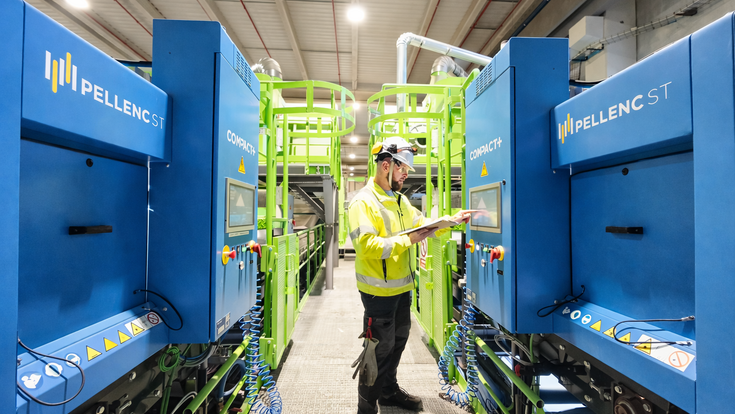
For this project, PreZero entrusted plant integration to Bianna and optical sorting to Pellenc ST. Pellenc ST machines are at the core of the process. Six optical sorters in total ensure maximum recovery of recyclable materials and the preparation of an SRF stream that complies with the requirements of the cement industry.
The Pellenc ST equipment supplied belongs to the COMPACT+™ range, which is designed for constrained and dusty industrial environments. These machines stand out for their ease of integration, low energy consumption and optimised maintenance costs, notably through reduced compressed air consumption and wear parts. All sorters are equipped with the new FLOW detection chain, which combines a spectrometer that covers an extended NIR/VIS spectrum with high-precision focused lighting. This configuration significantly improves the purity of recovered fractions.
Smart control and SRF traceability
All optical sorters are configured to connect to the SMART&SHARE™ SaaS application. This gives operators access to indicators that allow them to monitor SRF quality, such as lower heating value (LHV), chlorine content, PVC rate, moisture and biogenic carbon content. Thanks to customised reports and smart alerts, operators can precisely control the quality of the SRF stream and adapt it to the specific requirements of end users.
Exemplary collaboration
The teams from PreZero, Bianna and Pellenc ST unanimously emphasise that the project’s success is based on a relationship of trust and close collaboration between the operator, integrator and technology provider. Each partner mobilised its expertise to achieve the expected performance levels within the required timeframe.
'This plant is a prime example of tripartite cooperation, addressing today's environmental challenges,' says Juan A. Gázquez Serrano, PreZero Iberica's Director of Industrial Business North.
This installation strengthens the position of the Zona Franca de Barcelona as a benchmark hub for industrial innovation and sustainable energy transformation.
The SRF sector is now emerging as a forward-looking solution and a viable alternative to fossil fuels. By combining material and energy recovery, the three partners are helping to reduce dependency on landfill sites and greenhouse gas emissions, while strengthening the region’s energy independence.
