
Plastic waste : Chinaplas 2026: European expertise in plastic recycling and the circular economy
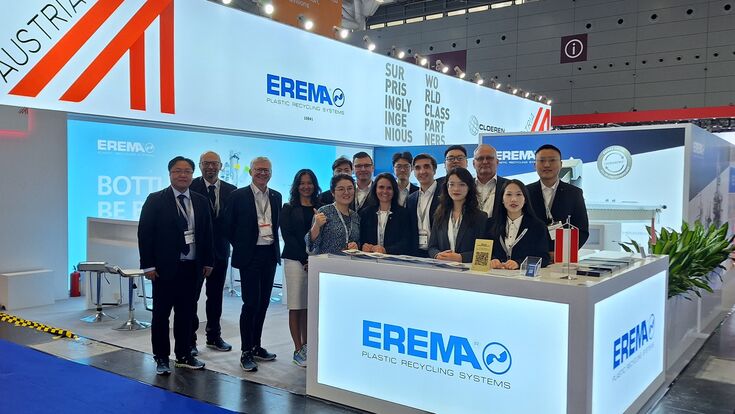
Taking place from 21 to 24 April 2026 in Shanghai, Chinaplas remains the leading platform for the plastics and rubber industries in Asia. This year, EREMA — founded in 1983 and regarded as the global market and innovation leader in plastics recycling systems — will use the event to address the industry’s most pressing questions about recyclate quality and end applications. EREMA experts will be available for in-depth discussions at stand 2.1 B58.
“Many companies are currently addressing specific questions about which applications recyclates can and will be used for today and in the future,” says James Qiu, General Manager at EREMA Shanghai. “These are exactly the topics we are addressing at Chinaplas.”
PET polymer recovery: flexibility across different target markets
Solutions for PET continue to account for the majority of recycling systems in China, and EREMA has already installed more than 50 VACUREMA® and VACUNITE® systems in the region. The trend is firmly moving towards food-grade applications, with the technology’s flexibility cited as a key advantage.
“Our technologies offer customers maximum flexibility,” explains Christoph Wöss, Global Sales Director at EREMA. “The regranulates are used in applications such as sheets, fibres, or packaging. As soon as the market opens up for bottle-to-bottle recycling, our customers can immediately enter this segment as well.”
One area with significant potential is tray-to-tray recycling of take-away packaging. The required technology has already been proven on an industrial scale. Danish food packaging manufacturer Faerch, through its recycling division Cirrec, is considered a pioneer in this field: trays made from rPET thermoforming film contain up to 100 per cent recycled post-consumer PET and meet stringent requirements in terms of food safety, durability, and transparency.
The VACUREMA® and VACUNITE® machine series have been approved by globally recognised food safety authorities for the production of food-grade rPET. In December 2025, EREMA received four additional positive opinions from the European Food Safety Authority (EFSA) in accordance with EU Regulation 2022/1616, confirming that the technology meets current requirements for decontamination and process validation. The distinction between bottle and sheet applications also reduces complexity for recycling companies.
“The majority of rPET in China is currently used in textile production,” adds James Qiu. “With a future opening of bottle-to-bottle recycling, it will be crucial to establish solutions that keep PET within its respective loops.” With its fibre-to-fibre technology FibrePro:IV, as well as its investment in Australian clean-technology pioneer BlockTexx®, EREMA is consistently expanding its specialist knowledge in textile recycling.
Post-consumer reprocessing gains momentum
“We are seeing growing interest in post-consumer solutions in China,” says James Qiu. “EREMA supports customers with extensive expertise.” Alongside PET, this interest extends to a broader range of material streams. One compelling example involves a collaboration between EREMA, Irish company Polymer Matters, and joint venture partner Lindner Washtech, in which HDPE milk bottles from post-consumer collections are recycled and used to produce new milk bottles. The combination of washing and extrusion technology underpins the high quality of the recyclate, and the process has recently been classified by the European Commission as an advanced novel technology for direct food contact.
Increasing requirements are also apparent in the recycling of film waste. Household, supermarket, and agricultural films pose particular challenges due to contamination and moisture. With the INTAREMA® TVEplus® DuaFil® Compact, EREMA offers a solution designed for precisely such demanding material streams.
A further example of what high-quality recovered materials can achieve in practice is INTCO, which operates around 30 INTAREMA® TVEplus® systems equipped with EREMA laser filters for EPS recycling. “The regranulates achieve a high level of quality and are used in premium products such as picture and photo frames,” explains James Qiu. “Thanks to its integrated value chain, INTCO holds a strong international market position.” While such applications already demonstrate the potential of post-consumer recyclates in premium goods, they remain comparatively rare in China; in Europe, by contrast, this model is well established.
Keeping materials in closed-loop resource cycles
A central theme running through EREMA’s approach at Chinaplas is the ambition to keep materials within dedicated value loops rather than allowing them to migrate to lower-quality applications. This is particularly relevant for PET, where existing infrastructure in China supports textile production but future regulatory conditions may open bottle-to-bottle and tray-to-tray pathways. EREMA’s broad technology portfolio is positioned to serve each of these loops independently, offering recycling companies the flexibility to adapt as markets evolve.
Sustainability targets set by international brand owners and regulatory requirements are accelerating this transition. The consistent quality of secondary raw materials, as delivered by EREMA systems, is increasingly seen as the deciding factor in enabling recyclates to compete directly with virgin materials in demanding end applications.
Deep roots and local know-how in the Asia-Pacific region
EREMA has been present in Asia for several decades and has operated its own subsidiary in China since 2005. Locally based technicians have received comprehensive training at the company’s headquarters in Austria and provide on-site support to customers. Further subsidiaries in Asia are located in India and Thailand, extending the company’s regional reach.
In addition to the exhibition stand at Hall 2.1, Booth B58, EREMA representatives will present at “The Power of Plastics” Conference. Scheduled talks include presentations on flexible PET recycling and scaling high-quality post-consumer recyclate production through advanced recycling technologies, covering both the commercial and technical dimensions of the transition towards a more resource-efficient plastics industry.
