
Glass Recycling : Dryden Aqua and MSort make water filters made from recycled glass
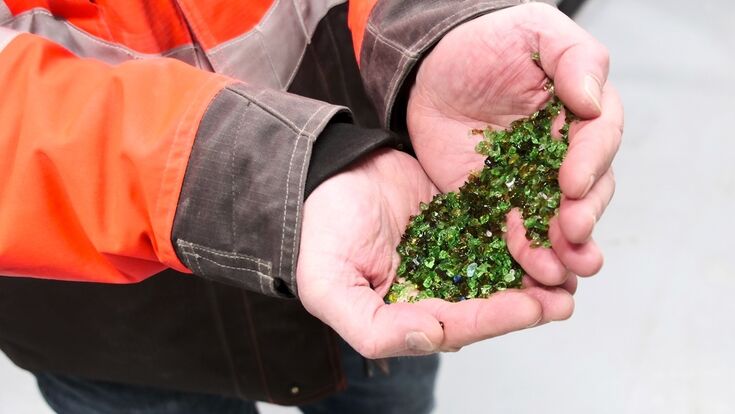
The sorting result: pure green and brown glass, also referred to internally as “Gramber”.
- © STEINERTClean water is the foundation of Dryden Aqua Ltd.'s operations, and the process begins with a secondary raw material that many would consider waste: used glass bottles. The company produces AFM® (Activated Filter Media) from green and brown recycled glass. This activated, biofouling-resistant, glass-based filter medium is used in the treatment of drinking water, in swimming pools, in aquaculture and in industrial and municipal water applications.
“Our goal is to make clean water accessible to all,” says Jamie McBride, Operations Director at Dryden Aqua. Having grown up in the British glass recycling industry, Mr McBride's family background and decades of experience in cullet processing have shaped his perspective, evolving from traditional cullet recycling to the high-precision production of AFM®. "The quality of the filter medium depends on the feedstock – and therefore on the ability to process recycled glass with the utmost precision."
This concept was first conceived by Dr Howard Dryden, the founder of Dryden Aqua. As a marine biologist, he studied the conditions in which marine mammals were kept in artificial enclosures. The filtration systems were often inadequate and had to be heavily chlorinated. Sand, the conventional filter medium, had a fundamental weakness in that biofilm could form on its surface. Dryden's aim was to develop a filter medium that cleans water more efficiently while creating better conditions for humans, animals, and the environment.
Only the right glass becomes feedstock
Dryden Aqua is responsible for the collection of waste glass from all over Scotland. Green and brown glass are essential as they both have the specific properties required for the subsequent activation process. Sorting systems remove contaminants such as flint glass, metals, ceramics, stones and porcelain before the glass is turned into a high-quality filter medium.
“Our standards are extremely high because we are talking about water – drinking water,” emphasises McBride. "The purity of the material is crucial right from the start."
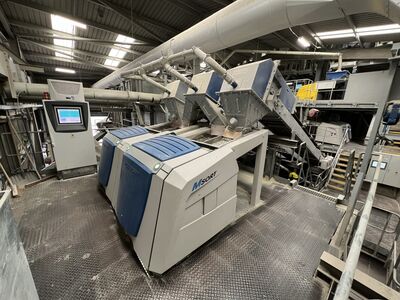
During pre-processing, metal separators remove ferrous and non-ferrous metals, such as caps and lids, as well as other metallic residues. The MSort AX Twin then performs the first sorting stage, separating the flint glass from the green and brown glass. At Dryden Aqua, the MSort AX is used for wet sorting of particles measuring 6 millimetres or more. MSort AF sorting systems are used for the second cleaning stage. These systems sort dry material in the 4–60 mm grain size range and remove contaminants such as ceramics, stones and porcelain. The material is fed evenly and analysed by sensors according to colour and shape before being separated with high precision. The result is a clean, high-quality green and brown glass fraction, referred to internally as 'Gramber'.
This fraction forms the basis for the filter medium. Dryden Aqua offers this in different grain sizes, including particularly fine grades.
Technical precision and decades of partnership
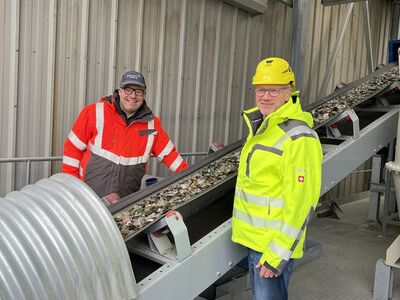
For Dryden Aqua, sorting is a crucial quality control step. McBride therefore compares the sorting plant to a kidney, as it extracts unwanted substances from the material stream in a similar way to the organ in the human body. Dryden Aqua's collaboration with STEINERT MSort dates back many years. Jamie McBride describes a relationship with the MSort and, previously, the Mogensen that has existed for almost 30 years. During this time, the focus has been on developing a production logic tailored to Dryden Aqua’s specific requirements.
“At Dryden, we had to make a million mistakes to find one or two solutions,” says McBride. "That is true pioneering work, true research and development. For that, you need partners who work with you and don't immediately dismiss every idea as crazy."
This attitude defines the partnership between Dryden Aqua and STEINERT. On the one hand, there is technical precision. On the other, there is openness to development work.
“Dryden Aqua does not view sorting as a standard process, but rather as a critical quality step for highly sensitive products. This is what makes the collaboration so special: we can discuss ideas with Jamie McBride, explore technical possibilities, and develop solutions that contribute to the high purity of the recycled glass," says Eddie Lüth, STEINERT MSort's Sales Manager.
"We have taken the best technology from various industries and integrated it into our plants in Scotland and at our headquarters in Switzerland," says McBride. "This enables us to consistently decontaminate the glass and achieve very high colour quality and colour purity. This is precisely the starting point for manufacturing our AFM®.”
From recycled glass to a contribution to clean water
What Dryden Aqua is creating is an example of how recycling, water treatment and industrial precision can work together. Used glass bottles are turned into a high-performance filter medium. A sorting task becomes a central element of product quality. And a long-standing collaboration gives rise to a process that supports Dryden Aqua’s vision: making clean water accessible to as many people as possible.