
Waste Wood : Meinhardt Holzwerk invests in modern recovered-wood processing at Mainz-Wiesenau
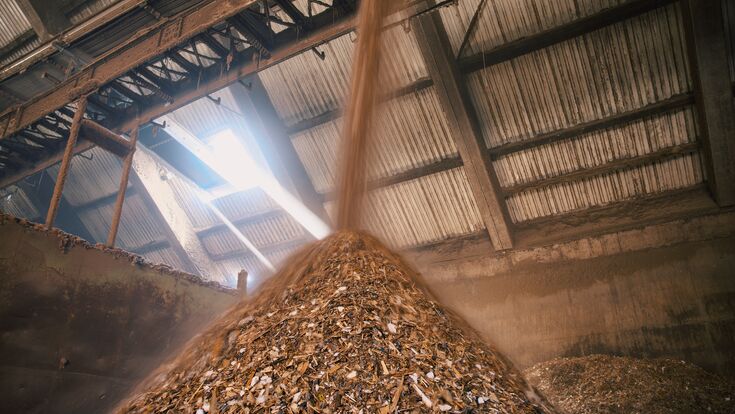
The two sites of Meinhardt Holzwerk GmbH handle around 200,000 tonnes of wood waste per year between them.
- © VecoplanFrom heavy railway sleepers to everyday wood waste – there is probably very little that Meinhardt Holzwerk GmbH has not seen and processed in the field of recovered wood. Every day, lorries carrying the most varied wood fractions arrive at the company's site in Mainz-Wiesenau. Whether relatively clean construction timber or heavily contaminated material laden with paints, coatings, and foreign matter – everything that comes in is sorted, shredded, and, depending on its quality grade, either processed for material recovery in the chipboard industry or supplied as fuel to power plants, for which Meinhardt acts as an exclusive supplier.
Meinhardt Holzwerk GmbH was founded in 2018 as a subsidiary of Meinhardt Städtereinigung GmbH & Co. KG and consolidates the group's wood-related activities across two sites. At Bischofsheim and Mainz-Wiesenau, the company accepts and processes not only wood waste but also refuse-derived fuels and scrap metal. The two sites handle around 200,000 tonnes of wood waste per year between them. The company is part of the Meinhardt Group, a waste management business with approximately 1,000 employees across 17 sites in the Rhine-Main region, founded by Alfred Meinhardt in 1964. This sheer breadth of input materials makes processing a demanding task – and explains why the Mainz-Wiesenau plant was consistently designed around defined output quality and efficient operation during the rebuild.
Investing in quality and process reliability
The decision to modernise the waste wood processing plant in Mainz-Wiesenau had a clear cause. The existing system was around 15 years old and needed to be brought in line with new quality requirements from customers. Since this could no longer be reliably achieved, it was not a case of replacing individual components but rebuilding the entire plant from the ground up. At the same time, this presented an opportunity to fundamentally improve process efficiency. The previous line used a large hammer mill for secondary shredding, which was highly energy intensive. "Energy efficiency wasn't a nice-to-have for us, but a clear objective from the outset," explains Dennis Göttert, Managing Director at Meinhardt. "We wanted to move away from hydraulic-based solutions to minimise conversion losses and meaningfully reduce the overall power consumption of the plant." A further requirement arose from the nature of the material itself. Recovered wood is often dry and therefore prone to generating dust. A high proportion of fines can be problematic further down the process chain, particularly when the material is used as fuel in power plants. The goal was therefore to consistently achieve the desired particle size whilst keeping the fines content to a minimum.
Two-Stage Shredding: VRZ 2500 and VEZ 3200
For the modernised recovered wood processing line, Meinhardt was looking for a shredding system capable of delivering the required quality consistently and reproducibly, while integrating seamlessly into the overall plant concept. The Meinhardt Group has a long-standing working relationship with Vecoplan, the Westerwald-based machinery manufacturer. Vecoplan shredders have been in use across the group for many years, and at the Mainz-Wiesenau site the company had previously delivered a refuse-derived fuel processing plant as a turnkey project. Against this backdrop, it was a natural choice to approach Vecoplan AG once again for the wood line rebuild. "When a customer has been relying on our technology for years, we already know their requirements and their processes," says Florian Greb, Area Sales Manager at Vecoplan. "That's a strong foundation for a project of this scale."
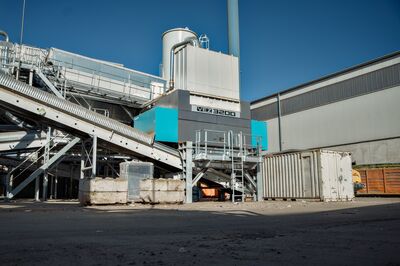
At the heart of the new plant is a two-stage shredding process. The VRZ 2500 handles primary shredding and takes care of a large part of the work at the start of the line, thereby reducing the load on the downstream units and keeping the line running smoothly. A clear performance requirement was also a key factor in the design: the primary shredder needed to achieve a throughput of at least 60 tonnes per hour during the summer months. Secondary shredding is handled by a VEZ 3200, which is fitted with two HiTorc direct drives. Like the VRZ 2500, the VEZ 3200 also uses Vecoplan's HiTorc direct drive concept: virtually maintenance-free and resilient to contaminants, with no hydraulics and no conventional power transmission components such as gearboxes, couplings, or belts. The drive delivers its full torque from the very first rotation and can be brought to a standstill within seconds if required. This makes it not only exceptionally reliable when processing difficult material streams, but also compact and space-efficient in its design.
Functionally, the VEZ 3200 is the key unit in the process: this is where the final particle size is defined. Material that has already reached the correct particle size is separated by upstream screening technology and fed directly into the finished product stream. This takes load off the VEZ 3200 and reduces wear. The specification for the finished product required particle sizes of less than 150 millimetres after secondary shredding. To make the concept work in practice, interfaces across the project had to be clearly defined. Conveying technology and steelwork were also renewed as part of the rebuild, and the project managers from all companies involved coordinated closely on drawings and installation requirements. From the operator's perspective, the Vecoplan equipment integrated smoothly into the existing plant layout.
Lower energy consumption, reduced maintenance, improved quality
The new line at Mainz-Wiesenau has been running since the end of September and has processed around 60,000 tonnes of recovered wood in that time. That is enough for an initial, well-founded assessment, and the verdict is positive: energy consumption is approximately half that of the previous plant, a figure that Meinhardt attributes directly to the new shredding technology.
There is a further benefit that only becomes apparent during ongoing operation. Unlike the former hammer mill, the VEZ 3200 shreds the material gently rather than grinding it down. As a result, the proportion of fines in the finished product is significantly lower, which makes a real difference for the power plants that use the processed wood as fuel. Fine particles tend to stick onto boiler walls and combustion surfaces. "The reduced fines content in the end product has a positive effect on the entire combustion process," reports Dennis Göttert. "It's a quality characteristic that our customers value greatly." Maintenance requirements have also been reduced: with the old hammer mill, the hammers had to be replaced every four to six weeks – since the new plant was commissioned, the knives have only been changed once. What may sound like a minor technical detail has a direct impact on ongoing operating costs.
For Göttert, the collaboration with Vecoplan was another positive aspect of the project. The close coordination between the project managers ensured that the rebuild was carried out in a structured and reliable manner, despite the complexity of the overall undertaking. Change requests that arose during the project were handled without significant friction. "The integration went smoothly and the collaboration was conducted on equal terms. If we faced a similar challenge again, we would take the same approach," Göttert concludes.
A successful partnership set to grow
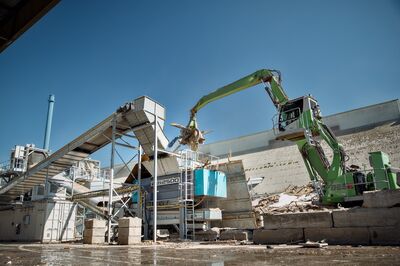
With the modernised recovered wood processing line at Mainz-Wiesenau, Meinhardt has achieved its intended goals. The next step in the partnership has already been defined: the plant is to be connected to the Vecoplan Smart Centre (VSC), through which Vecoplan gives its customers remote access to real-time machine data. This enables operating conditions to be monitored remotely and allows for faster response in the event of a fault. For Vecoplan, the Meinhardt project is an example of how a long-standing customer relationship can translate into tangible results. "When a plant delivers such clear results within just a few months of commissioning, it's a rewarding confirmation for both sides," says Greb. "Meinhardt has been an important partner for us for many years, and we look forward to developing this collaboration further together."