
Climate change : Whey waste turns into a carbon capture material
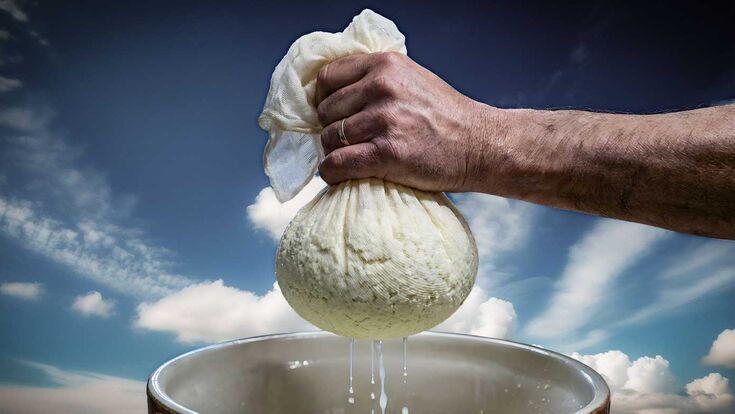
Whey from the food industry serves as a raw material for the new CO₂ capture technology.
- © Image created with AI: Adobe Stock / Montage ETH ZurichDirect air capture (DAC) has a waste problem hiding in plain sight, and it isn't the CO2. It's the sorbent. Most commercial systems rely on synthetic amines or engineered filters that need heat, vacuum, or both to release the carbon they've grabbed, and that energy bill is the main reason DAC still struggles to pencil out economically. A team at ETH Zurich led by materials scientist Raffaele Mezzenga has just published a study in PNAS proposing a fix that will sound familiar to anyone who works in food-industry waste streams: build the sorbent out of whey.
From waste stream to feedstock
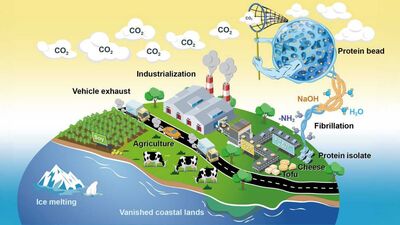
Cheesemaking and tofu production both generate large volumes of protein-rich liquid that's expensive to treat and, in many operations, simply discharged. The ETH group extracts protein from these side streams and converts it into amyloid fibrils, long thread-like protein structures, which are then loaded with potassium hydroxide (KOH) and shaped into porous beads about half a centimetre to a centimetre across. Exposed to ambient air, the KOH inside the beads reacts with CO2 to form a carbonate salt, pulling the gas out of the atmosphere the way a sponge pulls in water. "The resulting material is like a sponge that can absorb large quantities of CO2 via the potassium hydroxide," Mezzenga explains.
The performance numbers are notable for a lab-scale process: postdoc and lead author Zhou Dong reports capturing 97 milligrams of CO2 per gram of material from ordinary ambient air, which the team says is 10 to 50 percent higher than conventional DAC sorbents. Scaled up, a kilogram of beads should theoretically bind around 100 grams of CO2 per cycle.
Carbon capture without heat or vacuum
The bigger claim for the waste and climate sectors is what happens next. Instead of heating the sorbent to release the trapped CO2 — the energy-hungry step that undermines DAC economics — the ETH beads are regenerated by alternately spraying them with a mild acid and base at room temperature for about ten minutes. Both the acid and base can be reused, and in lab testing the beads completed 30 capture-and-release cycles without a significant drop in performance. Dong contrasts this with today's synthetic sorbents, which "decompose quickly," whereas, he says, "our protein beads remain stable for a long time."
Mezzenga is careful to flag that the beads will eventually wear out — after an estimated few thousand cycles — but argues that because the material is entirely organic and food-grade, it doesn't leave behind the disposal headache that synthetic sorbents do. "Our technology is cheaper and more sustainable because it requires little energy and is based on a widely available waste product," he says. "That could be a game changer for the future of removing CO2 from the air."
Feedstock logistics and scale-up
For waste management professionals, the interesting part of this story isn't the chemistry — it's the logistics. The tofu side of the feedstock is soy whey, the liquid protein stream left over from tofu production, not the solid pulp known as okara that's more commonly discussed as a byproduct. "It is analogous to dairy whey as a liquid protein side stream, but its composition and handling are different," says Mezzenga, noting that the soy whey typically holds only 0.5 to 1 per cent protein by weight. That dilution matters: producing a single kilogram of finished beads currently takes somewhere between 100 and 200 litres of it, depending on concentration.
That ratio is worth sitting with. It suggests that, at least for now, this technology is best understood as a use for a dilute, already-existing waste stream rather than a driver that would justify collecting or concentrating whey specifically for carbon capture. Mezzenga sees bead production sitting near a dairy or tofu plant, or at a dedicated side-stream processing facility, but stresses it isn't a drop-in step: protein recovery, fibril formation, potassium hydroxide loading, and bead forming are all additional unit operations that would need to be built out. "The input could be fresh liquid if co-located," he says, "but for transport a concentrated, pre-treated protein stream would be more practical." A first pilot, he adds, would likely take the form of a small modular unit co-located with a tofu or dairy processor or a DAC test site, run jointly with an industrial partner — with a realistic timeline of 12 to 24 months, depending on funding and partners.
Is this really circular?
It's the end-of-life story where the most caution is warranted, and to his credit, Mezzenga doesn't oversell it. Asked whether spent beads could eventually become fertiliser or biofuel feedstock, he's blunt: "The fertiliser/biofuel route is still hypothetical." Getting there would mean testing spent beads after many cycles for composition, residual alkali and salts, biodegradability, toxicity, and how they behave in composting or anaerobic digestion — as well as how they actually perform as a soil input. "The beads would likely need to be collected from the DAC unit, then neutralised or quality-checked before composting, digestion or land application," he says — hardly a material you'd simply leave in a field.
That's a meaningfully different proposition from the reversible-capture chemistry, which has already been demonstrated across 30 cycles in the lab. The waste-to-carbon-capture story is real; the carbon-capture-back-to-waste story is still a research question, and one that will determine whether this technology genuinely closes a loop or simply moves the disposal problem downstream to a different waste stream.

Why It's Worth Watching
A life cycle assessment included in the PNAS paper found the process generates less environmental burden across its full life cycle than comparable DAC methods, and the team hasn't yet put a firm number on cost per tonne of CO2 captured, though Mezzenga expects it to undercut conventional DAC substantially given the low energy input and the low cost of the feedstock. The researchers tested the approach so far only at gram scale in a controlled lab setting, isolating roughly 50 grams of CO2 in total, so scale-up remains the open question — one Dong is now tasked with answering.
For an industry that currently pays to treat or discharge protein-rich process water, this technology offers something concrete: lab-tested evidence that the waste stream can be turned into a working carbon sorbent, not just a promising idea.