
Plastic Waste : AB Plasta and TOMRA are setting new standards in plastic film recycling
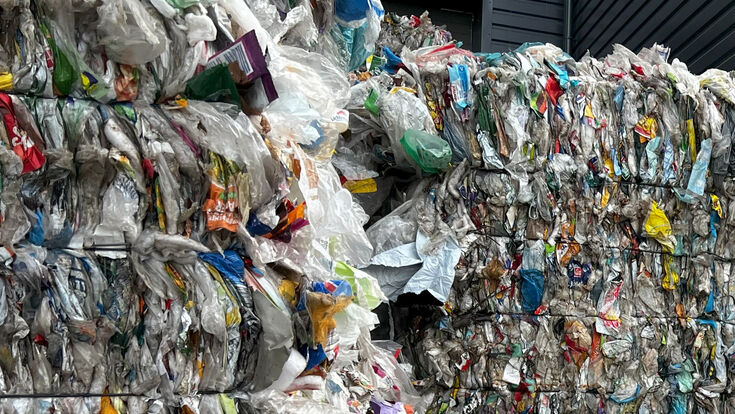
AB Plasta, one of the largest polyethylene recyclers in Central and Eastern Europe, produces 35,000 tonnes of recyclate annually.
- © TOMRAAB Plasta, located in Vilnius, Lithuania and part of the CEDO Group (one of Europe’s leading producers of plastic bags), has achieved an industry milestone by becoming the first company to produce high-quality PCR film recyclate exclusively from post-consumer flexible packaging waste.
This success is the result of a tailored approach combining raw material optimisation with sensor-based sorting — a strategy supporting both operational efficiency and compliance with Europe’s ambitious PPWR.
Danas Poderis, Managing Director of AB Plasta, comments: ‘Sorting flexible packaging waste into high-quality fractions is one of the most complex challenges in plastic recycling, but by adapting the post-consumer input material to our lines and integrating TOMRA’s advanced AUTOSORT™ SPEEDAIR as part of a customised sorting process, we have managed to overcome this challenge. We can now process post-consumer PE film and produce consistent, high-purity recyclates that meet our end customers' exacting standards.”
With over 60 years of experience in plastic processing, AB Plasta is one of the largest polyethylene recyclers in Central and Eastern Europe. The company integrates recycling and manufacturing in a single plant to create a fully circular production model, handling both post-consumer and commercial film streams on the same line. The plant produces approximately 35,000 tonnes of recyclate annually and operates 24/7.
Transforming challenges into circular opportunities
Processing flexible film waste from multiple European sources is considered a complex task. The input streams are highly contaminated and vary in composition, which makes producing recyclates of consistent purity suitable for reuse in new packaging difficult. Furthermore, this material is extremely low in density and is often sticky due to organic residues and moisture. Technologies such as AUTOSORT™ SPEEDAIR are therefore crucial in stabilising the material on the belt, ensuring high throughput and overall economic viability.
“AB Plasta needed a solution that would enable 100% recycled content in its products without compromising on quality. The goal was clear: stable 24/7 operation, high throughput and exceptional purity levels that meet the standards for direct reuse in consumer products,” explains Michał Bula, Sales Manager at TOMRA Recycling.
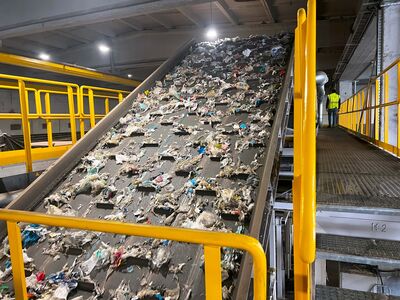
Complete process design
Not only did TOMRA supply the equipment, they also played a key role in designing the entire material flow, ensuring stable and efficient plant operation from the outset.
The solution is centred on a series of four AUTOSORT™ SPEEDAIR units — high-throughput, high-speed optical sorters that have been specifically developed for stabilising lightweight materials, such as post-consumer plastic film. TOMRA’s unique film stabilisation system delivers unmatched sorting performance, even with lightweight, irregular film fractions, providing the throughput and purity required for high-end PCR applications.
Once the baled flexible waste arrives at the facility, it is shredded and pre-screened to prepare the material for optical sorting. TOMRA’s film sorting systems then separate the various plastic fractions with high precision. The input material size ranges from 20 mm to 200 mm, enabling optimal detection and classification of varied film types. A key feature of the process is the use of a fourth AUTOSORT™ SPEEDAIR unit positioned at the end of the main sorting line to recover any remaining polyethylene film, resulting in 90% overall process efficiency.
The cleaned film then undergoes a washing and flotation process to remove any remaining contaminants, after which it is re-granulated into high-quality recyclate.
Optimising performance with TOMRA Insight
The facility is also connected to TOMRA Insight, a cloud-based monitoring platform. This provides AB Plasta with real-time access to machine performance and sorting quality, enabling faster, data-driven decision-making. Automatically generated daily reports help to identify process inefficiencies and ensure consistent, stable production output.
Danas Poderis explains: 'Having machine status, spare part consumption and near real-time sorting data all in one place enables us to closely monitor efficiency. This is especially important as we adapt to increasingly demanding EU regulations such as the PPWR, which require a higher proportion of recycled materials in packaging. Our collaboration with TOMRA has been excellent — professional, technically strong and focused on long-term results.”
Aligned sustainability and compliance
This project enables AB Plasta to meet the growing demand for packaging containing recycled materials, which is driven by EU legislation and broader sustainability goals. By replacing virgin materials with high-quality recycled material, the company is significantly reducing its carbon footprint and supporting a closed-loop production process.
As well as supplying recyclates, AB Plasta manufactures its own end products in-house, using the recovered material to produce bin bags, as well as film for construction and agricultural use. Conducting the entire process internally enables AB Plasta to reintroduce its own recyclates directly into production lines and supply film products with a high recycled content to European retailers, distributors and industrial clients.
This project's success also establishes it as a replicable blueprint for similar initiatives across Europe, particularly in regions seeking to enhance their flexible packaging recycling infrastructure.
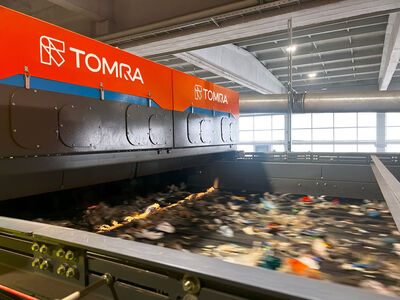
Long-standing collaboration
TOMRA's collaboration with AB Plasta began in 2014 and included joint reference visits and trials, leading to the current full-scale system. The new plant configuration, which was commissioned in November 2023, was built from scratch within an existing facility.
Danas Poderis concludes: 'Implementing TOMRA’s AUTOSORT™ SPEEDAIR and leveraging TOMRA Insight has significantly enhanced our operational efficiency, helping us to strengthen our position as a sustainability leader in the Baltic region and beyond. The advanced sensor technology consistently delivers reliable performance, and TOMRA’s expert support throughout the plant design phase was instrumental in achieving our objectives.'