
Artificial Intelligence : AI waste composition data enters UK compliance reporting
Since October 2024, expanded Material Facilities (MF) regulations have substantially raised the bar for UK materials recovery facilities (MRFs), demanding greater accuracy and consistency in composition reporting across both inbound and outbound material streams. For many operators, meeting those demands has meant more manual sampling, more resource, and more complexity — at precisely the moment when the industry is under pressure to do more with less.
That picture may now be changing. Biffa and FCC Environment have become among the first waste management companies in the UK to submit AI-derived waste composition data on outbound material streams directly to the Environment Agency as part of their existing compliance reporting — a development that could have far-reaching implications for how the sector approaches regulatory obligations.
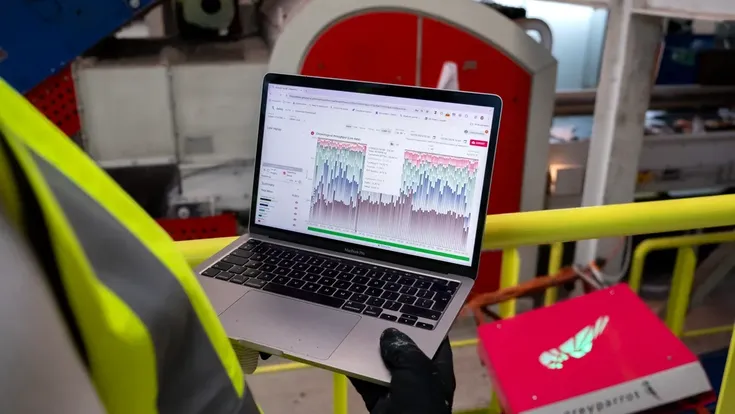
The milestone was made possible through the deployment of Greyparrot Analyzers, AI camera systems that monitor waste streams in real time across conveyor belts. Both Biffa and FCC Environment have had the units running at their facilities for several years, but this marks the first time continuous AI-generated compositional data has been formally incorporated into compliance submissions.
Automating the audit trail
Rather than relying solely on periodic manual samples, Greyparrot's system generates shift-by-shift compositional data across selected outbound material streams. For the Q1 2026 compliance period, Biffa and FCC Environment successfully included this AI-derived data as part of their formal submissions to the Environment Agency — a first for the UK sector.
To support this, Greyparrot developed an AI-supported sampling methodology specifically aligned with the Environment Agency's MF regulations and reporting requirements. The approach is consistent with government guidance, which states that there are no restrictions on the use of visual detection and recognition technology — including artificial intelligence — for materials facility sampling, provided operators can demonstrate how their methodology meets the regulations. Responsibility for sampling accuracy and regulatory compliance remains, as it should, with the facility operator.
Mikela Druckman, CEO of Greyparrot, described the significance of the Environment Agency's position: "The Environment Agency sets the standard for environmental compliance in the UK. Their acceptance of AI-derived data from Greyparrot Analyzer as part of compliance reporting is a significant milestone for the industry. We've been building towards this with our customers since day one. The implications will be felt across regulatory reporting, EPR and the future of resource recovery policy — in the UK and beyond."
From reactive processes to data-driven operations
For the operators involved, the practical value extends well beyond compliance. Continuous access to compositional data is helping teams make faster, better-informed decisions about material quality and sorting performance — work that has historically been constrained by the lag inherent in manual sampling regimes.
Ian McSpirit, Head of PRFs at Biffa, reflected on the operational shift: "By combining AI-driven insights with the expertise of our operations teams and technology partners, we can focus more on improving material quality, increasing recycling performance and staying ahead of evolving regulation. Access to reliable, real-time data is helping move the industry from reactive processes to smarter, data-driven action — an essential shift if we want to accelerate the circular economy at scale."
Pedro Faraldo García, Senior Technical Manager at FCC Environment, echoed that view: "At FCC Environment we're continuously exploring how digital and AI-enabled tools can help us optimise the way our facilities operate and respond to increasing data and reporting demands. The Greyparrot Analyzers have been running on our lines for some time and, combined with a robust methodology, using that data to support our Q1 mixed plastics submission to the Environment Agency was a logical next step. Access to continuous compositional data helps our teams focus on operational performance, with compliance being one of several areas where these tools can add real value."
Anticipating tomorrow's material flows
The timing of this development is significant. The UK waste sector is navigating a period of considerable regulatory change, and facilities that have access to rich, continuous compositional data are better positioned to respond to what is coming.
The rollout of Simpler Recycling is expected to increase volumes of mixed dry recyclates entering MRFs, while the 2027 deposit return scheme (DRS) will reduce high-value materials such as PET bottles and aluminium cans from infeed streams. For operators, understanding how those shifts affect composition in near real time — rather than discovering it weeks later through manual sampling — represents a meaningful competitive and operational advantage.
A landmark that points the way
The use of AI-supported sampling for outbound material streams is not, on its own, a transformation. But its formal acceptance within compliance reporting frameworks — under operator control, applied transparently, and aligned with regulatory expectations — represents something more durable than a pilot project. It demonstrates that AI and regulatory rigour are not in tension, and that the industry has the tools to manage both simultaneously.
As Druckman put it: "This feels like a real turning point in how we understand and run waste infrastructure. The UK is leading the way in what's possible with continuous waste monitoring. This is a landmark first step towards automating compliance reporting, and it adds to the full suite of applications for Greyparrot's waste intelligence. Operators like Biffa and FCC Environment are setting the standard for how technology can transform the way facilities operate — one I believe the rest of the world will look to."
