
Metal recycling : Built to last, designed to grow
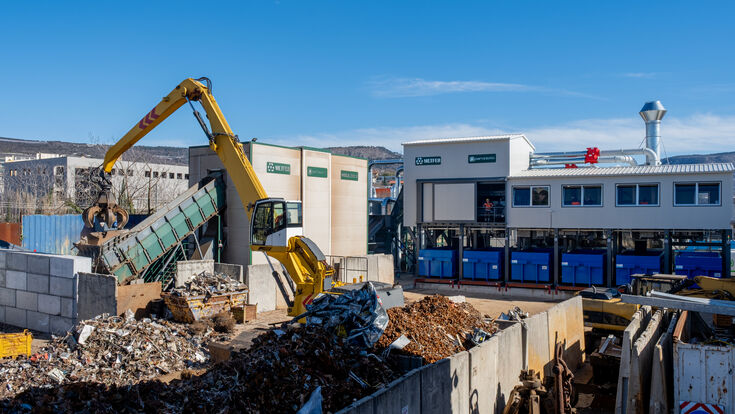
Thirty years in the metal scrap business teaches you one thing above all else: the moment you stop evolving, someone else fills the gap. It's a lesson Italian company Metfer S.r.l. has taken to heart since Michele Montrone reshaped the family firm in 1992, developing it into a specialised business in the management, transport and trading of metal scrap, particularly mixed metals and electric motors.
A company like Metfer is used to choosing its collaborators wisely. So, when the time came to pick a partner for a plant update, it turned to recycling expert Panizzolo. Metfer had already been operating one of Panizzolo’s Flex 1000 Mobile hammer mills with great success, but the new assignment asked for more.
Update and improve
The requirements were twofold: increase productivity and introduce a monitoring system to achieve a more informed and fully controllable view of the entire production cycle.
So, the specialists at Panizzolo got to work. The result: a facility customised for the needs of the client – now and in the future. “Designing a plant means thinking about how it can evolve over time, not just how it needs to operate today,” explains Mauro Panizzolo, owner and Sales Manager. Because the real measure of any industrial solution is its ability to absorb change – shifting production targets, expanding capabilities, rising performance demands. A system designed with this adaptability at its core grows alongside the business, sparing manufacturers the cost of reinventing their infrastructure. The result is something rare in industry: an investment that protects itself over time. “Our goal is to stand alongside our customers along their growth path, helping them build solutions that retain their value in the long term,” says Panizzolo.
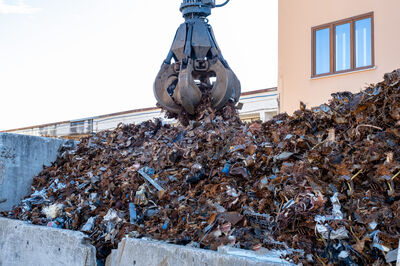
The brawn…
At the heart of the new plant sits the Mega Series hammer mill. Chosen not just for its performance, but for the pivotal role shredding plays in the overall process. It's a stage that's so easy to underestimate but is crucial: what happens here determines the quality of everything that follows. Every separation and concentration step downstream is only as good as the material preparation that precedes it.
Done right, shredding ensures proper material liberation, stabilises the process over time, and increases the quality of the final output. The Mega mill delivers on this with consistency and flexibility, handling different materials and input streams without missing a beat.
Beyond shredding, the plant integrates a selection and separation area engineered to work in close synergy with the mill. Designed from the outset with future upgrades in mind, so that as operational demands grow, efficiency and output quality can keep pace.
…and the brain
Hardware alone only tells half of the story. In mixed metals and electric motor processing, profitability isn't just about volume – it's about what you get out of every batch. Without tight control over yields and process parameters, ROI stays frustratingly abstract. As Metfer owner Diego Montrone puts it: “Today, growth depends on a clear understanding and control of the process, which makes it possible to identify where value is generated and how efficiency can be improved.”
Panizzolo’s Prisma does just that. This proprietary software platform gives operators a unified view of the entire process, cutting through the fragmentation typical of conventional monitoring systems. Its logic stems from Panizzolo's direct experience running its own treatment plants, where continuous process analysis has long been central to performance improvement. Metfer became the project where that know-how took on an industrial form.
Prisma continuously tracks machine status, energy consumption, material flows and anomalies, logging everything automatically, from panel-level electrical absorption to alarm events. At its core is batch management: every processing cycle is traced end-to-end, capturing yields, energy use and key process parameters in a single record. As Francesco Ruggiero, Head of Automation Design at Panizzolo, explains: “Technical data becomes a practical tool for controlling production, quality and profitability, allowing process efficiency and return on investment to be measured with precision.”
The implications go beyond process control. Knowing precisely what each batch costs – in energy, time and yield – allows for a clear economic reading of operations, not just a technical one. It also broadens what the plant can realistically take on: third-party processing, for instance, becomes a structured and measurable activity rather than an operational risk. In this sense, Prisma shifts plant management from experience-based judgement to decision-making grounded in continuously updated data.
It's a project that says something about how Panizzolo thinks: that a plant's value isn't fixed at installation. It develops over time.
Success story in cooperation with Panizzolo.