
Artificial Intelligence : From promising to profitability: How AI has transformed MRF operations in under a decade
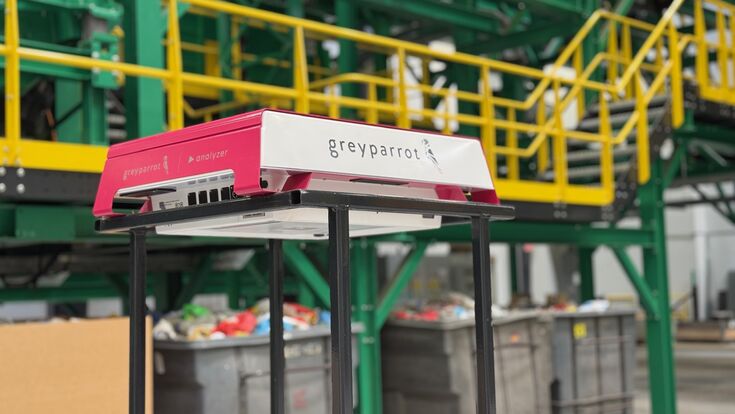
AI waste analytics has moved from experimental technology to operational non-negotiable inside MRFs and PRFs. What began seven years ago as an innovative tool for tracking specific materials is now something far more valuable: a decision-making engine for entire facilities.
Historically, plant technology focused on doing more: faster sorting, higher throughput and better quality.
The data we’ve gathered since 2019 has helped operators get specific about impact. Instead of ‘How do we sort faster?’, they’re asking questions that have actionable answers:
- Where are we losing value?
- Why is purity fluctuating?
- What’s really in our residue?
The impact is tangible. In one UK facility, the Analyzer system revealed that only 7% of residue was truly non-recyclable – the remaining 93% was recoverable, valuable material. In another, contamination on an aluminium line was diagnosed in under 12 minutes instead of 38 hours, saving £47,000 in reprocessing.
In both cases – and countless more at MRFs around the world – AI is providing a diagnosis, and operators are responding. Data alone doesn’t transform a sector, but data-driven action is changing the way that facilities are monitoring and improving their operations.
AI finds its product-market fit
Waste leaders are practical: new technology gets adopted because it contributes to profitability, not because it’s novel.
Over the last seven years, sector debates have moved beyond AI accuracy to focus on applications. Systems like Analyzer have become an operational pillar, and conversations about AI now evolve with broader industry pressures. At a recent Greyparrot webinar, operators from the USA, EU and UK debated how to use AI to protect profits in a volatile and uncertain market.
Live compositional data is now informing operational decisions. This means facilities can adapt instantly to changing infeed material and even to predict optimal sorting recipes. That shift – from reactive to proactive – is what AI’s product-market fit looks like in an increasingly challenging business environment.
USA Waste & Recycling’s Brian Popovich put that transition into words at a recent Greyparrot webinar: “What’s been most valuable is building a culture where data isn’t just reported, it’s acted upon. Conversations shifted from ‘is the data wrong?’ to ‘what’s driving the results we’re seeing?’. That’s when we started seeing and making real improvements.”
AI use evolves with market pressures
The days of AI pilot projects are behind us. Faced with rising costs and fluctuating commodity prices, operators are relying on AI to ensure that core operational decisions are backed by real performance and material data. Many are using systems like Analyzer to inform:
- Infeed blending
- Staffing allocation
- Supplier performance
- Maintenance priorities
- Offtake agreements
The next challenge is already on the horizon. DRS and EPR are set to reshape infeed composition, and profitability will depend on extracting value from what remains.
That requires visibility, and only AI can provide enough detail to support confident action. The question is no longer whether AI belongs in MRFs and PRFs, but how well facilities without AI will be able to weather an evolving market and legislative landscape.
Success Story in cooperation with Greyparrot.
