
Plastic waste : How heat-loving enzymes could transform plastic recycling
Plastic waste has become one of the defining environmental challenges of our time. Among the plastics most in need of better end-of-life solutions is poly(ethylene terephthalate) — better known as PET — a material ubiquitous in bottles and synthetic fibres. Conventional mechanical recycling has its limits, and the industry is increasingly looking to alternative approaches that can recover value from PET at a molecular level.
Against this backdrop, a team of researchers at the Tokyo University of Science (TUS) has published new structural findings that could help accelerate the development of enzyme-based plastic degradation. Their study, published in Crystals in March 2026, focuses on a heat-tolerant cutinase enzyme — CtCut — derived from the fungus Chaetomium thermophilum, and offers fresh insight into how such enzymes maintain their function at the elevated temperatures required for efficient PET processing.
Biological breakdown: understanding the potential of microbial degradation
Among the various plastic recycling methods currently under investigation, biological plastic recycling — or biorecycling — is attracting growing interest. This approach uses enzymes or microorganisms to break down polymer molecules, offering the prospect of cleaner, more selective degradation compared with thermal or chemical alternatives.
A particular class of enzymes drawing attention in this space is microbial cutinases. Naturally produced by bacteria and fungi to degrade the waxy cuticle layer of plants, these enzymes act on chemical bonds similar to those found in PET, making them promising candidates for polymer recycling applications.
“Plastic waste has become a severe problem in recent years, necessitating environmentally friendly recycling technologies. Thus, our aim was to contribute to the development of practical recycling technologies by clarifying the molecular basis of enzymes that function even under high-temperature conditions,” says Professor Tatsuya Nishino, who led the research.
>>> Are superworms the solution for our plastic waste problem?
Protein-based catalysis: the science of enzymatic polymer breakdown
A central challenge for enzymatic recycling of PET lies in temperature. The plastic is most efficiently broken down at around 70°C, the point at which it becomes sufficiently flexible for enzymatic attack. At such temperatures, however, proteins must strike a delicate balance: maintaining a stable overall structure to avoid denaturing, whilst retaining enough flexibility at their active site to bind and process substrate molecules. These are, in many respects, competing demands.
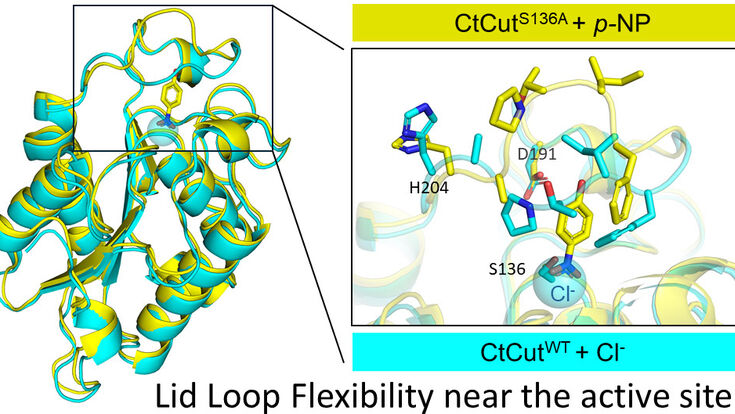
To investigate how CtCut manages this balance, Prof. Nishino’s team — including Assistant Professor Sho Ito and graduate researchers Ryohei Nojima and Lirong Chen — studied both the wild-type enzyme (CtCutWT) and a mutant version (CtCutS136A), in which the amino acid serine at position 136 is substituted with alanine. Using X-ray crystallography alongside differential scanning calorimetry, they probed the enzyme’s structure and thermal behaviour across a heating range of 30°C to 100°C.
Engineering for resilience: rigidity, flexibility, and functional design
The structural analysis revealed that CtCut adopts a highly stable α/β-hydrolase fold — a common architectural feature among cutinases. Covering the enzyme’s active site is a flexible lid loop that can open and close. In its closed state, the active site is relatively inaccessible; upon binding a molecule, however, the lid reshapes to permit catalysis.
The team also identified a chloride ion near the active site, even in the absence of a substrate. This suggests that the active site maintains a positively charged electrostatic microenvironment that may support ligand binding — a finding that could have implications for efforts to engineer more active variants.
Thermal unfolding experiments revealed a two-step denaturation process, with an initial gradual transition beginning around 60°C followed by a second transition at 65–70°C. This staged behaviour indicates that distinct structural regions within the protein lose stability at different temperatures, consistent with the idea of a rigid core alongside a more mobile region near the active site.
“Our findings suggest the possibility of functional division within the enzyme. We observed that the mobile region near the active site undergoes structural changes in response to ligand binding, and that thermal denaturation proceeds in multiple stages,” Prof. Nishino notes.
Implications for the circular economy
These findings carry practical significance for the development of industrial biorecycling processes. By mapping the structural basis of heat tolerance in CtCut, the TUS team has laid the groundwork for rational enzyme engineering — the targeted modification of protein sequences to improve performance under process conditions.
The research suggests that effective enzymes for plastic degradation will likely need to combine a thermostable scaffold with a catalytically active, flexible pocket — a combination that the structural data from CtCut helps to clarify.
“Our study may lead to the development of technologies for efficiently decomposing and recycling PET in the future by providing design guidelines for enzymes that possess both heat resistance and potential catalytic capabilities for polymer degradation. This may address the growing challenge of plastic waste and help realise a sustainable resource-recycling society,” concludes Prof. Nishino.
For an industry grappling with the limits of conventional plastic recycling, the promise of enzyme-driven polymer recovery represents a compelling frontier. Research such as this — revealing the molecular rules that govern enzymatic stability and selectivity — brings that frontier a step closer.