Artificial Intelligence : When waste plant design catches up with reality
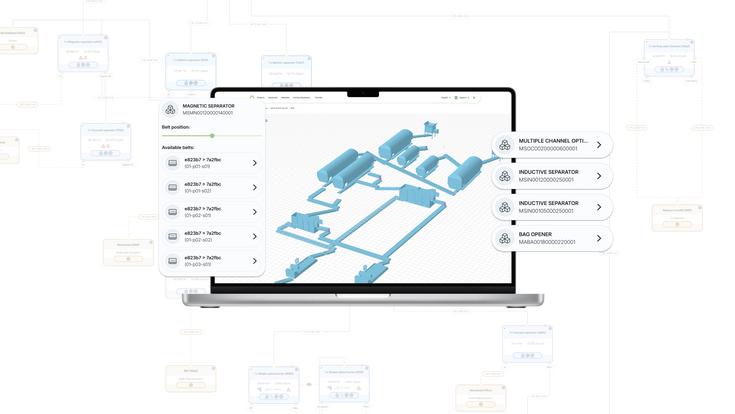
Picture this: Two EUR 76 million waste treatment plants, one in Sweden and one in Poland, fully designed and simulated in under two hours. Not weeks. Not days. Hours.
If that sounds impossible, you haven't met Laura Rodriguez and her team at Humara Design. After 30 years of designing and building waste facilities across Europe, Rodriguez had seen enough. "CAD and Excel forced sequential, manual iterations," she explains. "A single layout change meant recalculating mass balances, resizing equipment, updating BOMs – weeks of work." The industry's engineering tools simply hadn't evolved to match the complexity of modern waste treatment challenges. So, she and co-founder Martín Nogueira decided to build the solution themselves.
From frustration to innovation
What emerged is Humara Design, billed as the first SaaS platform purpose-built for waste plant engineering. The platform tackles a problem that has plagued the industry for decades: the disconnect between design tools that can't keep pace with the real-world complexity of waste streams, equipment performance and regulatory requirements.
"Waste streams are variable, equipment performance is nonlinear, regulatory requirements shift," Rodriguez notes. "Static tools couldn't handle that complexity. We needed software that could model reality as it actually behaves, not simplified assumptions."
Before Humara, engineers juggled disconnected tools: AutoCAD for layouts, Excel for mass balances, vendor datasheets for equipment specs and separate programs for economic modelling. Every iteration meant manual recalculation across all systems. A design cycle of more than six weeks was normal.
Carolina Viana, Innovation Manager at Ecoembes, puts it plainly: "Humara Design has greatly facilitated our process of studying facilities, optimising design times and helping our team make better data-driven decisions."
The impact extends beyond engineering efficiency. José María Navarro, Commercial Director at Leblan, reports tangible business results: "We've been using Humara Design for three years, and it's transformed our bid process. We respond to RFPs faster, our technical team can handle more opportunities simultaneously, and we present clients with validated scenarios they trust. It's shortened our sales cycle and increased our win rate on technical proposals."

Precision that pays
At the heart of Humara's approach is granularity. The platform simulates 82 different waste materials, each with distinct behaviour, through separation equipment. This level of detail might seem excessive, but Rodriguez argues it's essential.
"Precision at the material level determines whether your facility hits performance targets or misses by millions," she explains. "PET bottles separate cleanly with NIR, but black PET doesn't. Film contaminates paper lines. Ferrous metals need magnetic separation, non-ferrous metals need eddy current."
When your model treats "mixed recyclables" as a single category, you're designing blind. You oversize some equipment, undersize others, and discover the problems during commissioning. When changes are expensive.
A recent Materials Recovery Facility (MRF) design illustrates this perfectly. Initial calculations suggested a specific optical sorter configuration would meet purity targets. When the client ran the full simulation in Humara with actual feedstock composition data, the platform flagged contamination pass-through rates exceeding end-market thresholds by more than 6%. The issue? Peak contamination loads during certain collection periods overwhelmed the sorter's capacity.
"Traditional tools wouldn't have caught this until commissioning or worse, during operations," Rodriguez says. The team tested alternative configurations in minutes, finding a solution that maintained purity under variable conditions for just 8% additional capital expenditure. Far less than the revenue loss from rejected bales or a post-construction retrofit.
AI as engineering assistant
Humara's AI autolayout feature evaluates over 22,500 configurations in minutes, but Rodriguez is quick to emphasise that engineers remain in control. "The AI generates options, engineers decide. It's a design assistant, not a black box."
Engineers set the constraints: site boundaries, throughput targets, equipment preferences, budget limits, regulatory requirements. The AI explores thousands of layout permutations within those constraints, evaluating each against performance metrics like material flow efficiency, equipment accessibility, expansion potential and construction costs. Engineers then review, compare, select and refine.
"We've compressed exploration time, not removed engineering judgment," Rodriguez clarifies.
The platform is also tech-agnostic, integrating with clients' existing equipment databases from manufacturers like Stadler, Tomra, Pellenc and Bollegraaf. When an engineer changes an optical sorter model in the design, Humara pulls real throughput, purity and energy data for that specific machine. No generic assumptions.
Changing how teams work
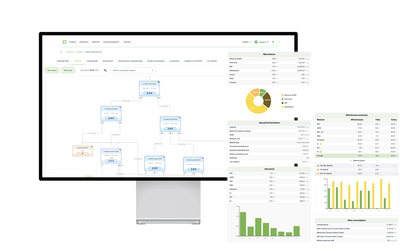
The numbers are impressive: more than 231 plants designed, over 162,000 engineering hours reallocated and cost reductions exceeding 70%. But Rodriguez says the qualitative changes matter just as much.
"Engineers tell us they're doing engineering again, not spreadsheet management," she reports. Senior engineers who once spent weeks on manual calculations now focus on optimisation, innovation and client consultation. Teams explore design alternatives they wouldn't have considered before because iteration was too expensive.
As one client from A Coruña Council's Solid Waste division notes: "Thanks to Humara Design, our team can design more efficiently, eliminating unnecessary paperwork and speeding up decision-making from weeks to just days."
The next frontier: Closing the loop
Humara's ambitions extend beyond design. By year's end, the company is launching three major betas, with Humara Operate poised to transform the industry fundamentally.
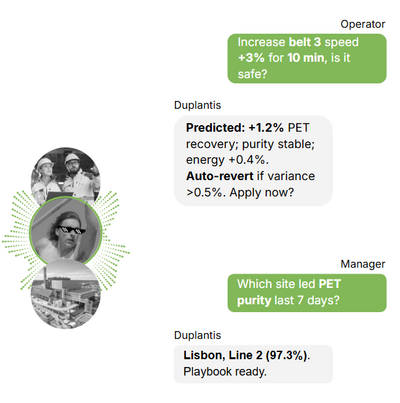
"For the first time, facilities will operate with a live Digital Twin connected to real-time SCADA data," Rodriguez explains. The AI copilot, Duplantis, will learn from every shift, suggesting parameter adjustments, predicting equipment drift and simulating operational changes before implementation.
Four operational pilots launching in 2026 project 4% recovery improvements and 7% energy reductions. The breakthrough? Every operational insight becomes validated design knowledge, feeding back into future projects.
"The platform will learn from every facility it operates, building a knowledge base of validated performance patterns," Rodriguez says. "Over time, designs become more accurate because they're based on actual operational data, not vendor specs or conservative assumptions."
Rodriguez sees the transformation as inevitable: "In five years, manual operations and static designs will be obsolete. The industry will operate on integrated platforms connecting design, operations, compliance and carbon accounting in real time. Those running manual operations won't survive."
It's a bold vision, but for a company that can simulate a multi million-euro plant in under two hours, perhaps bold is exactly what the industry needs. As Rodriguez puts it: "No time to waste."
In cooperation with Humara.