
Advanced waste sorting : Three challenges. One recycling innovator
There are challenges galore in the waste management industry. And most companies pick their battles carefully. Picvisa picked three.
The first: black plastics. Packaging trays, electronics housings, car parts — all coated in carbon black pigment that swallows the infrared light conventional NIR sorters depend on. Most recycling facilities simply route these materials to residual waste or incineration.
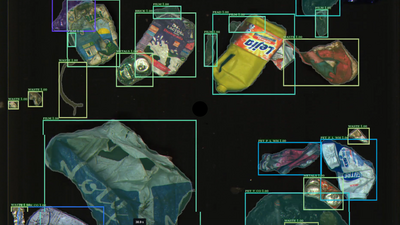
Picvisa has been building a different path, using hyperspectral imaging in the mid-wave infrared (MWIR) range, typically 3 to 5 micrometres. At those wavelengths, the molecular structure of polymers generates distinct absorption patterns that carbon black cannot suppress. Combined with AI, the system makes real-time sorting decisions on industrial conveyor lines.
In testing, it has successfully classified PE, PP, PS, PC and a range of engineering plastics including ABS/PC copolymers and thermoplastic elastomers, complex materials common in WEEE and automotive streams. Picvisa’s Technical Director Dani Carrero is measured about what the AI layer actually adds: “With just visible-light imaging and an algorithm trained on a robust dataset, we can now solve problems that previously required hyperspectral imaging. AI also allows us to incorporate shape information into applications where we were previously relying solely on spectral response.”
The system can go further still. Combine MWIR with X-ray fluorescence (XRF) and you can detect brominated flame retardants — substances restricted under EU environmental regulation — separating non-compliant material from clean streams and turning a regulatory headache into a solved problem. It makes Picvisa’s black plastics capability not just a sorting upgrade but a compliance tool, and one arriving at exactly the right moment. “Based on past experience,” says Carrero, “regulations always precede these technologically complex demands.” As EU legislation around recycled plastics tightens, having the detection capability moving toward industrial integration puts Picvisa squarely ahead of the curve.
Glass: Solving for light
The second challenge sits in glass recycling, a sector that looks solved on paper but remains stubbornly problematic in practice. Glass is 100% recyclable, indefinitely. Yet contamination with CSP — ceramics, stones and porcelain — consistently downgrades cullet quality and limits its use in high-value applications. Add dark and labelled glass into the mix, and the economics of glass recovery start to look shaky.
Picvisa’s response is a significant upgrade to its ECOGLASS optical sorting system, built around a new pulsed lighting technology that replaces conventional continuous illumination. The results are striking: up to 40% reduction in energy consumption from the lighting system alone, lower operating temperatures, and higher light intensity that improves detection accuracy for dark and complex glass fractions.
Was energy efficiency the original goal? “In any development project, we evaluate the pros and cons,” says Carrero. “In this case, there were only benefits in terms of functionality and energy efficiency. The downside is that this system is more expensive to purchase, but in the long run, the cost is offset by reduced energy consumption.” A pay-now-save-later calculation. Increasingly compelling as energy costs bite.
Alongside the lighting upgrade, ECOGLASS is integrating AI algorithms trained specifically on CSP contamination and labelled glass containers. Colour and NIR systems handled some of this before; AI extends the reach. “What has allowed AI to complement these applications,” Carrero explains, “is its ability to detect contaminants other than CSP that the market also does not want in the final recoverable material.”

Textiles: Automating the unsortable
If black plastics and glass feel like engineering problems with clear engineering solutions, post-consumer textile recycling feels like something else entirely. It’s not a single material stream. It’s a chaotic mix of garment types, fibre blends, contaminants and conditions, arriving in volumes no manual workforce can sustainably handle. Fast fashion has made it worse. EU legislation is making ignoring it impossible.
Picvisa’s answer is a strategic alliance with Girbau, the global industrial laundry and automation specialist, combining Girbau’s Sortech automated garment feeding system with Picvisa’s ECOSORT optical sorting technology into a single continuous line. The first plant built on this model has launched in Northern Europe. One of the first on the continent to fully combine automated feeding with advanced optical sorting for post-consumer textile treatment.
“Every company has its own expertise,” says Carrero. “What we sought to leverage through this collaboration is the best of both companies toward a shared goal: we provide machine vision and artificial intelligence for sorting, while Girbau contributes robotics and textile handling.” In practice, Sortech handles the upstream chaos — feeding garments in a controlled, steady flow — while ECOSORT classifies by composition, colour and type, generating cleaner fractions for second-hand markets or fibre-to-fibre recycling.
But “fully automated” is relative. “Post-consumer textile recycling is a very young industry,” Carrero notes. “We have achieved a significant level of automation, but it is not yet complete — clothing still needs to be sorted manually for reuse, and some post-sorting processes may also require manual handling.” Picvisa now has eight ECOSORT installations across Europe, and is developing AI-based brand detection to identify labels and logos, helping route garments to the second-hand market by value — adding intelligence and commercial logic, to a pile of discarded clothes.
The long view
Picvisa didn’t set out to tackle all three challenges simultaneously. As Carrero tells it, the company started with glass because it was the most technically feasible and because a client was ready to back the proposal. The rest followed the market. “The other two solutions emerged in response to the market’s own needs, where we saw gaps that weren’t being filled and where we could provide solutions based on our experience in machine vision technologies.”
Which of the three is closest to being solved? Which keeps him up at night? “None of them keeps me up at night,” Carrero says, with what sounds like genuine equanimity. “I’m always optimistic about technological advances. But if I had to pick one as the most complex, the textile challenge would surely be the hardest to achieve in terms of human effectiveness.”
Success story in cooperation with Picvisa.