
Intelligent waste sorting : Sorting for the future: How flexibility and efficiency are redefining waste sorting in Brazil
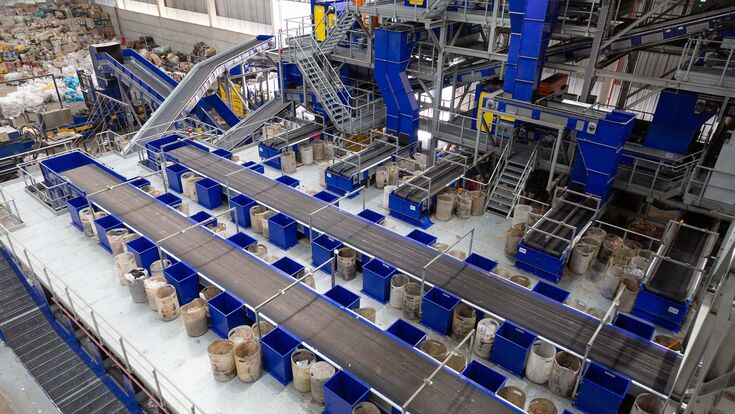
Commissioned in December 2019 and officially inaugurated in February 2020, the Guarulhos sorting plant was conceived from the outset as something more than an upgrade. Flacipel Comércio de Aparas e Sucatas Ltda, part of the Multilixo Group, partnered with STADLER Anlagenbau GmbH — a globally active specialist in the planning and delivery of turnkey sorting plants — to create what Rubens Prinet, Operations Manager at Flacipel, describes as "a value hub with multiple layers."
The scope of the project was ambitious. Flacipel required a facility capable of sorting material into 21 fractions whilst retaining the versatility to handle a diverse range of input streams — from selective collection to office and commercial waste. Achieving that breadth of capability without compromising throughput demanded a design that was both technically sophisticated and inherently adaptable.
"The possibility to change the type of the material infeed requires a very clever design," said Henrique Filgueiras, Sales Director at STADLER do Brasil. "Our task was to create a plant that performs consistently at a high level in every operating scenario, without compromising flexibility. This is where STADLER's modular approach and experience with complex material streams really make a difference."
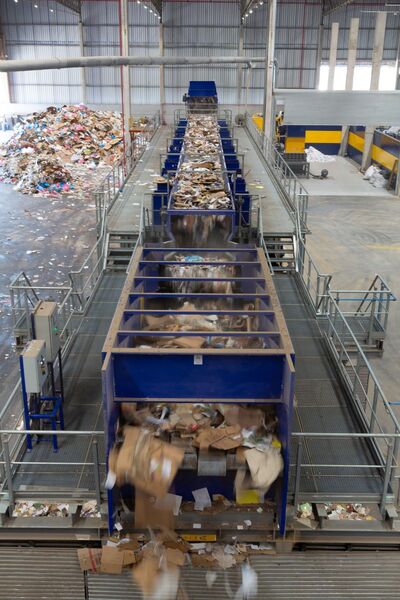
The technical solution centres on a pre-sorting station that separates material by bag colour, followed by a STADLER ballistic separator to isolate cardboard. Pre-classified streams are then stored and fed separately into the main sorting line, which incorporates dosing units, bag openers, two further STADLER ballistic separators, advanced optical sorting, windshifters, and magnetic and eddy-current separation. This configuration allows the recovery of an extensive range of fractions — including various plastic types, films, paper grades, cartons, metals, and RDF — whilst enabling process settings to be adjusted for each input stream.
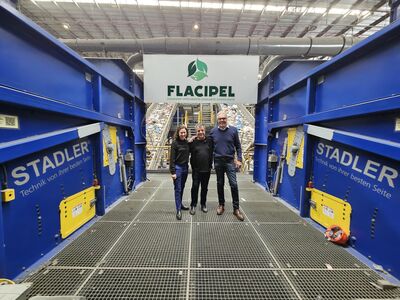
Performance rooted in partnership
Flacipel's decision to work with STADLER was not taken lightly. The Multilixo Group had already operated a STADLER sorting line for seven years prior to the Guarulhos project, gaining direct experience of the technology's performance under Brazilian conditions. That accumulated knowledge proved invaluable in shaping the new facility.
According to Silvio Urias, Managing Director and Owner of the Multilixo Group, "the choice of STADLER was not merely a technical one. It was a strategic positioning decision for the Multilixo Group and Flacipel. It is like playing in the first division."
The plant was developed collaboratively, drawing on real operational data, continuous testing, and joint process and layout design. Installation was completed in just four months, with commissioning carried out by STADLER's Brazilian team — enabling rapid knowledge transfer and a smooth ramp-up to full production.
"This hands-on experience was fundamental in validating the technology under Brazilian conditions and in guiding the design of the facility inaugurated in 2020, reducing risks and ensuring high performance from the outset," said Urias.
Measurable gains in throughput and productivity
The operational impact of the Guarulhos plant has been significant. Monthly throughput has risen from 4,800 tonnes to 8,000 tonnes, delivering economies of scale, stronger margins, and greater commercial leverage across the Multilixo Group's operations.
"We are now a benchmark in both volume and quality," said Urias. "The operation has become more resilient. For our clients, this means a stable partner, lower environmental risk, reliable data, and continuity."
The ability to guarantee high recovery rates and material traceability has also opened new commercial avenues. Flacipel has secured additional contracts, particularly with customers pursuing zero-landfill targets for their waste streams. "Flacipel has become a trusted partner where clients can transfer their environmental challenge and receive predictability, security and documented proof in return," Urias noted.
STADLER's commitment extends beyond project delivery. An ongoing inspection and preventive maintenance contract brings STADLER technicians to the site on a monthly basis, minimising downtime and supporting long-term service planning. Regular commercial visits further reinforce the partnership and cement the facility's status as a benchmark for advanced sorting solutions across the country.
Advancing Environmental Stewardship at Scale
Beyond its commercial achievements, the Guarulhos plant is playing a meaningful role in advancing regional circular economy goals. With comprehensive material recovery across all output streams, no material is directed to landfill — every fraction is channelled towards a defined, sustainable application.
"Flacipel's sorting facility is the key instrument for enabling the circular economy, reducing the amount of waste sent to landfill and ensuring environmental traceability," said Prinet. "At the same time, the project has evolved through the integration of new equipment and capacity expansions, moving beyond the original design to become a dynamic industrial platform."
Further upgrades are already in development, including an expansion of the 3D line to automatically sort additional fractions, underscoring the facility's capacity to evolve alongside both regulatory demands and market conditions.
For STADLER, the project serves as a demonstration of what is achievable when technical excellence meets long-term commitment. "This plant shows how a well-conceived sorting facility can become a growth engine," concluded Filgueiras. "By combining performance, adaptability, and close partnership, we have helped Flacipel build an operation that is not only efficient today, but ready for future challenges."
