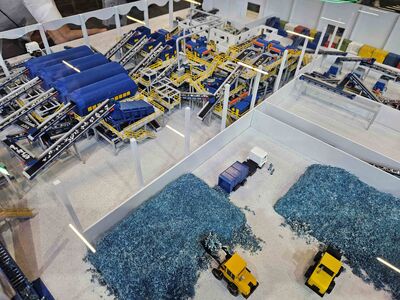
Waste Sorting : STADLER and Ecourbis Ambiental will build the most advanced waste treatment plant in Latin America
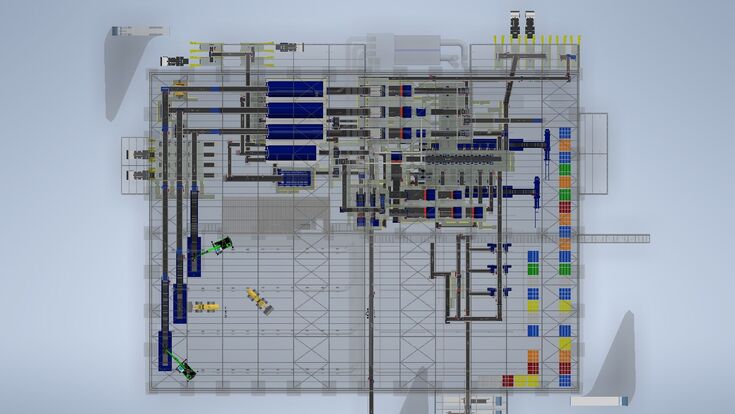
3D drawing Ecourbis sorting plant.
- © STADLERA major contract has been awarded to STADLER Anlagenbau GmbH, the globally active German company specialising in the planning, production and assembly of turnkey sorting plants, by Ecourbis Ambiental S.A. for the design and construction of the UTM Leste sorting plant, a state-of-the-art municipal solid waste (MSW) facility in São Paulo, Brazil. Scheduled for commissioning in August 2027, the plant will be the most advanced MSW treatment facility in Latin America, setting a new standard for technological excellence and circular resource recovery.
UTM Leste will have a processing capacity of 135 tonnes per hour (550,000 tonnes per year) and will recover 48,000 tonnes of recyclables, produce 260,000 tonnes of Refuse-Derived Fuel (RDF) and generate 170,000 tonnes of organics for biogas. This will divert over 308,000 tonnes from landfill disposal annually.
A partnership for São Paulo's circular economy
STADLER and Ecourbis Ambiental are working together to improve waste management in São Paulo. By combining STADLER’s global engineering expertise and local operational insight with a shared commitment to innovation and sustainability, the project will improve resource recovery, boost process efficiency and lessen reliance on landfills.
“The choice of STADLER reflects not only its international leadership in providing mechanized sorting solutions with highly robust, reliable, and efficient equipment, but also its alignment with Ecourbis Ambiental’s innovation strategy,” said Ednei Rodrigues, Superintendent of Engineering, Innovation and Projects at Ecourbis Ambiental. “This combination ensures technology transfer, digitalization, and process replicability, reducing risks and strengthening São Paulo’s position as a reference in urban solid waste management.”

Tailoring European technology to Brazilian conditions
At the heart of the project lies STADLER’s ability to adapt its tried-and-tested European waste treatment model to local circumstances, including the composition of Brazilian waste, the climate, and the regulatory environment. With extensive experience across Latin America and technical expertise from its German headquarters, STADLER ensures each system delivers optimal performance under local conditions.
The advanced UTM Leste plant is unique in its application of artificial intelligence through STADLERconnect, which supports predictive maintenance, blockage detection and real-time process optimisation. This marks the platform’s first deployment in Latin America.
“Years of continuous learning, combining in-depth technical studies and hands-on experience, have enabled us to design the most efficient process flow and mass balance for Brazilian conditions,” explained Henrique Filgueiras, Commercial Director of STADLER do Brasil. “Brazilian waste streams present specific challenges compared to Europe: higher organic content, greater moisture levels, a larger share of bulky and non-recyclable materials, and a generally poorer gravimetric composition. Achieving the right balance between capital and operational expenditures is crucial, as is adapting plant design to address the high costs of civil works in Brazil. By adapting layouts and reinforcing equipment robustness, STADLER ensures stable and reliable plant performance even under the challenging waste composition typical of Brazil.”
Turning waste into energy and opportunity
A key innovation at UTM Leste is the integration of a drying line for organic fractions, transforming traditionally considered residual materials into high-calorific green RDF and contributing directly to São Paulo’s clean energy transition.
“The drying of organic fractions plays a crucial role in enabling the large-scale production of green RDF, a sustainable alternative to fossil fuels. At UTM Leste, approximately 132,000 tons of waste per year are directed to alternative energy generation through green RDF, reducing landfill dependency and contributing to greenhouse gas mitigation”.
For Ecourbis Ambiental, UTM Leste is also a strategic contribution to Brazil’s National Solid Waste Plan. “The facility will operate as part of an eco-park integrating several technologies, ensuring the reuse and energy recovery of various materials, enhancing circularity, and reducing Greenhouse Gas emissions,” Rodrigues added.
Driving innovation in the circular economy
In São Paulo, the benefits of UTM Leste will also have a significant social impact. The plant's automation and modernisation will generate hundreds of direct and indirect job opportunities, enhance working conditions for operators and foster the growth of a local circular economy market centred on secondary raw materials and renewable fuels.
At the heart of the process lies a focus on circularity: “The plant transforms residual waste into inputs for new production chains, such as plastics, metals, and paper, as well as into renewable energy through RDF. This closes material loops and reduces the need for natural resource extraction,” explained Rodrigues. 'In addition, it is directly aligned with the guidelines of the latest update to Brazil’s National Solid Waste Plan, establishing São Paulo as a living laboratory of the circular economy in Latin America, as well as a platform for replicating technology in other Brazilian cities.'
Not only is UTM Leste the largest and most advanced waste treatment plant in Latin America, it also provides a tangible demonstration of STADLER’s long-term vision for the circular economy, in which waste becomes a valuable resource for multiple industries and the loop is closed for a sustainable future.