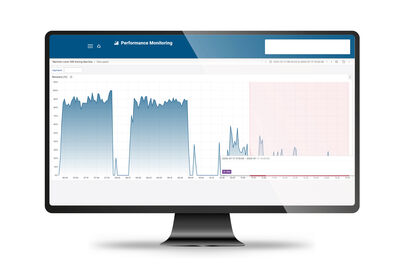
Waste sorting : STEINERT and Eggersmann join forces to unlock NIR sorting data
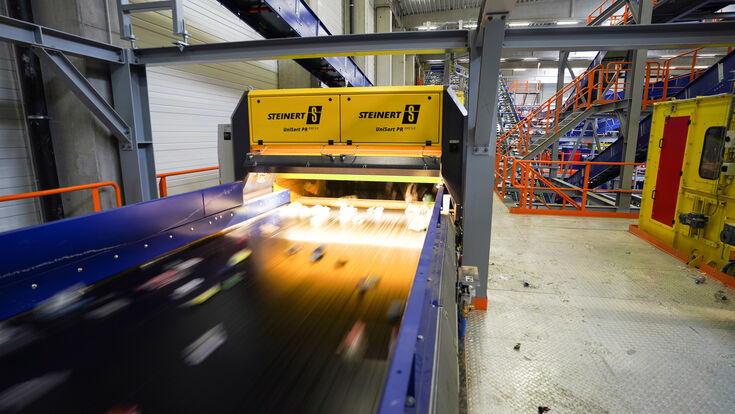
A STEINERT UniSort PR sorting system during the warm commissioning of SITEL's LVP sorting plant in Liège (Belgium) in 2023 – one of the pilot plants of the ESA app, for which Eggersmann was the general contractor.
- © Eggersmann"The principle of near-infrared sorting enables extremely precise separation, especially when it comes to the difficult differentiation of plastic types at high throughput rates," explains Andreas Jäger, Managing Director at STEINERT UniSort. "But only as long as the sensors can work properly."
In recycling plants, however, contamination is a constant threat. A 70% drop in performance caused by build-up on sensors, nozzle strips, or light sources is a familiar scenario for NIR sorting systems across all manufacturers. Such contamination can occur rapidly yet go undetected for hours if monitoring is carried out manually — often only coming to light at the next shift change. In the interim, the system continues to run, producing lower yields or batches of inferior purity.
The performance monitoring and integrated anomaly detection in Eggersmann's ESA app directly address these hidden losses. "Our performance monitoring analyses all data transmitted by the machine's sensors in real time and presents it visually. Material flows are recalculated from multiple NIR data sources and conveyor belt speeds to continuously determine KPIs such as the sorting performance of individual units," explains Dr Sebastian Felder, Head of Digital Solutions at Eggersmann. "Thanks to the AI-based anomaly detection, performance deviations are recognised abnnd flagged automatically at an early stage. The ESA app can demonstrably reduce incorrect output from NIR sorters by up to eight hours per machine per month." Higher fraction output translates directly into greater value.
The anomaly detection also identifies both full and partial material blockages at an early stage. Particle distribution on conveyor belts is continuously monitored, and throughput data from different NIR sensors is synchronised — making line under-utilisation visible as well.
Technical cooperation for more efficient recycling
Performance monitoring and anomaly detection are just two of several modules in the ESA app, which also includes maintenance management, a logbook, and document storage. "Our ESA app is designed as a comprehensive all-in-one solution for digital plant management and process optimisation. Plant operators can assemble the modules individually according to their specific needs," explains Dr Felder. "For live data transmission and real-time evaluation, we depend on capable sensors and reliable interfaces. STEINERT UniSort's stable, open interfaces already provided an excellent foundation — but what was truly remarkable was the quality of the collaboration itself. The commitment shown by STEINERT UniSort made a significant contribution to optimising how the sensor data is used. What began as a routine coordination process developed into a genuine technical partnership."
Jäger echoes this assessment: "We want plant operators to achieve operational excellence with our sorting systems. Eggersmann shares that goal, which made the cooperation constructive from the outset. By connecting our sensors directly to the ESA app, our customers can respond to deviations faster and safeguard their system performance." Both companies plan to continue the partnership going forward.