
Recycling : Try before you buy: UNTHA's trial tour puts shredding to the test
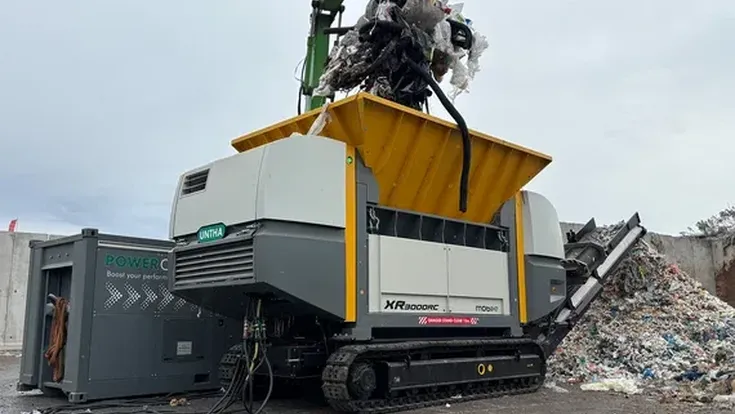
The logic is straightforward. No two waste streams are alike, and no specification sheet can fully replicate the conditions of a working facility. UNTHA's response has been to put its machines on the road — travelling to prospective customers rather than waiting for them to come to a showroom. The semi-mobile XR shredder arrives on site, is configured to the customer's material and throughput requirements, and is handed over to their team to operate for several days as if it were already theirs. Clemens Jäger, Sales Manager at UNTHA Deutschland GmbH, is clear about what sets the programme apart: "We bring a suitable shredder to interested parties and they can then test the machine for several days as if it already belonged to them: with their material, their staff, and exactly as it fits into their everyday work. We are there to provide support."
Testing IRL
The range of materials covered is broad — from waste wood, metal and tyres to pulper ropes, mattresses and mixed construction waste. The XR class processes inputs to a defined particle size of between 25 mm and 300 mm, while the two-shaft ZR class handles coarse pre-shredding of the most difficult recyclables. Both run on UNTHA's water-cooled synchronous motor, consuming up to 75% less energy than a diesel-hydraulic equivalent.
The proof, as ever, is in the doing. Clemens Karletshofer, Managing Director of Karl Karletshofer GmbH, found that a week-long in-situ trial made the purchase decision straightforward: "During a one-week test run at our company, we were able to get a comprehensive picture of the performance of the UNTHA XR3000C. We were able to test the shredder ourselves and received intensive support from UNTHA. After that, the decision was very easy for us."
In a sector where capital investment decisions carry real weight, the ability to put a machine through its paces on your own site — before signing anything — is no small offer. UNTHA's trial tour makes it the default starting point.
