
Waste sorting : UV tags take recycling from bulk sort to barcode precision
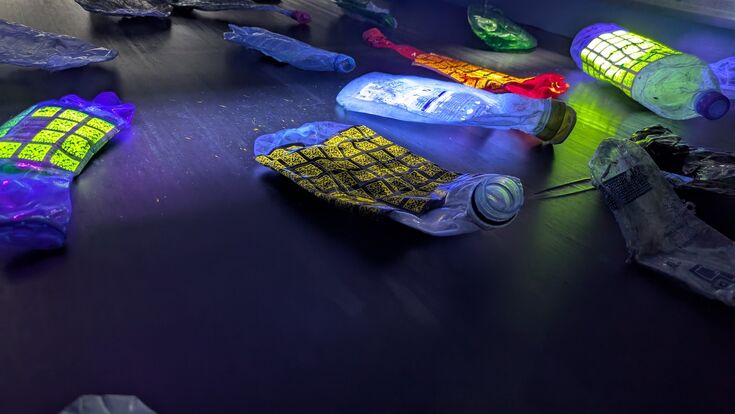
The partnership between Pellenc ST and Polytag has reached a pivotal milestone: the integration of a UV detection module into a commercial sorting line at SUEZ's Avonmouth recycling centre, planned for Q2 2026. Building on a prototype validated at Pellenc ST's Innovation Centre, the deployment represents the first time this joint solution has moved from controlled testing into a fully operational environment.
The system reads GS1 open standard data matrices — invisible to the naked eye but detectable under UV light — printed onto individual packaging items. These markers uniquely identify each item and, when combined with Pellenc ST's high-performance near-infrared (NIR) sorting systems, enable packaging to be recognised and directed in real time.
Precision separation at barcode level
Unlike conventional bulk sorting, the joint solution enables recyclers to identify and separate packaging at the level of individual items, recovering granular sorting and processing specifications in the process. Rather than categorising material by broad type, facilities can now process packaging with a specificity that was previously unachievable at industrial scale. The Polytag data platform manages the UV tag information, whilst Pellenc ST's optical sorting equipment handles the physical separation — giving recyclers and brand owners unprecedented visibility into what is moving through their facilities. "This is a major step from concept to reality. By moving our joint UV tag solution from lab validation to an operational recycling line, we're proving that smart sorting technology works in the real world — not just the lab. For the first time, recyclers will be able to see exactly what packaging is moving through their facility, where it came from, and where it's going. That's the kind of visibility that turns recycling from a volume game into a precision one," says Polytag CEO Alice Rackley.
Streamlined operations and quality recyclates
For SUEZ Avonmouth — the first recycling centre to host this module — the expected benefits extend beyond improved sorting accuracy. Richer data on the composition of incoming packaging streams is anticipated to support longer-term operational improvements and enable the facility to deliver higher quality recyclates to its customers.
"We are proud to be the first recycling centre to host this innovative module on our sorting line. The technology will give us richer insight into the composition of the packaging we process, helping us in the long term to optimise operations and deliver higher quality recyclates to our customers," says Stuart Hayward-Higham, Chief Technical Development and Innovation Officer of SUEZ UK.
Pioneering technology and open standards
The solution has been designed in alignment with two significant pieces of EU legislation: the EU Packaging and Packaging Waste Regulation, which sets binding targets for recyclability and recycled content across the bloc, and the incoming Digital Product Passport requirement, under which products must carry a verifiable digital identity throughout their lifecycle. "Having our module running in a live recycling environment confirms its readiness for scale. This collaboration shows how open standards and innovation can transform the economics and sustainability of material recovery," says Pellenc ST CEO Jean Henin.
Polytag, which established its Ecotrace Programme in 2024 to track and increase recycling rates of single-use plastic packaging in the UK, brings data platform expertise to what is now the first live implementation of its kind. Pellenc ST — with over 20 years of experience in the recycling industry and more than 3,500 machines installed worldwide — provides the optical sorting hardware. With SUEZ Avonmouth serving as the demonstration site, the collaboration lays the groundwork for replication across multiple recycling facilities in Europe, marking a meaningful step in the industry's shift from volume-based processing to a genuinely data-driven circular economy.