
Informal Waste Sector : Why action for women in the informal recycling sector can’t wait
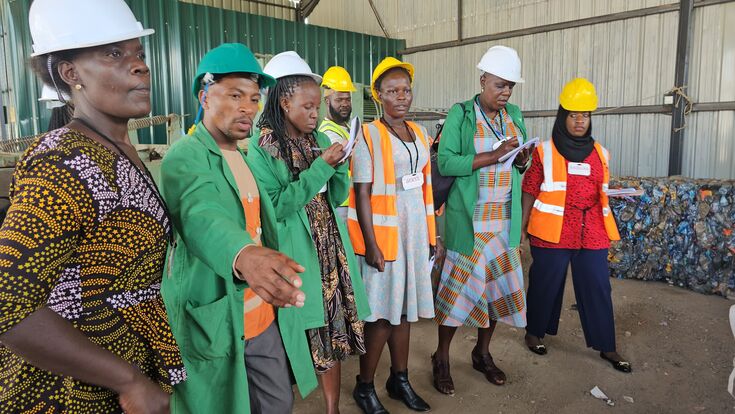
For years, conversations about inclusion in the waste sector have been gaining traction. Reports have been written, commitments announced and the role of women, particularly in the informal recycling sector, has gained increasing visibility. Yet despite this progress, significant policy gaps remain. In many countries, legal, regulatory, and social protection frameworks that fully recognise and support informal waste workers, especially women, are still underdeveloped or entirely absent.
But waiting for perfect policy conditions is no longer an option.
This is the space where I have been directing my efforts. Through my work with the International Solid Waste Association (ISWA) Women of Waste Task Force and GRID-Arendal, the focus has been on taking practical steps that can improve conditions now, while policy continues to evolve.
The invisible backbone of the circular economy
Across the Global South, women are central to informal recycling systems. In many cities across Africa, Latin America and Asia, women account for a significant share, and frequently the majority, of the informal recycling workforce. Research involving 1,025 informal recyclers working at major landfill sites across Latin America reported that women represented approximately 67% of workers in the sector (Cruvinel et al., 2019; GRID-Arendal, 2022). Similarly, in India, women are disproportionately engaged in street sweeping and waste picking at landfill sites, occupations that tend to be highly informal and require continuous sorting and material identification (UNDP, 2021; GRID-Arendal, 2022). Evidence from Viet Nam also highlights the prominent role of women in waste management, where they constitute around 65% of waste collectors and more than 70% of junk shop owners in some urban areas (USAID CCBO, 2021; GRID-Arendal, 2022).
Beyond their numerical representation, women of the informal recycling sector make essential contributions to resource recovery by collecting, sorting and trading materials that would otherwise be lost to dumpsites or leak into the environment. Their work supports local economies, reduces waste volumes and contributes directly to circular economy practices. In many cases, they are the system.
And yet, their contribution remains insufficiently recognised. Many women work in hazardous conditions, without protective equipment or a stable income. Access to finance and formal markets is limited, and social stigma continues to shape perceptions of their work. At the same time, they are rarely included in the policy discussions that influence the future of the sector. On top of this, they often face harassment and gender-based violence at work and at home.
Addressing these realities requires action that does not depend solely on policy reform.
From frameworks to fieldwork: The toolkit approach
A key example is the “Awareness and Capacity-building for Women of the Informal Recycling Sector” Toolkit for facilitators, developed by GRID-Arendal, ISWA Women of Waste and Kagad Kach Patra Kashtakari Panchayat (KKPKP). Designed for training organizers and facilitators specifically to engage and support women working in the informal recycling sector, the toolkit provides a structured yet flexible capacity-building framework that can be adapted to different local contexts and learning needs.
The Toolkit comprises seven key training modules organised around four key thematic areas. The first focuses on skills development and awareness raising, equipping women with knowledge and practical competencies related to business and financial management, recycling value chains, global market trends for recyclable materials, quality collection and sorting practices, pre-processing techniques, and extended producer responsibility (EPR) systems. The second area addresses work conduct, covering topics such as occupational health and safety, mental and physical wellbeing, access to personal protective equipment (PPE), and the promotion of equality within the workforce.
The third thematic area examines internal interactions and organisational structures, highlighting the benefits of collective organisation, cooperation and participation in cooperatives and other forms of worker associations. The fourth focuses on external interactions and governance structures, strengthening women’s understanding of regulatory frameworks, governance mechanisms and the rights and protections available to informal recycling workers.
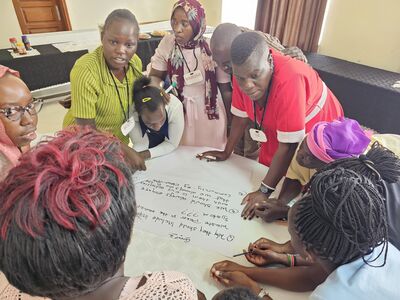
The proposed training approach is deliberately participatory. Through peer exchange, storytelling and group-based learning, it creates space for women to reflect on their work, share experiences and build knowledge and skills that is immediately applicable. It also encourages the formation of local groups that can continue beyond the training itself, strengthening collaboration and collective voice.
The emphasis is not only on skills, but on positioning women within a broader transition. As waste systems evolve towards more formal and circular models, there is a growing need to ensure that informal workers are not excluded but actively included in these changes.
Practice in Action: Kisumu, Kenya
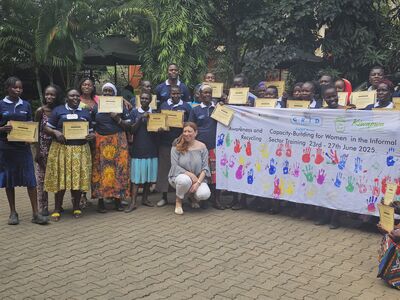
This approach has already been tested by GRID-Arendal in Kisumu, Kenya, in partnership with the Kisumu Waste Pickers Welfare Association (KIWAPWA) and with financial support from the Deutsche Gesellschaft für Internationale Zusammenarbeit (GIZ) GmbH. The pilot brought together 26 women working across different parts of the informal recycling sector, including waste collection, sorting, aggregation and recycling activities. The training was delivered over five days in June 2025 and was followed by an assessment six months later to understand how participants had applied the knowledge and skills gained through the programme. The capacity building training was built on a cascading approach starting with a train-the trainers and facilitators phase which followed up by the final training of women.
The roll-out began with understanding local realities by listening to women waste pickers. This helped shape discussions around occupational health and safety, financial management, leadership, workers' rights, waste handling practices and collective organisation. Rather than focusing solely on technical skills, the training created space for women to reflect on their experiences, exchange knowledge and explore opportunities for strengthening their livelihoods.
The feedback from participants reflects the value of this approach. Participants described improvements in material sorting and handling practices, stronger engagement with buyers, and a more structured approach to managing income and savings. While these changes did not fundamentally alter the structural constraints faced by workers in the informal recycling sector, they appeared to support more stable market participation and strengthen women’s ability to navigate existing value chains.
A further outcome was the strengthening of collective organisation among participants. Women reported continued collaboration beyond the training itself through peer learning, collective sales arrangements and group-based initiatives. In addition, emerging engagement with local authorities and environmental institutions pointed to opportunities for strengthening the visibility and recognition of waste pickers within local waste management systems.
Challenges, but also opportunity
While the Kisumu pilot demonstrates the value of locally adapted and participatory approaches in strengthening the knowledge, skills, and collective voice of women working in the informal recycling sector, it also underscores the scale of the challenge ahead. Structural barriers such as the lack of formal recognition, limited institutional support and fluctuating recycling markets continue to constrain the potential of informal waste workers, particularly women.
At the same time, there is a growing convergence of factors that create new opportunities. The global shift towards circular economy models and increasing pollution challenges s bringing increased attention to resource recovery and recycling systems. There is also growing recognition of the critical role of the informal sector, supported by international networks and alliances that advocate for their inclusion and rights. Organisations such as the Women in Informal Employment: Globalizing and Organizing (WIEGO), the International Alliance of Waste Pickers (IAWP) and regional waste picker movements have helped elevate the voices of informal recyclers in international policy discussions, while initiatives such as the ISWA Women of Waste Task Force provide additional platforms for for knowledge exchange, networking, and sharing experiences among women working across the waste and recycling sector. Additionally, new funding streams linked to climate action and sustainable development are beginning to open pathways for scaling such initiatives.
A turning point for the sector
The work my collaborators and I have led highlights a broader reality within the waste management sector: While policy remains critical, and important gaps still exist, particularly in the recognition and inclusion of informal waste workers, there is also an urgent need to place greater emphasis on action and to focus efforts on initiatives that can deliver tangible benefits while policy and regulatory frameworks continue to develop.
The transition now underway, exemplified by the development and deployment of the Toolkit in Kisumu, signals a move towards practical, scalable solutions. It demonstrates that when women in the informal recycling sector are equipped with the right tools, knowledge and support systems, they are not only able to improve their own livelihoods but also to drive the development of more inclusive and resilient circular economies.
Policy remains critical. But action cannot wait for it to be complete. Stakeholders can act now by adopting and supporting the implementation of the Awareness and Capacity-building for Women of the Informal Recycling Sector toolkit, engaging with initiatives such as the ISWA Women of Waste Task Force, investing in women waste picker organisations and ensuring that workers in the informal recycling sector are actively represented in policy development, extended producer responsibility schemes and broader circular economy discussions.
Relevant work
Cruvinel, V.R.N., Marques, C.P., Cardoso, V. et al. (2019). Health Conditions and Occupational Risks in a Novel Group: Waste Pickers in the Largest Open Garbage Dump in Latin America. BMC Public Health 19, 581. Available at https://link.springer.com/article/10.1186/s12889-019-6879-x
GRID-Arendal (2022). A Seat at the Table: The Role of the Informal Recycling Sector in Plastic Pollution Reduction, and Recommended Policy Changes. GRID-Arendal.
Godfrey, L., Tsakona, M., Nitzsche, G., Khaled, D. and Garcés Sánchez, G. (2023). Findings of the WOW! Global Survey II. Mapping the status of women in the global waste management sector. ISWA Women of Waste Task Force: Rotterdam
Tsakona, M., Nitzsche, G., Rucevska, I., Chauhan, D. M., Sultania, S., & Romola, A. (2023). Just Transition of Women in the Waste Management Sector. GRID-Arendal: GRID-Arendal.
GRID-Arendal (2024). Awareness and Capacity-building for Women of the Informal Recycling Sector: Toolkit for Facilitators – First Edition.
GRID-Arendal (2026). Awareness and Capacity-building for Women of the Informal Recycling Sector: Toolkit for Facilitators – Second Edition. https://www.grida.no/publications/3245
USAID CCBO (2021). Gender Equality and Women’s Economic Empowerment. Available at: https://decfinder.devme.ai/urban-links/usaid-clean-cities-blue-ocean-womens-role-in-waste-management-and-recycling-2021/
United Nations Development Program (UNDP) India, Urban Social Protection Programme (2021). Baseline Analysis of the Socioeconomic Situation of Safai Sathis. Available at: www.in.undp.org/content/india/en/home/library/poverty/Baseline_analysis_ of_the_socio-economic_situation_of_Safai_Sathis.html