
Pollution : Global Waste Index 2025 exposes the world’s biggest waste polluters
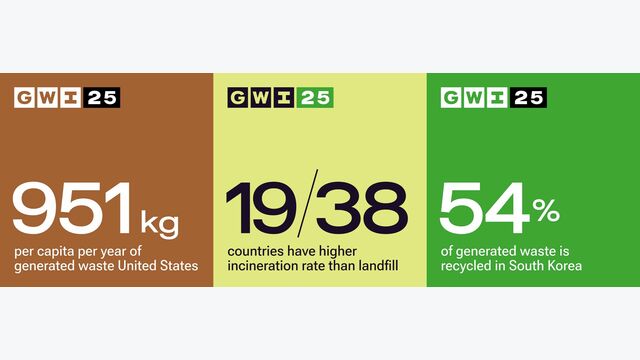
The Global Waste Index 2025, developed by waste management technology firm Sensoneo, offers a sobering look at municipal solid waste generation across 38 OECD nations. Israel tops the list of worst performers, followed closely by Chile and the United States — the latter generating a staggering 951 kilograms of waste per capita annually.
Notably, the U.S. has increased its per capita waste output since the last edition of the report, reinforcing its status as the country that generates the most municipal solid waste. “The United States has even increased its output from 811 kilograms to 951 kilograms per capita,” the report notes, underscoring the persistent upward trend in waste generation.
High waste production with low recovery
The disparity between generation and treatment is a key metric of inefficiency. In Israel, 524 kg out of 650 kg of municipal waste per person ends up in landfills — the highest figure among all countries analysed. Meanwhile, Chile recycles virtually none of its waste (0%), and the U.S. only recycles 30%, while nearly half is landfilled.
Other countries with troubling waste generation and landfill rates include Canada (684 kg per capita, 67% landfilled), Greece (519 kg per capita, 81% landfilled), and Australia (543 kg per capita, 53% landfilled).
“In Israel, 524 kg out of 650 kg of generated waste is sent to landfills and disposed of in a particularly environmentally harmful way — the highest amount among all countries analysed,” the report states.
Pollution from landfills still rampant
Despite advances in recycling and energy recovery, landfilling remains the default waste management strategy for many. Twelve of the 38 countries studied still send more than 50% of their waste to landfill. Among them are developed nations such as New Zealand and Australia, revealing systemic inefficiencies even in affluent economies. “Along with its neighbour Canada, both North American nations rank at the bottom in terms of waste management, with alarming rates of landfill disposal,” it's reported.
Conversely, Switzerland stands out as the only country in the ranking that sends none of its waste to landfill, with Belgium, Finland, Estonia, and Japan following closely behind.
Key findings
- Israel and Chile emerged as the two largest waste producers in the world.
- The United States increased its output from 811 to 951 kilograms per capita per year, remaining the country that generates the most municipal solid waste.
- The UK managed to decrease its incineration rate by approximately 74% — from 190 kg to 50 kg per year.
- Estonia joined the top three countries with the best waste management practices, alongside two Asian countries, Japan and South Korea.
Efficient waste management and reduction
On the other end of the spectrum, countries like Japan, South Korea, and Estonia have emerged as global leaders in waste management. Japan ranks first with a perfect score of 100, despite a high incineration rate, thanks to minimal landfilling and robust overall treatment efficiency. Estonia’s rapid improvement is particularly striking, climbing from 32nd to 3rd place in just one ranking cycle.
Additionally, 16 of 26 European countries managed to reduce their overall waste generation — including notable declines in New Zealand, Finland, and Iceland — signaling progress toward more sustainable waste practices.
The divide widens between leaders and laggards
The 2025 Global Waste Index underscores the urgent need for harmonised, effective waste management practices globally. While some nations demonstrate promising advancements in waste reduction and treatment, others continue to rely heavily on landfill disposal with little to no recycling infrastructure.
As municipal solid waste generation continues to rise, particularly in high-consumption countries, the report is a wake-up call for governments and industry leaders to take responsibility for pollution and shift toward circular waste strategies.
Other findings of the Global Waste Index 2025
- Austria recycles the highest amount of municipal waste, at 334 kilograms per capita, which represents 42%, even before the introduction of a national deposit return scheme.
- In Israel, 524 kg out of 650 kg of generated waste is sent to landfills and disposed of in a particularly environmentally harmful way — the highest amount among all countries analyzed.
- Three countries with the largest decreases in the amount of waste generated compared to the previous edition of the ranking were New Zealand (173 kg), Finland (128 kg) and Iceland (107 kg).
- From an environmental perspective, waste incineration is preferable to landfilling. However, in 12 out of 38 countries, more than 50% of generated waste still ends up in landfills — including in countries like Canada, New Zealand, and Australia.
- Switzerland is the only country that does not send any waste to landfill. Other countries with minimal amounts sent to landfill are Belgium (1 kg), Finland and Estonia (2 kg) and Japan (3 kg).