
Circular Economy : Austrian research initiative RecAL receives top honor for advancing aluminium recycling
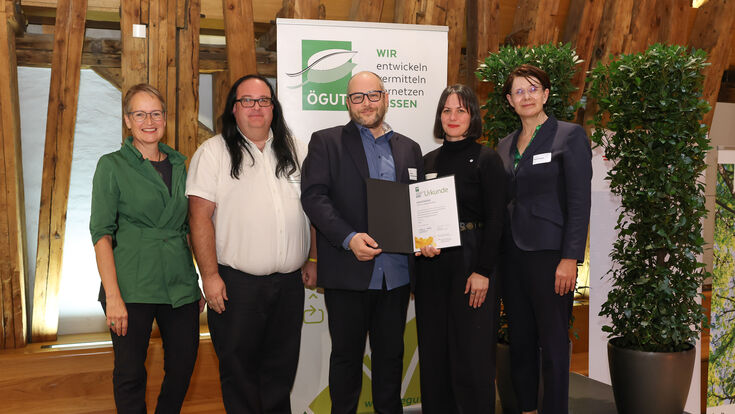
ÖGUT Award for the RecAL project: (from left) Monika Auer (ÖGUT Secretary General), Hubert Grün-Lutterotti (AIT Austrian Institute of Technology), Gerald Prantl (LKR Light Metal Competence Center Ranshofen), Kathrin Renz (BMIMI), Andrea Reithmayer (ÖGUT President).
- © Katharina schifflThe Austrian Institute of Technology's RecAL project has been recognized with the ÖGUT Environmental Award 2025 in the "Research & Innovation for the Circular Economy" category, marking a significant milestone for sustainable metal recovery in Europe. The award, presented on November 18, 2025, acknowledges the project's groundbreaking approach to transforming aluminium waste streams into valuable secondary resources through technological innovation and digital integration.
Readers of Waste Management World may recall our earlier interview about the RecAL initiative, which explored the project's ambitious goals. Now, with this prestigious recognition from the Austrian Society for Environment and Technology (Österreichische Gesellschaft für Umwelt und Technik, ÖGUT), the project's significance for the waste and resource management sector has been formally acknowledged at the highest level.
Transforming metal recovery through innovation
RecAL (Recycling technologies for circular Aluminium) represents a fundamental shift in how the industry approaches aluminium production. Rather than depending on virgin materials, the project develops advanced methods to efficiently recycle aluminium and connect recovery operations across Europe through a digital platform.
Led by the LKR Leichtmetallkompetenzzentrum Ranshofen of the AIT Austrian Institute of Technology, RecAL brings together 19 partner organisations from nine European countries under the HORIZON EUROPE funding program. The consortium includes research institutions, technology providers, and industrial users, all working to increase the proportion of secondary aluminium in production, conserve resources, and reduce the industry's carbon footprint.
"With RecAL, we want to show that high-tech and the circular economy are not a contradiction," emphasises Gerald Prantl, project manager at the LKR Leichtmetallkompetenzzentrum Ranshofen. "Through new recycling-tolerant alloys, digitally controlled sorting processes, and a Europe-wide aluminium recycling system, we are creating the basis for an industrial future that combines ecology and competitiveness and also contributes to Europe's resilience with regard to this valuable raw material. The award from ÖGUT is a great recognition of the commitment of our entire team and our partners throughout Europe."
Closing the loop: Advanced solutions for material streams
One of the aluminium industry's most pressing challenges lies in separating and recycling complex alloys. RecAL addresses this by developing solutions that enable higher tolerance for recycled content in alloy design while maintaining essential material properties. This technical advancement is paired with the creation of the "RecAL Hub," a digital platform that intelligently connects recycled material streams, innovative recovery technologies, and both producers and consumers—a critical step in transforming linear material flows into closed loops.
The project is developing and testing 14 technological solutions up to technology readiness level 6 (TRL6). Beyond materials science, the initiative focuses on robotics, sensor technology, and digital twins to manage aluminium flows transparently and efficiently throughout their entire life cycle.
Close collaboration among partners—including Cancom Austria, Gebauer & Griller, the German Aerospace Center (DLR), Fraunhofer Gesellschaft, ALUMIL, SWERIM, Benteler Automobiltechnik, Stena Aluminium, and KU Leuven—is establishing a Europe-wide innovation ecosystem that integrates energy, resource, and data cycles.
Strategic importance for resource management
"RecAL impressively demonstrates how research, digitalization, and industrial practice intertwine to strengthen Europe's competitiveness while reducing the burden on the environment," explains Alexander Svejkovsky, Managing Director of the AIT Austrian Institute of Technology. "This award is not only a success for the LKR team, but also a strong signal for Austria as a location for innovation and for Europe's path to a sustainable circular economy."
The recognition comes at a crucial time for the waste management and resource recovery sector. As Europe pursues the European Green Deal and the transition to climate-neutral industry, projects like RecAL demonstrate the practical pathways for achieving these goals through technological innovation combined with cross-border cooperation.
Double recognition for urban and industrial solutions
At the same ÖGUT awards ceremony, AIT received a second accolade in the "Sustainable Municipality" category for its collaboration with the city of Lienz. This project focuses on integrated urban development, energy and greenhouse gas balancing, and comprehensive climate neutrality planning, with Lienz targeting climate neutrality by 2040.
The dual recognition—spanning both industrial recycling and municipal transformation—illustrates the breadth of expertise required to address sustainability challenges across different sectors, all united by the common thread of advancing resource efficiency and environmental responsibility.
About the recognition
The ÖGUT Environmental Award has been presented annually since 1988 and ranks among Austria's most prestigious sustainability honors. It recognizes outstanding projects, organizations, and individuals who contribute to a climate-neutral, fair, and sustainable society through innovation and commitment.
In 2025, 27 projects were nominated from 252 submissions across six main categories. The €40,000 prize fund is supported by the Federal Ministry for Innovation, Mobility and Infrastructure (BMIMI), the Federal Ministry of Agriculture, Forestry, Regions and Water Management (BMLUK), the FFG, the Austrian Association of Cities and Towns, and partner companies and foundations.