
Sustainable construction : BamRe Roof: Bamboo and recycled plastic roofing for a global circular economy
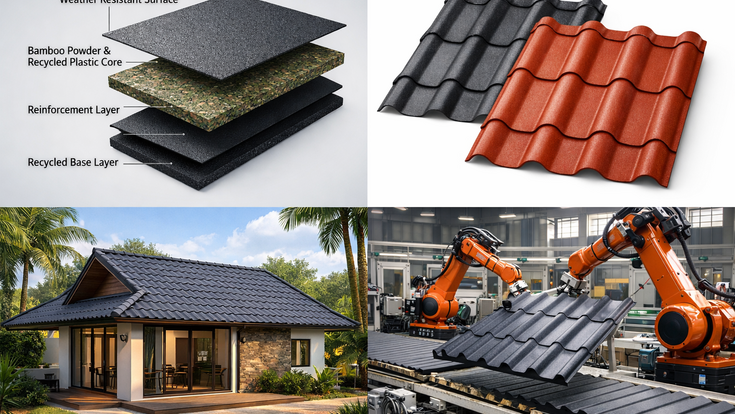
Bamboo powder – A renewable, underutilized resource
Vietnam is home to abundant bamboo forests spanning millions of hectares. Traditionally, bamboo has been used for furniture, scaffolding, and handicrafts, leaving a large portion of bamboo biomass underutilized or discarded during harvesting and processing.
Ms. Do Thi Hoang Anh explains, “Bamboo is a fast-growing, renewable resource with high structural strength. By combining bamboo powder with recycled plastics, we can produce roofing panels that are both environmentally responsible and high-performing.”
The challenge of underutilized bamboo is not unique to Vietnam. Similar opportunities exist in Asia, Africa, and Latin America, where agricultural and forestry by-products remain largely excluded from industrial value chains.
Turning bamboo and recycled plastics into roofing panels
BamRe Roof transforms bamboo powder and post-consumer recycled plastics into composite roofing panels suitable for residential, commercial, and industrial construction. The panels provide several key benefits:
- Durability and Weather Resistance: Panels withstand heavy rain, UV exposure, and temperature fluctuations, with lifespans comparable to traditional roofing materials.
- Sustainability: Utilizing recycled plastics and renewable bamboo reduces dependence on virgin raw materials and diverts waste from landfills.
- Lightweight and Easy Installation: Up to 40% lighter than clay tiles, simplifying transport and installation.
- Design Flexibility: Panels are available in a variety of textures and colors, able to mimic conventional roofs or provide contemporary aesthetics.
These features make BamRe Roof panels functional, sustainable, and aligned with circular economy principles, enabling material recovery at the end of life.
Embedding circular economy in construction
A core principle of BamRe Roof is designing for circularity from the outset. Unlike many conventional roofing materials that become mixed, non-recyclable waste, BamRe Roof panels are disassemblable, recyclable, and reusable in subsequent cycles.
The project applies Life Cycle Assessment (LCA) across the entire value chain—from bamboo harvesting and recycled plastic sourcing to panel production, use, and end-of-life scenarios. This allows precise monitoring of carbon emissions and resource efficiency, making BamRe Roof suitable for ESG-driven markets in Europe, the U.S., and Australia.
Global market applications
- United States: Growing demand for sustainable building materials and LEED-certified construction makes BamRe Roof highly attractive for residential and commercial projects.
- Europe: Stringent environmental regulations and incentives for low-carbon, recyclable construction materials align with the use of bamboo-recycled plastic roofing panels.
- Emerging Markets: In Asia, Africa, and Latin America, lightweight, durable, and affordable roofing panels support social housing, post-disaster shelters, and vulnerable communities.
Ms. Do Thi Hoang Anh emphasizes, “Our approach can be adapted to local bamboo resources or other agricultural by-products, making BamRe Roof flexible for diverse regions and climates.”
Automation and industrial scalability
BamRe Roof production integrates robotic automation, ensuring consistent quality, minimizing material waste, and enhancing precision. Experts note that combining recycled and renewable materials with automated manufacturing overcomes a common scalability barrier in sustainable construction. This allows BamRe Roof to meet both local and international demand efficiently.
Implications for sustainable construction and investment
Beyond roofing panels, BamRe Roof opens new opportunities in the sustainable composite materials sector. By linking bamboo utilization, plastic recycling, and industrial manufacturing, the project fosters a circular ecosystem replicable across borders.
The initiative attracts global impact investors seeking ESG-aligned projects that reduce waste, lower carbon emissions, and promote sustainable building. BamRe Roof demonstrates that locally developed solutions can achieve global environmental and social impact.
Guest post in cooperation with Agriconst VN.