Circular economy : Electronic waste as a key to Europe’s supply chain security
The EU has ambitious plans when it comes to energy policies: by 2040, more than 90% of electricity generation should come from renewable sources. At the same time, the EU will continue its efforts to electrify the current energy system. The expansion of domestic storage capacity as well as solar and wind power plays a central role in this ambition, and key resources like cobalt and lithium will be essential. They are among the EU’s so-called Strategic Raw Materials (SRM) which, in comparison to Critical Raw Materials (CRM), are not only economically important, but strategically paramount for key future technologies. A modern digital infrastructure, e-mobility, astronautics, and the establishment of an independent European energy supply are almost impossible without these resources – and therein lies the problem. The EU has long been dependent on international markets. With geopolitical tensions and global trading conditions, the risk for bottlenecks increases – and so does the overall risk for the European economy.
Sagging diversification despite global crises
A special report by the European Court of Auditors (ECA) paints a clear picture of current global dependencies: in 2010, 90% of the rare earth metals traded worldwide were sourced from China. Export restrictions enforced by the Chinese resulted in supply bottlenecks and massive price increases. Geopolitical crises can shake the economic and transformational capabilities of the European Union to a similar extent. For example, imports of CRMs and SRMs out of Ukraine, which is also part of the European resource strategy, were reduced to a sixth following the onset of Russian aggression three years ago. Despite such disruptions, the EU still imports several strategic resources from non-EU countries. Not only that, in multiple cases it also sources the majority of one specific resource supply from a single country. For instance, 97% of magnesium (essential for hydrogen production via electrolysis) is imported from China, and 99% of boron (used for solar panel modules) comes from Turkiye.
The ECA provides a very different picture of how resource autonomy must look. Strategic partnerships alone will not guarantee a reliable supply of much-needed resources for the European Union. What the Union needs is to sustainably manage its existing resources.
Outdated legal frameworks decelerate potential in e-waste
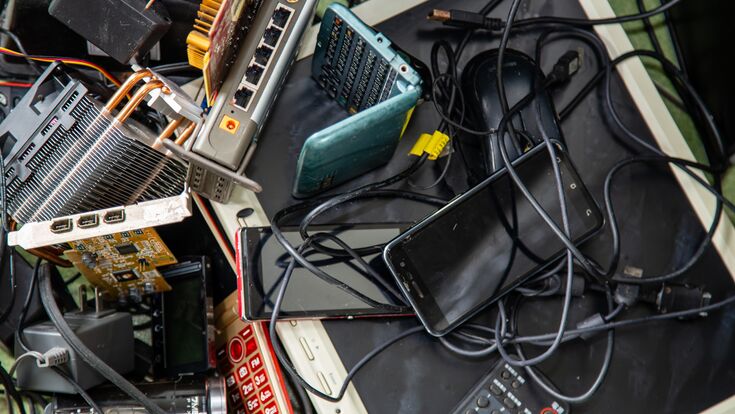
A part of the solution could lie in EEE (Electrical and Electronic Equipment), if waste management, industrial policy and raw material supply security could be linked together. E-waste contains a multitude of CRMs and SRMs, albeit in small amounts. However, considering the several hundred tons of e-waste already in existence, there is great potential that could be tapped. To guarantee a reliable supply of resources in Europe a circular economy could deliver a major contribution.
Currently, the market for secondary raw materials suffers from structural deficits. Prices for secondary (recycled) materials are strongly linked to those of primary materials, material flows are difficult if not impossible to track, and primary materials are still preferred over secondary ones. In Austria specifically, a stable customer base is missing. Legal constraints add to the challenge: processed materials can technically be of high quality, but continue to be classified as waste. The legal framework is simply not yet designed to accommodate these cases. As a result, they are subject to stricter transport and export regulations which lead to higher costs, limited recovery pathways and reduced trade across Europe.
Potential in Austria
In Austria, just over half of all WEEE was collected in 2024. Although this put Austria well above the EU-average of 35%, it still fell short of the collection quota target of 65% set by the EU. Small devices and IT components in particular often end up in residual waste. The consequence is the loss of valuable resources and value creation, as several materials are difficult to recover after thermal treatment – or at least not in an economically viable way.
Climate Lab examined the recycling of critical materials out of WEEE as well as the impacts of the Critical Raw Materials Act and additional legal instruments for Austria as part of a partnership project with the Ministry for Agriculture and Forestry, Climate and Environmental Protection, Regions and Water Management.
As it turns out, Austria is on a solid pathway forward. The country already possesses a comparatively high level of recycling expertise, well-functioning circular economy networks, and strong research in the field. However, it is also clear that in order to ensure a future for the industry, incentives to increase collection rates and clear legal frameworks are needed. A standardised approval process is vital to changing waste and product designations in a way that is legally solid and predictable. Recycling is not merely another environmental measure, but a strategic “must” as Europe faces urgent questions in resource and industrial security.