A greek success story : From landfills to circularity: A conversation on Greece's waste management reforms
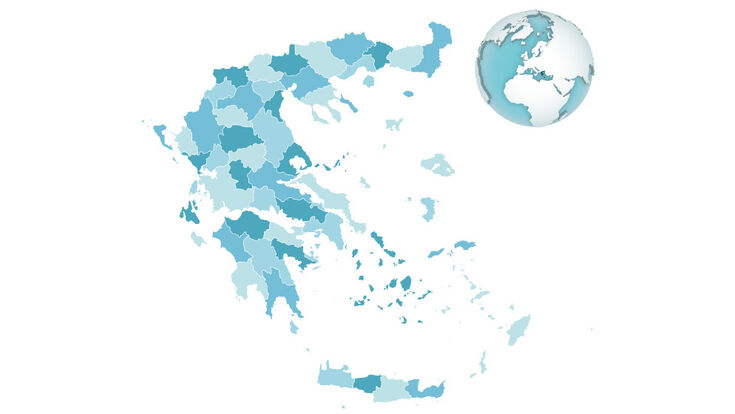
Greece stands at a critical crossroads from a waste management point of view. Waste management has been recognised as one of the most severe problems in Greece’s environmental performance indices, suffering in the past from a low level of organisation while relying predominantly on landfill practices. Since 2019, however, Greece has entered a transitional phase, aiming to close the gap with EU-27 and targeting interventions to steer the country towards a circular economy. In June 2026, I had the pleasure of discussing this transition with the heart and brain behind it, Mr. Manolis Grafakos, General Secretary for Waste Management Coordination, at the Greek Ministry of Environment and Energy.
Mr. Grafakos, thank you for your time. I am sure you have many fascinating stories for the readers of Waste Management World, from your (almost) seven years in the hot seat for waste management on behalf of the Greek Government. Please tell us about the situation when you took charge in summer 2019.
First of all, I want to thank you for this discussion. In 2019, Greece’s performance in waste management was not satisfactory. The country recorded low recycling and high landfilling rates and, most critically, 65 cases of fines from the European Court of Justice for active dumpsites and inappropriate waste management practices. We had a National Waste Management Plan that did not achieve its goals, a small amount of waste treatment infrastructure and, in fact, in 2019, the National Strategic Reference Framework (NSRF) 2014–2020 was the last eligible financial tool for MSW, with no prospect of financing infrastructure from 2023 onwards. In other words, the country was paying fines, had no infrastructure, inadequate planning and, last but not least, no money for MSW infrastructure and equipment.
A landmark project for waste management in Greece is the Peloponnese Integrated Waste Management System. Briefly describe the history of the project, the difficulties, your collaboration with the European Commission, the financing and, finally, its implementation.
When we took over in the summer of 2019, 21 cases of fines had been imposed by the European Court of Justice for illegal landfills in the Peloponnese Region, the most in Europe at regional level. The tender process for the implementation of the infrastructure was underway, but no contract had been signed. In addition, in 2020, the issue of financing the project arose, following objections raised by the EU. The truth is that the project file that had been submitted to the EU was not good and did not do justice to the project. But despite the difficulties, we succeeded. We made a new file under the responsibility of the Ministry of Environment and Energy, we had constructive discussions with the EU, we finally secured the financing, the project was contracted, constructed and is finally operating. Thus, today Peloponnese is one of the regions of the country that has achieved a disposal rate of less than 35%, while of the 21 fines for illegal landfills, only two remain
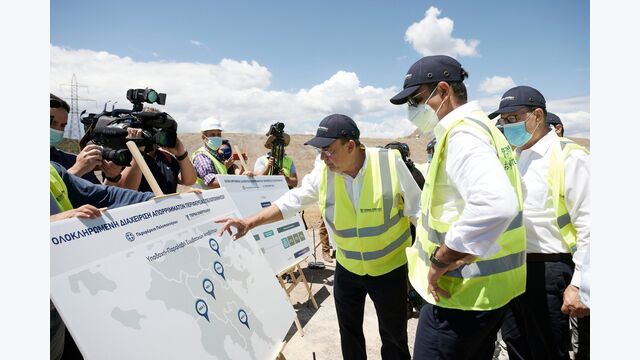
The Greek Prime Minister, Kyriakos Mitsotakis, oversees the Peloponnese Integrated Waste Management Project during its opening ceremony
- © Greek Ministry of Environment and EnergyLet’s go back to 2019. How did the transition begin? I would like you to tell us about the vision of the National Waste Management Plan in 2020, as amended in 2023. How does strict target setting allow for specific milestones to be achieved?
The first thing we did in 2019 was to prepare a new National Waste Management Plan, compatible with the EU target requirements, which even included the waste landfill target of 10% by 2030 (5 years before the deadline from the EU Directive), with the mandatory addition of energy recovery, which until then was not allowed due to the ideological obsessions of the previous government. We then accelerated the procedures and put many waste management infrastructure projects out to tender, in order to make up for lost time. The fact that the tender procedures for these projects progressed gave credibility to the argument to apply for financing from the EU, after 2023, for the implementation of MSW treatment facilities. This target was achieved and thus we have secured funding until 2030 for waste management infrastructure projects. Now, with the new targets, the planning, and the resources to achieve them, we are optimistic that we will meet our goals.
But what happens at regional and local level? Please describe to us the Holistic Separate Collection Plans and Cost-Benefit Investment Plans, and how they will allow the Regional Waste Management Plans under elaboration to propose specific and costed actions?
The Holistic Separate Collection Plans in each region comprehensively and holistically record the necessary collection equipment to achieve the collection goals of the different waste streams at regional level. Therefore, all available resources will finance a total and holistic plan that can increase recycling rates in every region. These are part of the new Regional Waste Management Plans (PESDA) being drawn up. As far as the PESDAs are concerned, the main change is that they now have a Cost-Benefit Investment Plan based on both an examination of alternative scenarios and a Cost-Benefit Analysis. So, now we are sure that the investment solutions that have been proposed are optimal and at the same time achieve the collection and treatment goals for the main waste streams. In this regard, we have PESDAs that can achieve the waste management targets set by the EU.
I understand that all this planning leads to a significant investment cost. Are there any financial tools available? What efforts has the Greek Government made towards this end?
As I mentioned, we have secured from the EU the financing of the necessary infrastructure for waste management, up to the year 2030. Given that all the Recovery and Recycling Facilities (RRFs) are now either operating, being constructed or are in the tender process (so they will have been contracted by 2027), we are confident that they will be completed by 2030 when there are available resources. In addition, the acquisition of recycling equipment by the Municipalities and the FODSAs will be done with resources from the landfill tax, a fee that we have applied since 2022. Finally, the financing of the infrastructure for Waste to Energy, for the secondary fuels and MSW residues will come from the private sector. We therefore have a clear plan to acquire separate stream waste collection equipment and infrastructure, along with the resources available to finance them.
All available resources will finance a total and holistic plan that can increase recycling rates in every region.Manolis Grafakos, General Secretary for Waste Management Coordination at the Greek Ministry of Environment and Energy
Beyond the treatment of residual mixed MSW, the most important pillar for the transition to the new era is prevention, separation at source and recycling of different streams. Describe to us the actions you have taken and the first results of these.
I agree with what you say – that the most important pillar is indeed separate collection and recycling. For this reason, we established the Holistic Separate Collection Plans in each region of the country, the financing of which we have secured. But apart from these, it is additionally necessary to increase efforts and the alternative management systems (EPR) created for different waste streams by the obliged producers. Thus, in the coming days, we expect the submission of the business plan for the development of the Deposit Return Scheme (DRS) for plastic and metal bottles, while we expect the submission of a new business plan for packaging waste within the year, which will significantly increase the available resources. Finally, Extended Producer Responsibility will be applied during 2026 to other important waste streams such as bio-waste from hotels and restaurants, mattresses, furniture and textiles.
You mentioned DRS. At EU level it is recognised as a very powerful tool that makes it possible to increase the purity of materials and achieve high recovery rates. Would you like to update us on the country's planning? When is the system expected to come into force?
As I mentioned before, we expect the business plan to be submitted by the responsible body, which has already been created for this purpose by the obliged producers, including the water, soft drinks and beer companies. We know that it will be a colossal investment project of the order of 100 million euros per year. It includes approximately 4,200 points where machines will be installed to automatically return the guarantee fee of 0.10 or 0.15 euros per plastic or metal bottle (bottles <1.5 l and >1.5 l, respectively), when the citizen returns the bottle. There will also be another 10,000 manual return points. It will be a huge change that will be implemented during 2026, which will increase the amount of recycling and will affect the daily life of all citizens and visitors in our country. The contribution of this effort to the environment will be invaluable, given that today these bottles often end up in the natural environment and our seas.
Last step, the management of non-recyclable MSW residues. The ISWA community is aware of the ΜΕΕΝ's planning for energy recovery. Are you optimistic that market players, local authorities and citizens will embrace the projects? Do you recognise risks in the planning until the implementation of WtE projects?
Energy recovery did not exist as an option in 2019. We institutionalised it, through the NWMP in 2020, and we have been implementing it since then in steady steps. We have completed the relevant Feasibility Study concerning the necessary infrastructure, the environmental approval of our planning is progressing, while during 2026 we estimate that the relevant legislative regulations will also be completed, as well as the State Aid scheme application to the EU for the biogenic fraction of waste (considered RES). The Plan envisages that quantities of mixed residual MSW will be converted into SRF after being processed in the RRFs, as mentioned above. The quantities are estimated after achieving a recycling rate of 65% (planned to be raised to 70% from 2040 onwards). The fuel will feed six WtE plants that will be constructed by the private sector in our country. These facilities are expected to generate sufficient energy, covering 1.5–2% of our country's annual electricity needs (baseload energy) and together with their operation by 2030, the country will manage to achieve a disposal rate significantly below 10%.
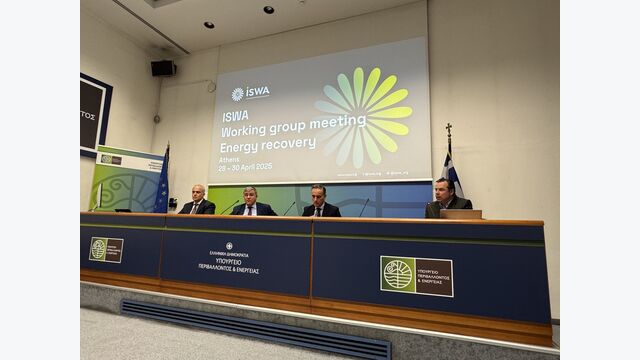
The ISWA Working Group on Energy Recovery (WGER) was held in Athens in April 2025.
- © Antonios SakalisSumming up, how do you see Greece in 2030, in terms of waste management? Have all the weaknesses been addressed? How could a future government build on the achievements of the present one and lead the country to convergence with the EU average?
We are working with the goal that by 2030, our country will be in the narrow core of European countries that will have achieved low waste disposal, high recycling rates, and at the same time zero fines for dumpsites and inappropriate waste management practices. A country that will have all the infrastructure for the transition towards a circular economy, a country that will manage MSW residues through WtE, a country that, in waste management, will finally succeed – within a decade – from being EU underperformers to being at the forefront and a star along with the other countries that have succeeded in this field. Thus, Greece will have achieved a small miracle, we will have a clearly better environment and, of course, improved living conditions for the Greeks and the millions of visitors who come every year to our beautiful homeland.
A circular future
The transition from a linear to a circular economy is not just a logistical challenge for Greece. It is a cultural and systemic shift. Our discussion highlighted the important role of the Ministry of Environment and Energy in providing the necessary strategic and institutional framework. However, success in managing MSW depends on synergy between central government, local government and citizens’ participation. The roadmap is clear, the goals are ambitious and the next decade will determine whether Greece can truly transform its waste into a valuable resource for the future.