
Giorgio Colombo, ICMA San Giorgio, on why reconfigurable twin-screw platforms beat dedicated machines : "Flexibility must be engineered, not assumed"

How has your product lineup changed over the past five years in response to material-specific requirements? Are you offering more specialised machines or fewer general-purpose models?
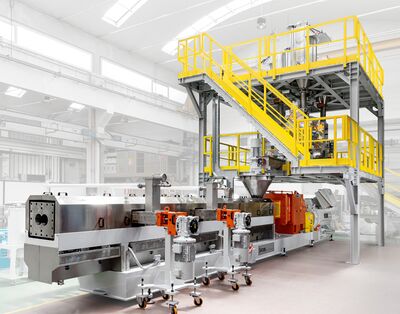
Over the past five years, our product lineup has evolved toward greater application specificity, which is always built on flexible extrusion platforms. As recycling streams have become more complex and variable, the market requires modular co-rotating twin-screw systems that can be configured according to each material challenge, rather than rigid, material-dedicated machines. With over 40 years of experience in twin-screw recycling, ICMA San Giorgio has strengthened its focus on adaptable architectures — higher torque density, advanced degassing, and optimised screw geometries — within a fully reconfigurable platform. The evolution is not toward fixed specialisation, but toward flexible systems delivering material-specific performance.
What material presents the biggest technical challenge for co-rotating twin-screw extrusion equipment today, and why? What specific engineering modifications does it require?
Highly contaminated post-consumer materials remain the most demanding challenge. Moisture, inks, adhesives, and volatile degradation products compromise melt stability and final properties. Addressing this requires multi-stage vacuum degassing, dedicated stripping sections, and carefully engineered screw configurations to ensure effective decontamination. Lightweight, low bulk-density materials such as films or textile fractions represent another challenge, demanding high-efficiency force feeders and optimised intake geometries to guarantee stable throughput. The real objective is not simply processing waste — but restoring material performance through controlled energy input.
Your "ONE-STEP UP-CYCLING" concept handles everything from recycling to re-compounding in a single extruder. What are the practical limits of this approach? Where do you still need multiple processing steps?
Our ONE-STEP UP-CYCLING concept eliminates upstream agglomeration by directly feeding lightweight flakes into the twin-screw extruder using advanced force-feeding technology. This avoids additional thermal history, reduces energy consumption, and simplifies plant layout. The limit arises when further high-performance compounding is required — for example, adding fillers or blending recycled and virgin polymers to meet specific targets. In these cases, a downstream twin-screw extruder in cascade configuration may be appropriate. Both solutions can be validated on our ReCoPurTech recycling platform at ICMA’s new Recycling Tech Center.
>>> Using recycled plastic in the building industry: Sustainable construction: From niche to norm
When processors ask for equipment that can handle multiple plastic types, what trade-offs do you have to explain? Where does material flexibility compromise throughput or quality?
Flexibility may involve trade-offs. Slightly lower throughput can be the price for processing different polymer families — such as various polyolefins — on the same line. Maximum productivity is achieved with fully optimised screw configurations. When broader flexibility is needed, the setup must be balanced. A practical solution is a second pre-configured screw set optimised for another polymer family — preserving performance while maintaining versatility. Flexibility must be engineered, not assumed.
How much of your R&D budget now goes toward material-specific customisation versus general equipment improvements? Has this balance shifted significantly in recent years?
A growing share of our R&D now focuses on material-specific customisation driven by circular economy demands. At the same time, we continue investing in core improvements — torque performance, energy efficiency, and process control. Despite the current market adjustment phase, structural sustainability drivers continue to shape our development priorities.
Flexibility will dominate in the future. While certain applications may justify dedicated configurations, the growing variability of recycling streams favours adaptable processing platforms.Giorgio Colombo, ICMA SAN GIORGIO
You've pioneered direct extrusion that combines compounding and forming in one step. How do material properties affect whether this works? Are there materials where the traditional two-step process is still necessary?
Direct extrusion combines compounding and extrusion in one step, exposing the polymer to only one thermal cycle and reducing degradation risks — particularly important for recycled materials and enhancing output results. The two-step process remains suitable for simpler applications or moderate production volumes.
Your work with wood-plastic composites is distinctive. How do WPC extrusion requirements differ from pure plastic recycling, and does this experience help with contaminated post-consumer materials?
In wood-plastic composites, protecting natural fibres from thermal degradation is critical. This requires precise temperature control, optimised screw design, and careful residence time management. The same discipline applies to advanced recycling, where controlled shear and thermal profiles are essential to prevent further polymer degradation. In both cases, mastering energy input and process stability is key.
How are emerging feedstocks—like pyrolysis oils from chemical recycling or mixed flexible packaging—forcing you to rethink traditional extruder design?
Rather than redefining extrusion, we leverage the modularity of co-rotating twin-screw technology to adapt efficiently to new material challenges.
Looking three years ahead, do you see the industry moving toward greater specialisation with material-dedicated lines, or will advances in co-rotating technology allow for more flexible equipment that can truly handle multiple materials effectively?
Flexibility will dominate. While certain applications may justify dedicated configurations, the growing variability of recycling streams favours adaptable processing platforms. Co-rotating twin-screw technology, with its modular and reconfigurable architecture, enables application-driven specialisation built on a flexible foundation. The future belongs to systems that evolve with the materials — and twin-screw extrusion is naturally positioned to lead that transition.