
Sustainability : Mind the Gap: Why waste management must be at the center of the circular economy transition

There seems to be a consistent pattern across continents and income levels: a gap between regulatory ambition and operational reality. Once the discussions are over and the targets set, the hard question surfaces: do the systems on the ground actually exist to deliver what the policy requires? Understanding this gap is essential to making progress.
The Global Waste Management Outlook 2024 (GWMO 2024) puts the stakes in sharp relief. Without intervention, the world is on track to nearly double waste generation and the costs of environmentally sound management by 2050. Luckily, the same report argues that improving waste and resource management is not a cost burden but a strategic investment. When circular systems are planned and delivered at scale, the environmental, climate, health, and economic benefits they generate outweigh the costs of building them. This is the core foundation of ISWA's global advocacy, the conviction that waste management is a lever for unlocking value, reducing emissions, and protecting public and environmental health on a scale that most policy discussions still fail to recognize.
When the rules arrive before the infrastructure
India's Solid Waste Management Rules 2026, which came into force on April 1, offer an instructive case. The new framework is ambitious, with mandatory four-stream waste segregation at source, EPR obligations for bulk waste generators, circular economy integration, and digital monitoring requirements. The panel convened at IFAT Delhi 2026 by ISWA National Member the Institute of Chartered Waste Managers (ICWM) was clear that India has the regulatory intent. The gap between that intent and operational reality, however, remains wide and will require sustained investment in infrastructure, institutional capacity, and political commitment at every level of government to close.
This is not unique to India. In February, ISWA convened a webinar on EPR for textiles: "Textiles in the Focus - How Extended Producer Responsibility Can Enable a Circular Economy for the Sector." Since 2025, all EU Member States have been required to collect textile waste separately under the revised Waste Framework Directive. The webinar discussion revealed that the regulatory obligation might have arrived well ahead of the conditions needed to make it work. Panelists noted that financing mechanisms and system readiness remain uneven, while collection volumes are growing but the quality of collected textiles is declining, placing increasing pressure on reuse organizations and municipalities. Their conclusion: textile EPR schemes must finance the full value chain—collection, sorting, preparation for reuse, recycling, and market development—not just collection volumes. EPR is not a magic solution. Done right, it can relieve pressure on municipalities and stabilize existing collection systems. Done poorly, it risks generating increased volumes and costs without improving outcomes.
An editorial published in Waste Management & Research (Zorpas et al., 2026) found that despite over a decade of EU circular economy action plans and more than €10 billion in funding between 2014 and 2020, European countries have shown a persistently low transition rate toward circularity. The investment is there, but the behavioral and systemic change has not kept pace.
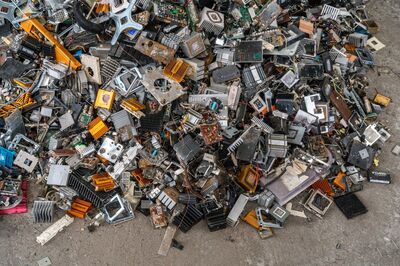
That gap will be tested again as the EU Circular Economy Act (CEA) seeks to double the EU's circular material use rate to 24% by 2030, from approximately 11.8% in 2023. Among its focus pillars is e-waste: measures to ensure effective collection, recycling, and market demand for secondary critical raw materials. Here too, the implementation gap is real. Worldwide e-waste generation reached approximately 62 billion kilograms in 2022 and is projected to reach 74 million metric tonnes by 2030 (Awasthi & Pandey, WM&R, 2026). Despite existing frameworks, significant volumes continue to end up in open landfills or are illegally exported to lower-income countries where they are handled by the informal sector, often without adequate protection for workers or the environment. Linking informal collection networks with formal processing systems, and building recycling infrastructure that matches the scale and hazardous complexity of e-waste streams, remains one of the sector's most pressing challenges
Not everything can be recirculated
ISWA's global advocacy campaigns are organized around the three D's:
- Decoupling growth from waste generation,
- Defossilizing our economies, and
- Decontaminating our ecosystems.
The Decontaminate pillar addresses a dimension that circular economy discourse too often passes over: not all materials can or should be returned to use. A significant proportion of what we discard contains substances hazardous to human health and the environment, requiring safe treatment and controlled final disposal rather than recirculation.
This is illustrated by the challenge of PFAS, a family of highly persistent synthetic chemicals used across industrial, commercial, and military applications, often called "forever chemicals" due to their extreme resistance to environmental degradation. A recent editorial in Waste Management & Research (Toskos et al., 2026) highlights the acute gap between the scale of PFAS contamination (now found even at previously pristine sites through atmospheric transport) and the regulatory and technological tools available to address it. PFAS is an extreme example of a broader challenge. Hazardous household waste, contaminated construction and demolition materials, certain categories of electronic waste, and legacy dumpsite leachate all represent streams where the priority is safe containment, treatment, and controlled final disposal rather than recovery and recirculation. This is not a failure of circularity. It is a recognition that a healthy circular economy requires dealing with what cannot be safely cycled back. Safe treatment and final sinks remain essential components of any sound waste management system. Treating circularity as an absolute goal, without acknowledging residual streams that require permanent management, risks creating new problems downstream in pursuit of metrics that look good on paper.
The work ahead
ISWA's contribution across all of these contexts is to make the connection visible between the policy layer and the operational layer, and to bring the evidence of what works into conversations that often lack it. Whether contributing to the UNFCCC COP process to lower emissions, Plastics Treaty negotiations, supporting capacity building through Study Tours that draw participants from around the world, or ensuring that zero waste ambitions are grounded in waste management reality, the Association's function remains constant: connecting knowledge with the people who can use it, and connecting ambition with the systems that can deliver it.
References
- Awasthi AK & Pandey AK (2026) Circular model turning e-waste into value-added solution for global issue. Waste Management & Research 44(2): 101–102. DOI: 10.1177/0734242X251407001
- Zorpas AA et al. (2026) Circular communication strategy as a framework to achieve robust circularity targets. Waste Management & Research 44(4): 369–375. DOI: 10.1177/0734242X251415516
- Toskos T, Panagiotakis I & Dermatas D (2026) Capping as a pragmatic strategy for polyfluoroalkyl substances-contaminated land redevelopment in the circular economy era. Waste Management & Research 44(6): 641–643. DOI: 10.1177/0734242X261439180
Further Reading