
Waste Collection : Athlete science, applied to the bin
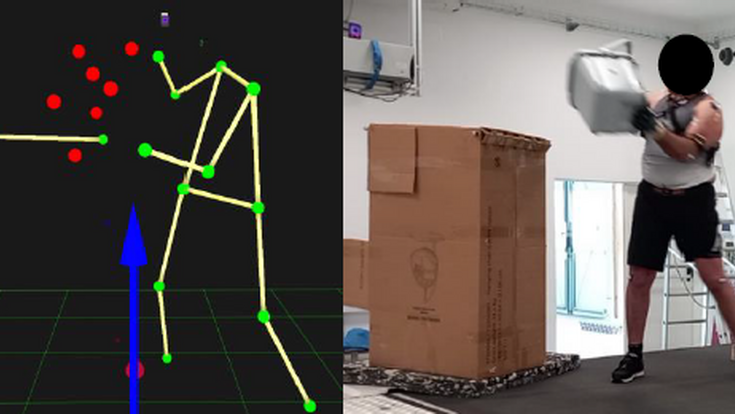
In the laboratory, the operators were fitted with electrodes and monitored using an electromyography system. Electromyography is a non-invasive examination that measures a muscle's natural electrical activity. This approach allowed their movements and musculoskeletal activations to be analysed in detail using 3D models, employing the same systems used for winter sports athletes. Cameras filmed them from every possible angle. The result was an extremely detailed scientific protocol containing a great deal of data.
- © CeRiSMFor Chiara Zoppirolli, looking at people’s movements and collecting and analysing data is her bread and butter. The sports scientist, with a plethora of publications from “Effects of slight ski boot weight variations on ski mountaineering energy cost and mechanical work at race intensity” to “Biomechanical determinants of cross-country skiing performance”, is not only teaching at the University of Verona but also working at the prestigious CeRiSM (Centro di Ricerca Sport Montagna e Salute, Research Centre for Sport, Mountains and Health) of the Universities of Verona and Trento. So, it’s better to clarify: Analysing athletes’ movements is (part of) her job. “Some sports apparel companies also hire us to test whether their sportswear meets the required standards and performs well in sporting activities,” Zoppirolli explains. One can imagine her surprise when back in 2021 a waste management company contacted CeRiSM to do some testing.

Put the human at the centre
Sartori Ambiente is well known for its separate waste collection systems and containers. And you might think that designing a bin is pretty straightforward. After all, what specific requirements are actually necessary? But since 2021, Leonardo Benuzzi has been Sartori’s Innovation Manager, and he decided to approach the design process differently: with the operator at the centre. “Without waste operators our modern lives would descend into chaos, yet they are essentially invisible,” says Benuzzi. “My goal was to improve the life of operators by designing a bin that makes their work easier.” He knew that he could not do it alone. As a former MIT (Massachusetts Institute of Technology) employee – he was working for the Mobile Experience Lab – and consultant, he has learnt to tackle problems in a different way and trust the concept of design thinking. This is based on the idea that problems can be solved more effectively when people from different disciplines collaborate in an environment that encourages creativity. For Benuzzi, this was CeRiSM. “I knew about them, and it was clear from the beginning that I wanted to work with them.” Waste collection, after all, is a physically demanding job. And if you want to improve the work sequence – from picking up the bin to emptying it into the waste truck to putting it down again – you need an ergonomic bin. And to get there, you need the data.

Trust the science
In reaching out to the sports and movement scientists, he made it clear that they should take the lead, because “they know which questions are key to achieving the desired results.”
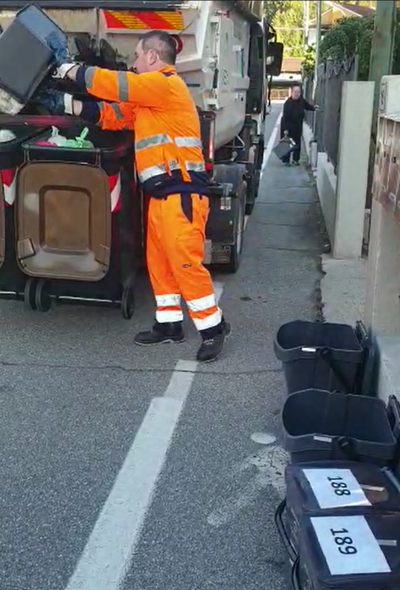
This led to a two-part approach. First, there was the qualitative analysis in the field. Zoppirolli, Benuzzi and Sartori Ambiente CEO Michele Sartori accompanied three waste collectors on their usual round. This meant starting at 4 am not only to film all of their movements (800 in total) but also to weigh each and every bin and, of course, to enter it all into a very long Excel sheet.
With the data collected and ergonomic design principles included, Sartori Ambiente 3D-printed a prototype and entered stage two: extensive lab testing. Benuzzi followed Zoppirolli’s instructions and brought 10 operators with different “characteristics” to the testing facility: older, younger, short, tall, with and without experience, female…
They were equipped with electrodes and monitored through an electromyography system. Electromyography is a non-invasive examination that measures the natural electrical activity of a muscle. This approach enabled their movements and musculoskeletal activations to be analysed in detail using 3D models, with the same systems employed for winter sports athletes. Cameras filmed them from every possible angle. The result was a very detailed scientific protocol with a lot of data.
So what did all that data reveal? Compared with a conventional bin, the redesigned model allowed a safer posture for the operators in all the phases of the work, with more upright positions, and a lower abduction of the shoulders during the emptying phase and with a tendence to reduce the emptying phase duration. Multiplied across the countless lifts a single operator performs in a typical shift, those margins add up to a substantial reduction in cumulative daily strain — and the potential to ease the musculoskeletal injuries that drive sick leave and early retirement across the sector.
“Some operators were a bit sceptical at the beginning. After all, it is an unusual situation,” remembers Zoppirolli. “They are also not used to being the focus of attention.”
Benuzzi, who also spent a lot of time interviewing operators about their opinions and experiences, would not have wanted to do it otherwise: “The happiness of the operators to be taken seriously is something I will probably remember forever.”
An ergonomic future
The result of this extensive research and testing is the UrbaE with an extra-long handle and edge-free body that was not only awarded the human-centred design certification from the ergonomics certifying institute Ergocert but also the prestigious Sustainable Development Award, promoted by the Foundation for Sustainable Development in collaboration with Ecomondo.
Both Zoppirolli and Benuzzi see this project as part of a bigger shift. The future will see more collaborations between industry and scientific research. “After all, innovation does not happen in one field but at the intersection of two,” says Benuzzi.
In cooperation with Sartori Ambiente.
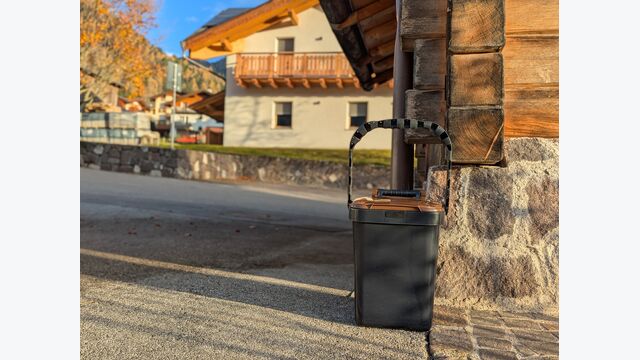
The result of the extensive research and testing is the Urba E bin.
- © Sartori Ambiente