
Lindner Washtech & EREMA : Advanced automation drives new quality standards in plastics recycling
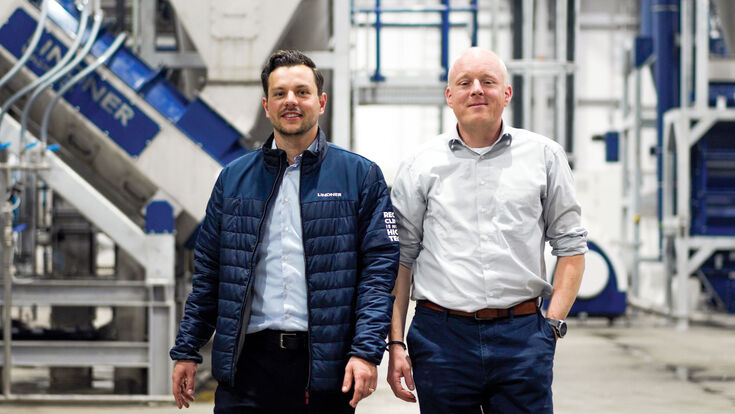
Innovating the standards in plastics recycling – this is the declared goal of the cooperation between Lindner Washtech and EREMA. Through targeted process optimisations along the entire value chain, the partners are setting new benchmarks in efficiency and recycling quality. In the photo (from left to right): Marcel Willberg, Sales Director at Lindner Washtech, and Clemens Kitzberger, Business Development Manager Application Post Consumer at EREMA Group.
- © Lindner RecyclingtechThe plastics recycling industry stands at a pivotal moment where traditional approaches to waste processing are being fundamentally reimagined. Through strategic collaboration and technological innovation, industry leaders are proving that comprehensive automation and process optimization can deliver unprecedented efficiency while establishing new quality standards that reshape competitive dynamics across the sector.
This transformation is exemplified by the work of BLUEONE Solutions, the joint venture established in August 2023 between Austrian family-run companies Lindner Holding and the EREMA Group. Their approach represents a paradigm shift from component-focused design to holistic process integration, addressing the entire technological recycling process from shredding, sorting, washing and drying to extrusion.
Streamlined operations through systematic integration
The conventional approach to recycling plant design has historically focused on maximizing the capacity of individual components. However, this methodology often overlooks the critical importance of seamless interaction across the entire process chain. The capacity of individual components plays a minor role when designing recycling plants that truly optimize performance.
Instead, the focus must be on the precise interplay of the entire process chain – from shredding and sorting to washing and drying to extrusion and post-processing. To reliably produce the desired quantity of recyclate at the required quality, it's essential to consider how material losses and rejection quantities during the recycling process impact the final output.
The partners have developed a sophisticated modeling approach that enables precise plant design according to required total throughput, accounting for specific output and materials from raw material input to final recyclate production. This comprehensive methodology ensures that every stage of the process contributes optimally to overall system performance
Enhanced performance through smart energy management
Energy utilization represents one of the most significant operational challenges in modern recycling operations, particularly at the critical transition point from drying to extrusion. Traditional systems often fail to capitalize on opportunities for energy recovery and optimization across process boundaries.
The solution lies in implementing a common control concept between the bunker silo and extruder. Dynamic system synchronization allows operators to specifically control the dwell time of dried material as well as extruder loading parameters. This intelligent coordination ensures that the pre-conditioning unit receives an optimum quantity of flakes at the ideal temperature, which significantly reduces the energy required for heating operations.
Operational excellence through intelligent process control
Maintaining consistent material flow represents a fundamental requirement for achieving both productivity targets and energy conservation objectives. Low downtimes are vital in matters of productivity and energy use to conserve resources, making early identification of potential interruptions essential for optimal system performance.
The implementation of a combined control concept addresses this challenge comprehensively. When the recycling process faces interruption due to scheduled maintenance work, filter changes, or the need to remove contaminants from the shredder, the system automatically detects these conditions. Intelligent control parameters maintain recycling process stability until maintenance completion or fault resolution, effectively preventing energy losses, unnecessary material waste, and unplanned downtime.
Once material flow is fully restored, the line automatically and seamlessly ramps up, ensuring consistent and high-quality granulate production at all times. This automated approach eliminates the variability and inefficiencies associated with manual intervention while maintaining optimal output quality.
Advanced monitoring for optimized production
Modern recycling operations require sophisticated monitoring capabilities to maximize performance across all operational parameters. The development of process-oriented monitoring systems provides operators with unprecedented visibility into system performance and optimization opportunities.
A process-oriented HMI dashboard displays all critical plant parameters in real time, supplying operating personnel with comprehensive information about current utilization, likely bottlenecks, and potential for optimization. This adaptive interface enables operators to respond to specific issues while monitoring automatic interventions, supporting stable, data-driven plant operation that forms the basis for future automated interventions and condition-based maintenance.
Setting industry benchmarks
The development of integrated, data-driven and holistic process solutions represents a key milestone in advancing recycling technology capabilities. The strategic collaboration demonstrates how comprehensive process optimization can deliver simultaneous improvements in efficiency, quality, and operational reliability.
At K 2025 in Düsseldorf, industry professionals will have the opportunity to examine these innovations firsthand. The focus will be on key themes such as integrated plant concepts, smooth material flow regulation, smart monitoring and data-driven, intelligent control systems – all designed for maximum process control and optimization along the entire value-added chain.
This approach to recycling technology integration suggests a future where automated systems, intelligent monitoring, and comprehensive process optimization become standard practice rather than competitive advantages. For waste management professionals, these developments signal both the potential for significant operational improvements and the imperative to embrace technological advancement as a core business strategy.
WMW is media partner of K 2025.
