Innovation : Leading by example: Austria's environmental technology at IFAT 2026
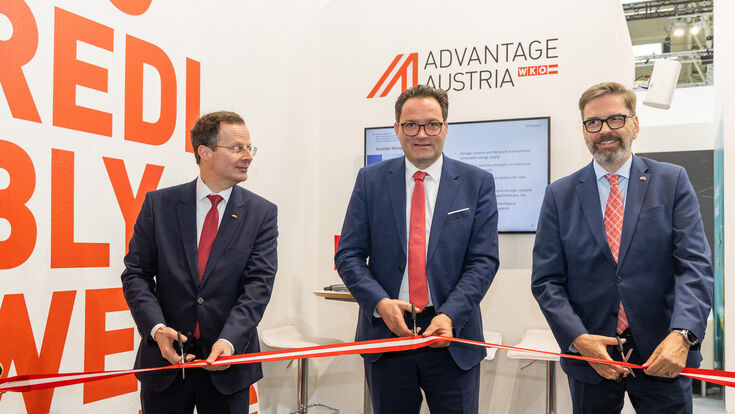
Federal Minister Norbert Totschnig opened the Austrian group stand at IFAT 2026, the world’s leading trade fair for environmental technologies in Munich, highlighting the strength of the country’s environmental technology and circular economy sectors on international markets.
- © www.felikss.deFor 60 years, IFAT has been the industry’s premier global gathering – and Austria rarely misses an opportunity to shine. This year, more than 100 new developments “Made in Austria” were on show, among them several genuine world firsts.
One of the most notable debuts was the new AEROSTRIP® strip aerator from AQUACONSULT Anlagenbau GmbH in Traiskirchen. Its defining feature: rather than replacing the entire unit, operators simply swap out the membranes. The existing installation stays in place, maintenance is reduced and service life is considerably extended. A practical illustration of circular economy principles at work.
Another world first came from CTP Air Pollution Control GmbH in St. Paul im Lavanttal: a Regenerative Thermal Oxidation (RTO) system designed to tackle nitrous oxide (N₂O) emissions from wastewater treatment plants. At high temperatures, the unit breaks N₂O down into harmless nitrogen and oxygen. Given that nitrous oxide carries a global warming potential 250 to 300 times greater than CO₂, the climate impact of this technology is hard to overstate.
The third innovation was presented by IFE Aufbereitungstechnik GmbH from Waidhofen an der Ybbs: the VARIOframe screening machine. For the first time, each screen deck can be adjusted continuously and independently while the machine is running – without stopping production. The upshot is better material quality, higher throughput and less downtime, all of which matter considerably to modern waste processing operations.
Secondary raw materials: The push for equal standing
One of the key themes at the ministerial press briefing at the Austrian booth was the future status of secondary raw materials. Federal Minister Totschnig was direct: “Every tonne of secondary raw material strengthens our industry, safeguards domestic value creation and makes our economy more resilient.” Austria’s circular economy already turned over 16.6 billion euros in 2024. A figure that rarely gets the attention it deserves.
Legislatively, the push to place secondary and primary raw materials on equal footing is gaining traction. A planned amendment to the Waste Management Act (AWG) is set to be tabled before the end of the year, with the goal of raising Austria’s circularity rate to 18 per cent by 2030. A demanding but necessary target if the country is to reduce its dependence on imported raw materials.
Running alongside this is the work of the government’s Circular Economy Task Force, which is preparing a position paper to map out how Austria’s Industrial Strategy 2035, its Circular Economy Strategy and its Bioeconomy Strategy can be made to pull in the same direction. Totschnig identified recycling, digital resource platforms, product passports and circular production systems as the key pillars of this agenda.
Biogas: Legislation stalled, industry under pressure
On biogas and biomethane, the reality on the ground is bleaker than Totschnig’s measured optimism might imply. The Renewable Gas Act (EGG) is written into the government’s programme, but it failed to clear the required two-thirds majority in the National Council in 2024 – and has not been passed to this day.
The stakes are real: the green electricity subsidy for existing biogas plants runs out in mid-2027. By that point, many operators will be legally required to switch to injecting biomethane into the gas grid – a conversion that costs between four and ten million euros per plant. Without a guaranteed offtake framework in law, that is a risk few can take on. For some, closure may be the only option.
The minister acknowledged the urgency and pledged to keep pushing: “We want the plants that have already received approval to actually be able to start producing.” Meanwhile, Austria’s European neighbours – Germany chief among them – are investing heavily in biogas infrastructure. For the waste management sector, this is particularly consequential: biogas and biomethane derived from organic waste and sewage sludge offer a dual benefit, serving both as a renewable energy source and as the final link in a truly closed material cycle.
A powerhouse for exports: Austria among the EU’s best
The numbers tell a strong story. Austria’s environmental technology sector – some 3,300 companies employing nearly 57,800 people – generated revenues of over 21 billion euros in 2023. With an export ratio of 73 percent, Austria sits at the top of the EU rankings for both exports and value creation in the sector, and places in the top three on the current Eco-Innovation Index.
Maintaining that position takes active support. The joint export initiative run by the Federal Ministry (BMLUK) and the Austrian Federal Economic Chamber (WKÖ) has been running since 2005 and has accompanied more than 500 representatives from over 400 companies into international markets. Its particular focus is on smaller businesses that lack the resources to go global on their own – from Shanghai to Brazil, the initiative helps them find a footing and build visibility.
Austria's showing at IFAT 2026 is impressive: technologically sharp, internationally connected and pointed firmly in the right direction. The challenge now is for the political and legislative framework – from the AWG amendment to the still-absent Renewable Gas Act – to keep up with the pace of innovation that Austrian companies have set.