
Emissions monitoring : Shifting winds and sulfur dioxide levels from mineral processing: A case study from Texas
Abstract
Gas emissions from waste management, thermoelectric power, and mineral processing facilities are potentially harmful to humans and the environment. Air monitors help operators assess the potential impacts of gas-emitting facilities. In a case study, hourly sulfur dioxide concentrations and wind patterns from November 16, 2016 through January 31, 2023 at a monitor near a mineral processing facility in north-central Texas were evaluated. The mineral processing facility is located approximately 1.1 km N14E (14 degrees east of north) of the monitoring station, though north-northeast (NNE) winds are relatively infrequent in the study area. Maximum monthly sulfur dioxide concentrations ranged from 9.7 to 313.7 ppb, with a median of 73.8 ppb, over the 75-month period. The 10 highest monthly maxima ranged from 182.2 to 313.7 ppb. For each of these 10 maxima, 25-hour concentration and resultant wind direction time series were constructed, centered on the peak concentration. Resultant wind directions at concentration peaks ranged from N4E to N35E. Typically, peak concentrations coincided with winds shifting into the NNE sector. More persistent NNE winds sustained concentrations above background levels for longer periods of time. Near peaks, small shifts in wind direction caused large concentration fluctuations, with abrupt decreases as winds shifted outside the NNE sector. Overall, the data show complex concentration patterns with shifting winds, effects of plume dispersion, and a need for radial monitoring around sources to capture the effects of predominant wind directions.
Keywords: sulfur dioxide, air pollution, waste management
Introduction
Waste management operators often focus on containing solid and liquid waste to protect groundwater and surface water. However, at many sites, gaseous emissions have more environmental impact than solid or liquid waste due to greater mobility and long-distance transport in the troposphere. Various facilities emit gaseous waste; large producers include thermoelectric power plants (fueled by biomass or fossil fuels) and mineral processing plants. Mapping gas concentrations in air space is difficult, especially at landfills with numerous, complex outlets in cover material. Several gaseous pollutants potentially impact humans and the environment. Sulfur dioxide is commonly emitted at waste and raw-material combustion facilities.
Source-focused monitoring is especially important for sulfur dioxide, which tends to have short residence times and steep concentration gradients in air space. Gaseous sulfur dioxide also reacts with chemicals in the atmosphere to form sulfate, a significant component of particulate pollution (EPA, 2023; Hewit, 2001). The regulatory standard for sulfur dioxide, calculated as the 99th percentile of one-hour daily maximum concentrations averaged over three years (design value), is 75 ppb (EPA, 2023). The objective of this study was to evaluate temporal characteristics of peak concentrations in sulfur dioxide and associated wind patterns over a six-year period at a monitor near a large stationary emitter in north-central Texas, U.S.
Methods
The study area is located at the southeast margin of the Dallas-Fort Worth metropolitan area in north-central Texas (Figure 1). The climate is humid subtropical, with hot summers and mild winters (NWS, 2022). Annual precipitation varies from less than 50 cm to more than 130 cm per year (NWS, 2022). Southerly winds are common in the summer, fall, and spring, with more variable wind directions in winter. Over a 75-month data record evaluated in this study: 31% of winds were from the south-southeast (SSE); 17% from the south-southwest (SSW); 12% from the north-northwest (NNW); 11% from the east-southeast (ESE); 10% from the north-northeast (NNE); and 14% from the remaining three compass sectors (IEM, 2023). Calm conditions prevailed about 5% of the time. The average wind speed was 14.5 km/h (IEM, 2023).
CAMS 1081 (latitude 31.9041045 degrees; longitude -96.3518648 degrees; elevation 93.0 m above mean sea level) is near a stationary source that crushes, heats (with natural gas), and processes shale to make light-weight aggregate used for concrete, road base, and other construction purposes (Figures 1 and 2). The emissions stack, located approximately 1.1 km N14E (14 degrees east of north) of CAMS 1081, released approximately 3,364 tons of sulfur dioxide in 2021 (TCEQ, 2022).
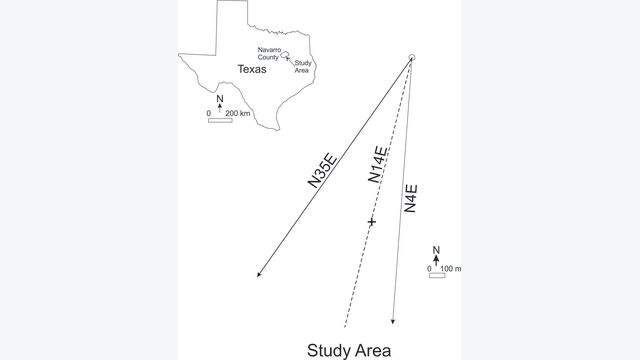
Figure 1. Study area showing source (o), monitoring station (+), and range of resultant wind directions (arrows) associated with ten highest monthly maximum sulfur dioxide concentrations.
- © Hudak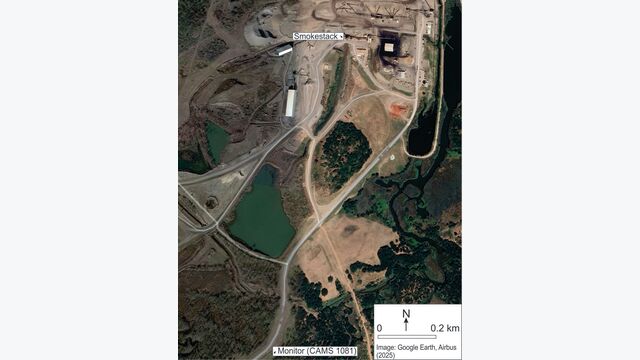
Figure 2. Aerial Image of processing plant and monitoring station.
- © HudakHourly sulfur dioxide concentrations and resultant wind directions from November 16, 2016 through January 31, 2023 measured at CAMS 1081 were compiled from TCEQ (2023). TCEQ follows federal sampling, analytical, and quality control requirements for air monitoring (TCEQ, 2023). Maximum hourly concentrations were obtained for each month. The 10 highest monthly maxima were determined, and for each one, two time series were constructed: one of hourly sulfur dioxide concentrations, and another of resultant wind directions. Both time series comprised 25 hours of data centered on the concentration peak. These data were evaluated to identify trends among and between sulfur dioxide concentrations and wind direction.
Results
Over 75 months, monthly sulfur dioxide concentration maxima ranged from 9.7-313.7 ppb, with a median of 73.8 ppb. In 38 of 75 months, no hourly sulfur dioxide concentrations exceeded the design standard of 75 ppb (Table 1). Moreover, in 53 months, one or fewer observations exceeded 75 ppb. Only 113 hourly measurements exceeded 75 ppb over the entire data record (Table 1). Through time, a vast majority of concentrations were well within regulatory guidelines, although NNE winds produced periodic, short-term spikes. However, monitor location contributes to a tendency for lower concentrations through time, as CAMS 1081 is not downwind of predominant wind mode(s) in the study area.
| Table 1. Number (N) of Hourly Sulfur Dioxide Measurements Above 75 ppb* | Month/Year | N | Month/Year | N |
|---|---|---|---|---|
| 2/17 | 3 | 8/20 | 6 | |
| 9/17 | 1 | 10/20 | 1 | |
| 10/17 | 1 | 3/21 | 1 | |
| 11/17 | 1 | 6/21 | 1 | |
| 12/17 | 1 | 8/21 | 1 | |
| 2/18 | 2 | 9/21 | 3 | |
| 3/18 | 1 | 10/21 | 4 | |
| 7/18 | 2 | 11/21 | 8 | |
| 9/18 | 2 | 12/21 | 1 | |
| 10/18 | 4 | 1/22 | 3 | |
| 11/18 | 1 | 2/22 | 9 | |
| 12/18 | 1 | 3/22 | 1 | |
| 2/19 | 4 | 5/22 | 3 | |
| 3/19 | 2 | 9/22 | 1 | |
| 9/19 | 3 | 11/22 | 7 | |
| 12/19 | 4 | 12/22 | 1 | |
| 1/20 | 2 | 1/23 | 3 | |
| 2/20 | 1 | Total | 113 |
The 10 highest monthly maxima ranged from 182.2 to 313.7 ppb (Table 2). These peaks were (approximately) uniformly distributed in time, with six peaks in the first half of the series, four in the second half of the series, and at least one in each full calendar year of the data record (Table 2). However, the three highest maxima, in 2018, 2022, and 2019, were relatively early in the record.
| Table 2. Ten Highest Monthly Maxima | Date | SO2 (ppb) | Wind Direction* (*Degrees clockwise from north ) |
|---|---|---|---|
| November 23, 2017 | 208.0 | 26 | |
| September 18, 2018 | 193.3 | 22 | |
| November 9, 2018 | 313.7 | 22 | |
| March 18, 2019 | 257.0 | 21 | |
| June 10, 2019 | 288.4 | 28 | |
| September 4, 2019 | 250.5 | 20 | |
| August 18, 2020 | 190.9 | 4 | |
| October 5, 2021 | 182.2 | 25 | |
| December 10, 2022 | 306.8 | 32 | |
| January 8, 2023 | 185.0 | 35 |
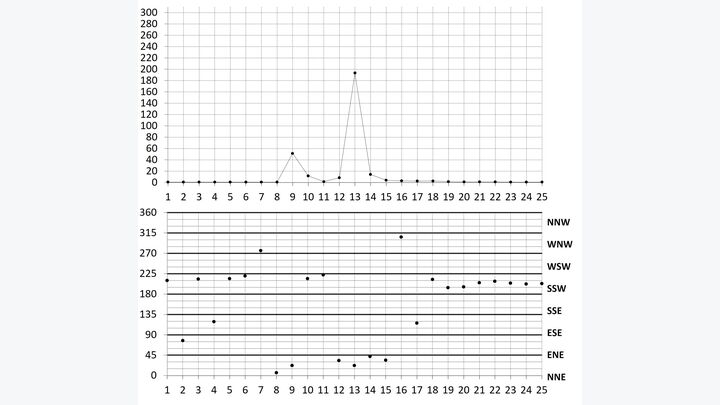
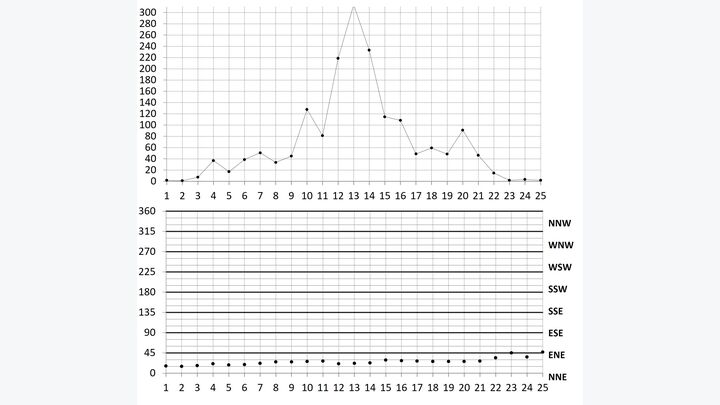
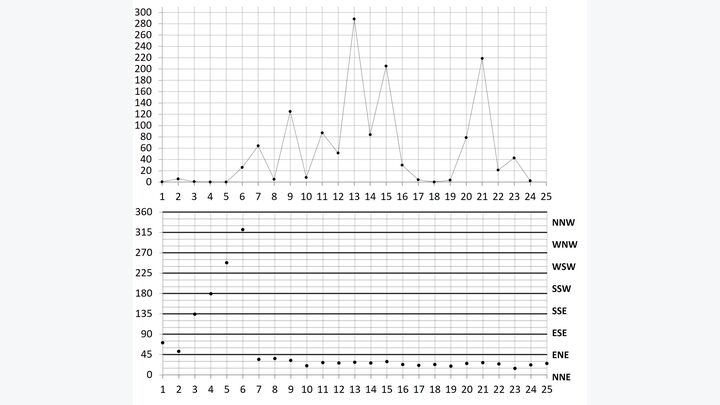
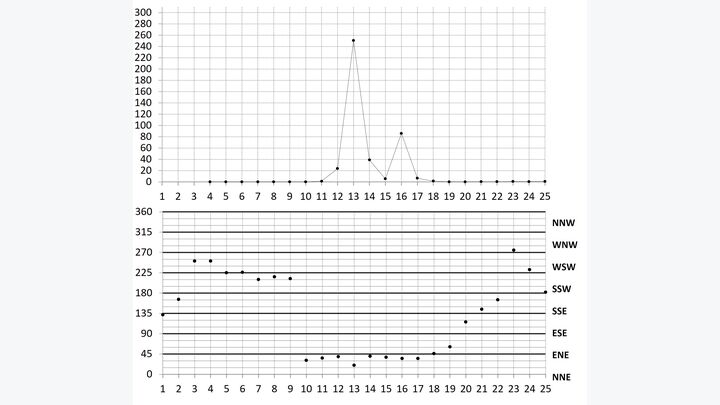
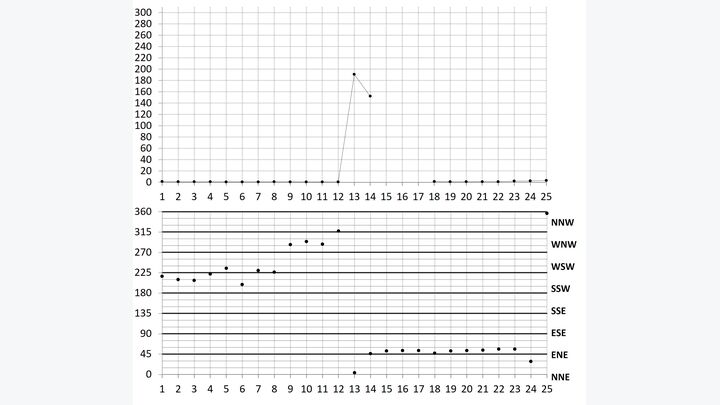
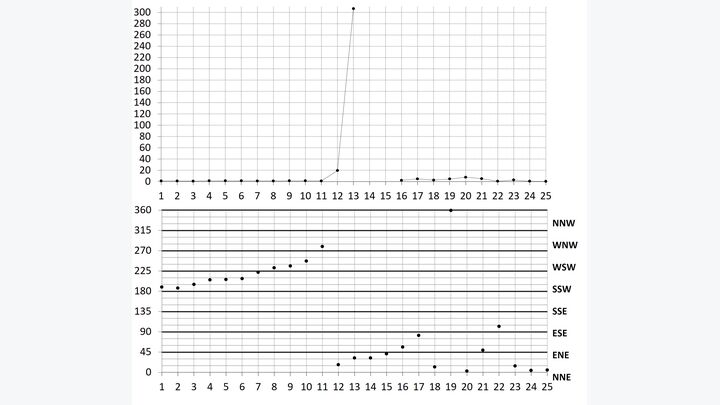
NNE winds ranging from N4E to N35E coincided with the 10 highest concentration peaks (Table 2, Figures 3 to 7). This range of wind directions straddles N14E, the linear direction from CAMS 1081 to the emissions stack at the mineral processing facility (Figure 1).
Figures 3-7
-

Figure 3 Hourly sulfur dioxide concentrations (top panel, x-axis in days, y-axis in ppb) and resultant wind directions (bottom panel, x-axis in days, y-axis in degrees clockwise from north) for November 2017 and September 2018 maxima.
-

Figure 3: Hourly sulfur dioxide concentrations (top panel, x-axis in days, y-axis in ppb) and resultant wind directions (bottom panel, x-axis in days, y-axis in degrees clockwise from north) for November 2017 and September 2018 maxima.
-

Figure 4. Hourly sulfur dioxide concentrations (top panel, x-axis in days, y-axis in ppb) and resultant wind directions (bottom panel, x-axis in days, y-axis in degrees clockwise from north) for November 2018 and March 2019 maxima.
-

Figure 4. Hourly sulfur dioxide concentrations (top panel, x-axis in days, y-axis in ppb) and resultant wind directions (bottom panel, x-axis in days, y-axis in degrees clockwise from north) for November 2018 and March 2019 maxima.
-

Figure 5. Hourly sulfur dioxide concentrations (top panel, x-axis in days, y-axis in ppb) and resultant wind directions (bottom panel, x-axis in days, y-axis in degrees clockwise from north) for June 2019 and September 2019 maxima.
-

Figure 5. Hourly sulfur dioxide concentrations (top panel, x-axis in days, y-axis in ppb) and resultant wind directions (bottom panel, x-axis in days, y-axis in degrees clockwise from north) for June 2019 and September 2019 maxima.
-

Figure 6. Hourly sulfur dioxide concentrations (top panel, x-axis in days, y-axis in ppb) and resultant wind directions (bottom panel, x-axis in days, y-axis in degrees clockwise from north) for August 2020 and October 2021 maxima.
-

Figure 6. Hourly sulfur dioxide concentrations (top panel, x-axis in days, y-axis in ppb) and resultant wind directions (bottom panel, x-axis in days, y-axis in degrees clockwise from north) for August 2020 and October 2021 maxima.
-

Figure 7. Hourly sulfur dioxide concentrations (top panel, x-axis in days, y-axis in ppb) and resultant wind directions (bottom panel, x-axis in days, y-axis in degrees clockwise from north) for December 2022 and January 2023 maxima.
-

Figure 7. Hourly sulfur dioxide concentrations (top panel, x-axis in days, y-axis in ppb) and resultant wind directions (bottom panel, x-axis in days, y-axis in degrees clockwise from north) for December 2022 and January 2023 maxima.
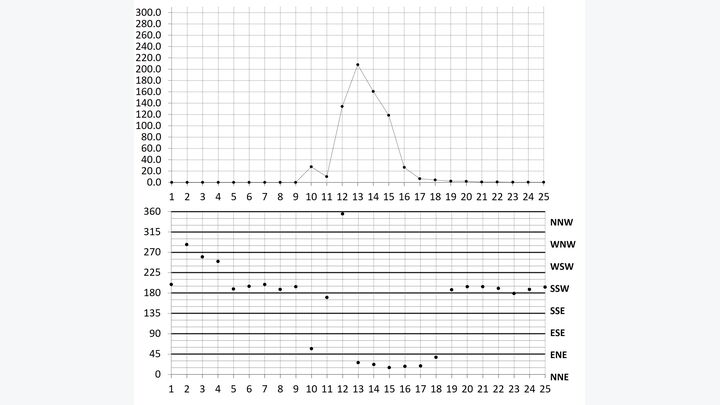
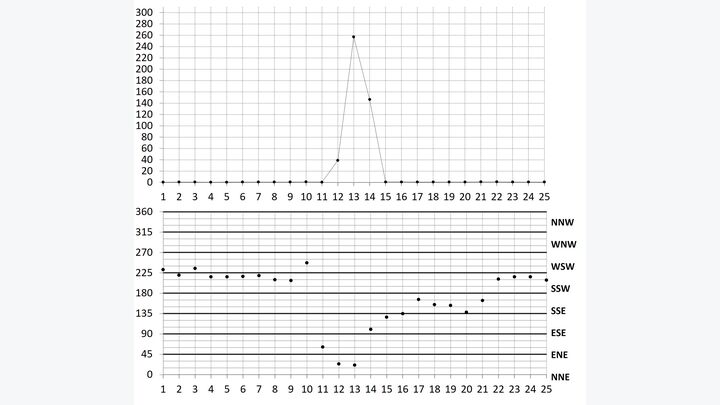
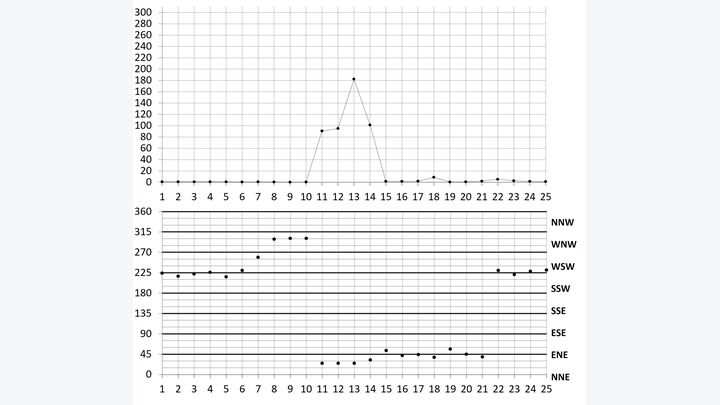
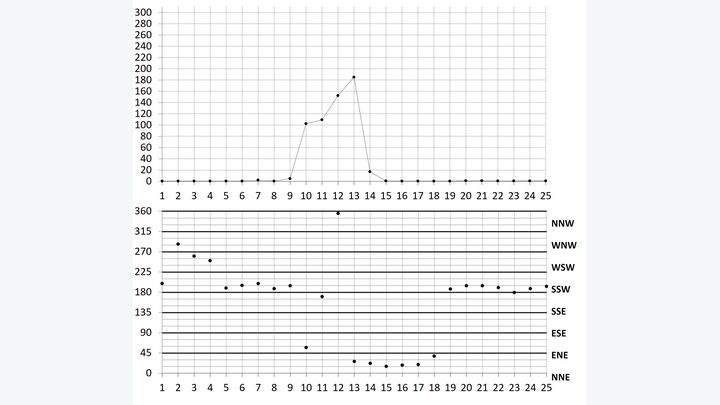
However, some of the data suggest a nonlinear pathway from the stack to the monitoring station. For example, in Figure 5 (top panel), small wind shifts within the NNE sector caused fluctuating sulfur dioxide concentrations. Highest concentrations coincided with approximately N30E winds, somewhat more easterly than winds associated with spikes in other time series. Winds coming from the north, moving through the source, and bending rightward into a N30E orientation could explain this anomaly.
Plume widening with dispersion also accounts for winds outside of N14E affecting sulfur dioxide levels at the monitoring station. For example, in Figures 4 (top panel), 5 (top panel), and 6 (bottom panel), sustained winds preceding concentration spikes were between N15E and N30E. Both buoyance at the emission source and air turbulence during transport affect plume dispersion (Borque and Arp, 1996).
Typically, winds moved from compass sectors with westerly components into the NNE sector to produce the peaks, followed by declining concentrations as winds shifted away from NNE (Figures 3 to 7). An exception to this tendency, sustained NNE winds in November 2018 produced the highest observed concentration over the data series (Figure 4, top panel). Another relatively high concentration among the 10 monthly maxima, in June 2019, was also associated with persistent NNE winds (Figure 4, bottom panel).
Peak duration—the amount of time concentrations stayed above background levels—ranged from approximately 4 to 21 hours for the 10 monthly maxima. Longer durations were associated with several hours of persistent NNE winds preceding and during a concentration spike, as in Figure 4 (top panel). In contrast, short-term winds arriving from the NNE produced shorter peak durations, as in Figures 3 (bottom panel) and 4 (bottom panel). Note that wind shifts do not necessarily follow the shortest line connecting neighboring points in the scatter plots. For example, in Figure 7 (bottom panel), from hours 9 to 10, winds likely shifted from SSW, through the NNE sector, and into (arriving from) the ENE sector to increase sulfur dioxide concentration at CAMS 1081.
Although concentration spikes illustrated above are noteworthy, more of them, with higher magnitudes, would likely register at a monitor located downgradient of the prevailing wind direction (SSE) in the study area. Various restrictions, especially property accessibility and a nearby lake, affected the actual location of the monitoring station (TCEQ, 2022).
Although this study involved sulfur dioxide and a mineral processing plant, the results have similar implications for strategic monitoring of other gaseous pollutants and sources, such as landfills and waste-to-energy facilities.
The results of this study have important policy implications for air monitoring. Brief concentration spikes, typically a few hours or less, indicate winds shifting into and abruptly out of the NNE sector. However, NNE winds are not frequent over a typical year in the study area. Monitoring around the source in a radial pattern, to include prevailing wind directions, would more effectively document sulfur dioxide concentrations in local airspace through time. Locating and maintaining conventional monitoring stations around stationary sources is not feasible in most cases, due to high costs and limited space; however, advances in drone technology (Jonca et al., 2022) may ultimately address this problem.
Although this study involved sulfur dioxide and a mineral processing plant, the results have similar implications for strategic monitoring of other gaseous pollutants and sources, such as landfills and waste-to-energy facilities. Landfills are perhaps most challenging, as gases from decomposing waste emerge through complex pore passages and cracks in cover material, rather than discrete smokestacks. Portable monitors and analyzers
Conclusion
The objective of this study was to evaluate temporal characteristics of spikes in sulfur dioxide concentration relative to shifting wind patterns near a stationary source over 75 months. There were 113 hourly exceedances of 75 ppb, a relatively small number considering the length of the data record. However, the monitoring station was not well positioned to detect spikes from prevailing wind modes. Concentration spikes coincided with various winds from the NNE sector, showing the effects of nonlinear travel and contaminant plume dispersion. Radial monitoring that includes predominant wind directions through stationary sources such could better characterize sulfur dioxide concentrations in space and time.
References
Borque, C. P. & Arp, P. A. (1996). Simulating sulfur dioxide plume dispersion and subsequent deposition downwind from a stationary point source: A model. Environmental Pollution, 91(3), 363-380.
EPA (2023). Our nation’s air: Trends through 2020. Retrieved from https://gispub.epa.gov/air/trendsreport/2021/#home
Hewitt, C. N. (2001). The atmospheric chemistry of sulphur and nitrogen in power station plumes. Atmospheric Environment, 35, 1155-1170.
IEM (Iowa Environmental Mesonet) (2023). Iowa Environmental Mesonet. Retrieved from https://mesonet.agron.iastate.edu/
Jonca, J., Pawnuk, M., Bezyk, Y., Adalbert, A., & Sowka, I. (2022). Drone-assisted monitoring of atmospheric pollution – A comprehensive review. Sustainability, 14(18), 1-31.
NWS (National Weather Service) (2022). DFW climate narrative. Retrieved from https://www.weather.gov/fwd/dnarrative
TCEQ (2022). Agenda item request for proposed state implementation plan revision. Docket No. 2022-0134-SIP. Retrieved from https://www.tceq.texas.gov/downloads/air-quality/sip/so2/navarro/21012sip_navarroadsip_propkg_web.pdf
TCEQ (2023). Air. Retrieved from https://www.tceq.texas.gov/agency/air_main.html