
Innovative solutions : Four waste management innovators make Time's top 300 inventions of 2025
Every year, the renowned Time magazine publishes a list of 300 remarkable innovations from all industries and areas of life. From aerospace to beauty, from medical and healthcare to, yes, parenting. And, most relevant for this publication: for reuse and recycling. This year, three representatives of the waste management industry made it on the list: AMP, Greyparrot, Glacier and VVater.
Amping up material recovery
US sorting specialist AMP impressed the jury with its AMP ONE. A full-scale facility solution to sort various material streams and capture more of the $300 billion in material value otherwise leaked to the environment, lost to landfills, or incinerated annually. CEO Tim Stuart explains: "By directly mining bagged trash, AMP can tap into the significant balance of commodities it contains. Even in many places with recycling programs, most recyclables never enter the recycling stream. But extracting material close to where it's generated produces significant transportation savings; it also allows access to the entirety of the material stream, not just what people place in their bins. Our MSW facility in Virginia is an industry first and a blueprint for other municipalities looking to reach ambitious diversion targets and preserve landfill airspace."
In short, AMP’s technology increases landfill diversion by enabling efficient, cost-effective recovery of recyclable material while reducing carbon emissions. The cost of landfill space and disposal transport are rising, and by increasing diversion, AMP effectively creates more space within current landfill footprints.
Filling a data gap
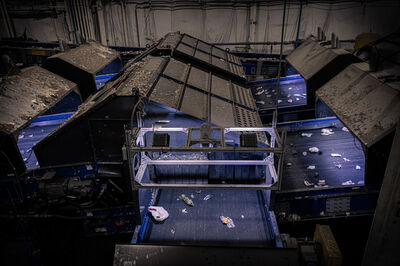
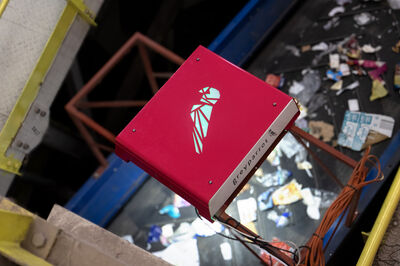
Another innovation that has the jury in raptures is the Greyparrot Analyzer, because this AI solution directly targets one of the major environmental challenges: plastic waste. Greyparrot Analyzer units are installed over conveyor belts in recovery facilities. The lightweight units are retrofittable, and their small form factor means that they can often be installed without requiring any adjustments to existing infrastructure. Furthermore, they integrate with third-party systems.
The units gather live data on the previously-invisible 99% of waste (they can identify 111 types of waste) passing through recovery facilities. Facility staff access previously-unavailable data using the Analyzer portal, which features live dashboards, historical trend analysis and a suite of reporting tools. Those features are transforming everything from day-to-day operations to long-term investment and maintenance plans, and commercial strategies.
“It’s very easy to simplify waste, but we live in a complex society with complex supply chains … the recycling industry gets criticised, but they are dealing with chaos”, says Ambarish Mitra, co-founder at UK-based Greyparrot. “AI was designed for this, to organise chaos into an understandable format.” CEO and co-founder Mikela Druckman emphasises the role AI plays for a circular economy: "AI is laying the foundation for circular decision-making. Data from waste is now flowing upstream to inform how products are designed, tested, and improved - closing the loop between packaging innovation and recyclability.”
US company Glacier also got recognised by Time for its AI-powered robots. They can identify more than 70 recyclable materials, and are being tested on bio-plastics.
Cleaner water through electricity
Wastewater treatment, on the other hand, is slowly catching up on modern trends and innovations. For the longest time the industry has relied on four methods: filters, membranes, chemicals, and biological processes. But the contamination landscape so to speak, has changed – think PFAS (“forever chemicals”), pharmaceutical residues and microplastics - and so the need for more innovative treatment methods. In comes VVater: Their Farady Reactor uses controlled electric fields to destroy chemicals, microplastics, and biological contaminants at the molecular level. “For a century, we’ve cleaned water by pushing it through filters, or membranes, and feeding it chemicals. We chose electricity instead. It’s cleaner, faster, and infinitely scalable”, said Kevin Gast, CEO of VVater, in a statement.
With innovative companies like these, the waste management industry's future looks bright indeed.