
Biowaste : From denial to detection: How biogas is confronting its methane problem
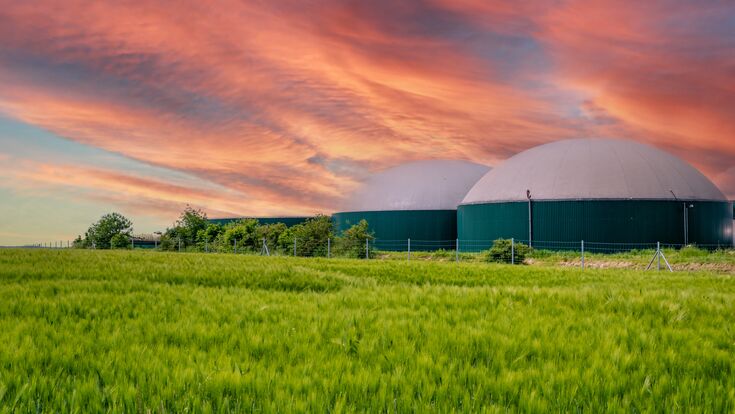
The cabbage leaves you throw away while cooking, the freshly cut grass from your garden and the manure from the neighbouring cattle farm: all could be turned into energy. Sustainable, locally produced energy. This is not a future prospect. It has been happening for many years.
Biogas and biomethane from various feedstocks – from biowaste to animal manure and crop residue – are a staple in the green energy toolkit. But, as the most recent report from the International Energy Agency (IEA), published last year, shows, they are a mostly untapped source. According to the report, only 5% of the potential sustainable feedstock is currently being used for biogas or biomethane production. If the potential is fully exploited, it is possible to achieve an equivalent of almost 1 trillion cubic metres of natural gas per year. This equates to a quarter of the world's current annual demand for natural gas.
The advantages of biogas and biomethane production are obvious: they are produced close to the source and close to where they are consumed. It creates jobs, especially in rural areas where jobs might be scarce. Co-products such as nutrient-rich digestate can be used as biofertiliser, replacing fossil-borne chemical fertilisers. And it reduces methane emissions from the agricultural sector.
But speaking of emissions: the report also identified the various barriers and challenges to biogas production. Apart from permitting, infrastructure and feedstock availability, one big challenge is methane leakage from biogas infrastructure. The exact greenhouse gas (GHG) that the technology aims to mitigate.
CO2 might be the most famous of the GHGs, but methane comes in a close second. And it has the remarkable property of being almost 30 times more potent than its counterpart CO2 over a period of 100 years.
According to the IEA‘s Outlook for Biogas and Biomethane, biogas and biomethane plants emit methane emissions in a range between 2% and 5% of their output. A closer look at European plants shows that 0.1–2.4% of methane escapes during feedstock handling, 0–12% leaks during biogas production, and an additional 0.2-10% is released during biomethane upgrading. The amount of leakage from digestate storage can vary significantly, ranging from 0.8% to 15%, depending on whether the digestate is stored in open conditions, such as in lagoons, or in gas-tight tanks. A high methane leakage rate could undermine some of the environmental benefits of biogas over fossil fuels, the report warns. (But it should be mentioned that some of the higher leakage rates came from older AD plants while newer and bigger plants showed better performance on methane leak mitigation.)
>>> Biomethane: The solution for Europe's energy independence?
Call for standardisation
“The findings from the IEA’s 2025 Outlook for Biogas and Biomethane were not unexpected,” says Charlotte Morton OBE, Chief Executive of the World Biogas Association (WBA), which also contributed to the report. Minimising methane leakage has long been a priority for WBA, she adds, “since the industry’s reputation and licence to operate depend on doing so.” The WBA has long been advocating for standardisation and therefore has launched the #MakingBiogasHappen Programme, encompassing a Global Biogas Regulatory Framework (GBRF) and The Anaerobic Digestion Certification Scheme International (ADCS Intl). The latter is the first global certification scheme dedicated specifically to enhancing the health, safety, environmental and operational performance of biogas plants, and “emphasises the risks that methane leaks pose both to the environment and to the financial performance of AD plants”. Because let’s face it: methane leakage means money lost. A recent financial analysis conducted by the WBA in the UK illustrates this clearly. “Assuming a biomethane injection rate of £6.69p/kWh – the standard support scheme rate in the UK – a large-scale plant producing 500m³ of biomethane per hour with a simple unrepaired leak of 5% could lose approximately £150,000 in annual revenues. For leaks exceeding 20%, the losses could surpass half a million pounds per year,” says Morton. “Methane is the product and so should be captured and used as a valuable resource to replace fossil methane.”

The super-emitters
A 2022 study by researchers from Imperial College London already pointed out that biogas and biomethane plants leak more than twice as much methane as previously thought.
A striking finding of the study is that just 5% of emitting sites are responsible for 62% of total emissions, mirroring “super-emitter” patterns seen in the fossil fuel sector.
“Super-emitters are typically a small number of sites responsible for a disproportionate amount of total emissions. The so-called ‘heavy tail’ of the distribution,” explains lead author Dr Semra Bakkaloglu. The reasons for leakage are “rarely about the technology type and more about operational management, for example operational instability issues like frequent start/stop and foaming,” she says. “Common culprits include pressure relief valves (PRVs) stuck open, poorly maintained digester covers or inefficient flare systems.”
The good news, according to Dr Bakkaloglu, is that super-emitter behaviour is highly preventable. “Regularly monitoring the site provides the opportunity for frequent inspection and the quick repair of point sources. Additionally, installing proper gas-tight covers helps to significantly mitigate emissions from digestate storage.”
>>> The challenges of financing methane mitigation in waste management

Monitoring best practices
The most effective approach to finding methane leaks is a layered one, Dr Bakkaloglu explains, built around a “detection, visualisation and quantification” workflow. The first step is screening: mobile surveys, site walkdowns and handheld gas detection instruments to quickly identify hotspots at the equipment level. Once a hotspot is found, an Optical Gas Imaging (OGI) camera pinpoints the precise source – “a loose flange, a degraded seal or a hairline crack in a membrane”. The final step is quantification, using tracer gas release or modelling-based approaches to measure emissions in mass units (e.g. kg/h) and understand the site's true climate impact.
“This ‘detection, quantification, decision’ framing has now become the standard for best-practice guidance across methane detection technologies,” she says.
The challenge is that many emissions are intermittent and event-driven, making them difficult to capture. Continuous monitoring is the gold standard but can be capital-intensive. A hybrid strategy, Dr Bakkaloglu argues, is currently the most practical and cost-effective alternative: vehicle-based or drone-mounted sensor campaigns to quantify plant-level emissions from above, complemented by OGI cameras to identify and quantify individual component leaks on the ground.
Where continuous monitoring is deployed, it should focus at a minimum on critical operational windows – feed loading, engine start-ups and shutdowns – when super-emitter events are most likely to occur. “This hybrid approach prevents small, intermittent failures from evolving into persistent, super-emitter-scale problems.”
Methane is the product and so should be captured and used as a valuable resource to replace fossil methane.Charlotte Morton, World Biogas Association
New tech is becoming standard
Every industry seems keen to keep developing new technologies to optimise procedures and workflows. But sometimes the biggest impact is not the technology itself but its implementation in day-to-day operations. “The biggest shift I've seen since my 2022 study isn't just new technology, but how that technology is finally moving from small pilots into real-world, everyday use,” says Dr Bakkaloglu. Chief among these developments is the integration of continuous methane sensors directly into SCADA (Supervisory Control and Data Acquisition) systems. “An operator doesn't have to check a separate app. Leak alerts pop up right on their main control screen alongside temperature and pressure data.”
On a larger scale, she says, remote sensing has matured rapidly. Drones, aircraft and satellites have brought transparency to an all-time high, and while platforms like MethaneSAT were originally designed for the oil and gas sector, the benefits are trickling down to biogas. “It's becoming much harder for super-emitters to go unnoticed when we have an eye in the sky providing that kind of data. It’s a very exciting time for accountability in the sector.”
Technology alone, however, only tells part of the story. The more significant shift may be cultural. “There was something of a watershed moment in 2025 regarding methane emissions and the recognition that fugitive emissions must be addressed as a matter of urgency,” says Morton. “The industry is clearly heading in the right direction.”
Dr Bakkaloglu agrees. “Since my study in 2022, the industry has moved past the ‘denial phase’ and is now focused on proactive mitigation. Operators are much more open to having their emissions measured. They want to know exactly where the leaks are happening and how to fix them.” Ultimately, she says, the industry is realising that methane leakage “isn't just an environmental issue – it's a loss of profit and a risk to their climate credentials”.
Setting the benchmark
Monitoring and detection are only meaningful if there is a clear target to work towards. So how low should the leakage actually be? “With rigorous application of current monitoring and LDAR programs, below 1% of total methane production is a realistic and achievable target,” says Dr Bakkaloglu.
Morton agrees that 1% should be the benchmark for best-in-class operators, though sets a slightly wider acceptable range. “Ideally, all AD plants should operate with zero leakage – not only to safeguard the environment but also to ensure optimal plant performance and revenue generation.” However, the operational reality is that small leaks do occur. For ADCS-certified facilities, she says, the aim is to keep emissions “as low as practically achievable, 1% or less”.
Since my study in 2022, the industry has moved past the ‘denial phase’ and is now focused on proactive mitigation.Semra Bakkaloglu, Imperial College London
Policy catches up
Technology and cultural change are not happening in a vacuum. The regulatory environment is shifting fast to match. Methane action plans are proliferating, emissions regulations are tightening, and clean fuel credits are increasingly tied to lifecycle carbon intensity – all of which make effective methane management a commercial as much as an environmental imperative, Morton notes.
Her advice to operators is straightforward: start by engaging with your local environmental agency. “These bodies exist not only to enforce regulations but also to provide guidance and support.” The upfront costs of a leak survey and repairs may give some pause, she acknowledges, but the business case is clear. “The cost of a survey and repairs for a medium-sized leak can typically be offset within just a few weeks of leak-free operations.” Facilities that invest in proper leak management, she says, will see returns not only in environmental performance, but on their bottom line.
How to become top of the class
Low-leakage facilities, “the sites that are really getting it right,” according to Dr Bakkaloglu, tend to share the same three qualities.
The first is an uncompromising attitude to containment. Nothing is left open to the atmosphere. “They use gas-tight, double-membrane covers, particularly on the digestate storage. A lot of people forget that even after the main digestion is done, that leftover material is still breathing out methane. The best sites catch every last bit of it.” The second is the mastery of the CHP engine performance – specifically the problem of methane slip at the exhaust. “These sites tackle that head-on. They might install a Regenerative Thermal Oxidizer or use advanced exhaust gas treatments to make sure no unburnt methane escapes. Those are really the two biggest leakage hotspots sorted right there.”
The third quality is harder to engineer but equally important: disciplined daily management. “They're obsessed with the health of their digester,” she says. “They optimise the process to maximise methane yield while working hard to avoid foaming, which is a nightmare for sensors and valves. By keeping pressure stable and measurements accurate, they avoid those accidental venting events that happen when a system gets overwhelmed. It's a mix of great engineering and really disciplined daily management.”
Scaling up without slipping back
The question hanging over all of this is whether the biogas industry can maintain its climate credentials while expanding rapidly. Dr Bakkaloglu is cautiously optimistic – but clear-eyed about the risks. “The short answer is yes, but it only works if we adopt a ‘measurement-first’ mindset from the start. If we scale up using the old ‘build it and forget it’ model – just assuming everything is airtight because it's new – we run a massive risk. High methane intensity could actually negate the carbon-neutral benefits that make biomethane so attractive in the first place.”
The antidote, she argues, is mandatory LDAR (Leak Detection and Repair) protocols and digital monitoring built in from day one, backed by regulatory and market incentives that reward measured performance rather than theoretical targets. “If we do that, biogas isn't just a renewable natural gas, it remains one of our most powerful, credible tools for a truly circular economy.”
What was once an inconvenient truth for the biogas industry is becoming a manageable reality. The monitoring tools are there, the frameworks are maturing, and – perhaps most importantly – the industry is now willing to use them. The task now is less about persuasion and more about making rigorous methane management universal, not just best practice among the leading facilities.