
Co-composting : South Tyrol's biogas plant leads digestate-to-compost pilot
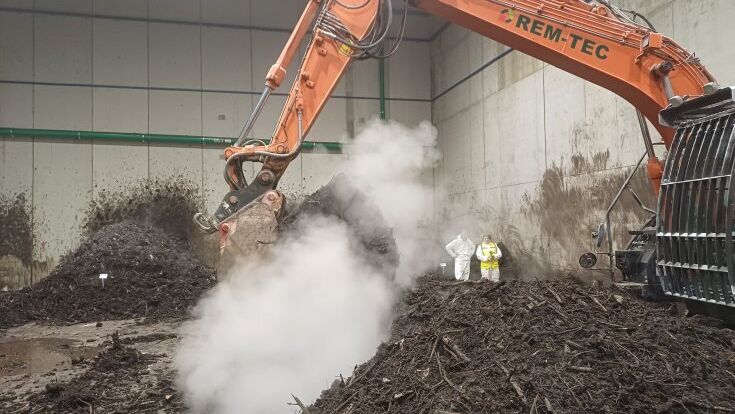
In South Tyrol, Italy, organic household waste has long been treated through anaerobic digestion, yielding both biogas and digestate. Until recently, this material presented a logistical and environmental headache for the province: with no local processing route available, the digestate from the Lana biogas plant was routinely transported outside the province for disposal. The result was high haulage costs, increased carbon emissions, and a missed opportunity to return valuable nutrients to local soils.
A new pilot project, developed under the EU Interreg Europe CORE (Composting in Rural Environments) programme, is seeking to change that. Now entering its second stage, the project is testing whether this overlooked fermentation residue can be reliably converted into high-quality compost fit for agricultural and landscaping use — right on the doorstep of where it is produced.
>>> Mixed results: Europe's patchy progress on biowaste collection
Putting post-composting to the test
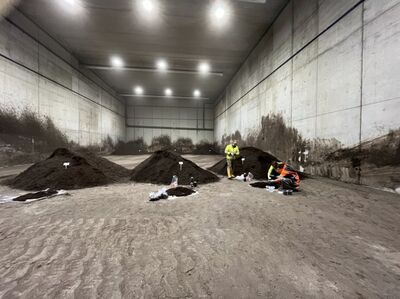
The first phase of the pilot has been completed successfully. Six experimental piles of co-composted material — combining digestate from the Lana anaerobic digestion facility with green waste such as grass clippings and urban greenery — were constructed and monitored over twelve weeks. Throughout that time, researchers tracked solids content, interstitial gases and emissions to build a detailed picture of how the composting process performs under controlled, indoor conditions. Unlike the open-air composting systems currently operating elsewhere in the province, the indoor approach offers tighter process control and significantly improved odour management.
On 2 February, the six compost windrows were screened, with the final samples now undergoing laboratory analysis. The results are expected to be reviewed in the coming weeks with project partners including BOKU Vienna, Vlaco — the Flemish organisation dedicated to closing the biological cycle — and the European Compost Network (ECN), which brings together more than 4,500 experts and plant operators across Europe representing over 45 million tonnes of biological waste treatment capacity.
Broadening the feedstock mix
Phase two of the pilot will expand the scope of the experiment considerably. Alongside the digestate from the Lana facility, researchers will introduce additional organic waste streams sourced from local fruit processing and beverage industries — materials such as pomace and diatomaceous earth that are currently also disposed of outside the province. By testing these inputs as co-composting substrates, the project aims to identify sustainable local solutions for multiple organic waste streams simultaneously, while assessing how different feedstock combinations affect the quality and consistency of the finished compost.
The composting protocol being developed will involve regular sampling and laboratory analyses throughout, with the ultimate goal of producing a replicable process that could be scaled and standardised. If successful, the intention is to mainstream the new model into the Waste Management Plan for the Province of Bolzano — the current version of which covers the 2021–2030 period — thereby normalising localised digestate recovery as standard practice across the region.
A circular economy ambition with regional roots
The CORE project, led by RSUSA (Waste Management Castilla La Mancha), brings together partners from eight European regions, including the LfU State Office of Environment Brandenburg, the Świętokrzyskie Region in Poland, the Municipality of Söderhamn in Sweden and the Region of Western Macedonia. Each partner is grappling with the challenges of managing biowaste sustainably in rural or low-density areas, where dispersed populations and limited infrastructure make centralised solutions difficult to implement cost-effectively.
The Bolzano pilot exemplifies one of the core ambitions of the CORE programme: that composting and anaerobic digestion need not be seen as competing technologies but as complementary ones. The fermentation plant produces energy in the form of biogas; the digestate it generates can, with the right post-treatment, become a valuable soil amendment — returning nutrients to local farmland and displacing synthetic fertilisers. Vlaco's experience in Flanders illustrates just how significant this market can become: through sustained quality assurance and strategic marketing, compost prices there have risen from an average of €3 per tonne to €6 per tonne, with demand growing steadily year on year across agricultural, substrate and carbon farming markets.
From waste stream to soil amendment
For South Tyrol, the stakes are both environmental and economic. The province's fruit-growing and beverage sectors generate substantial volumes of organic residues that currently leave the region for disposal. An inefficiency that carries both financial and ecological costs. By exploring whether these materials can be incorporated into a local composting stream alongside digestate, the pilot is working towards a model in which multiple organic by-products are retained within the region and valorised.
The CORE project has already facilitated a series of practical exchanges between partner regions — including a study visit to the composting facility in Egna and an "Open Doors" event at the Lana fermentation plant — building the kind of peer learning that underpins genuine policy change. With laboratory results from the first trial phase imminent and a second, more ambitious trial now underway, Bolzano's experiment in closing the loop on digestate stands as a compelling proof of concept for rural regions across Europe seeking to turn a costly waste stream into a circular resource.