
Women in Waste Management : Stamatina Vouyiouka is making polymers sustainable
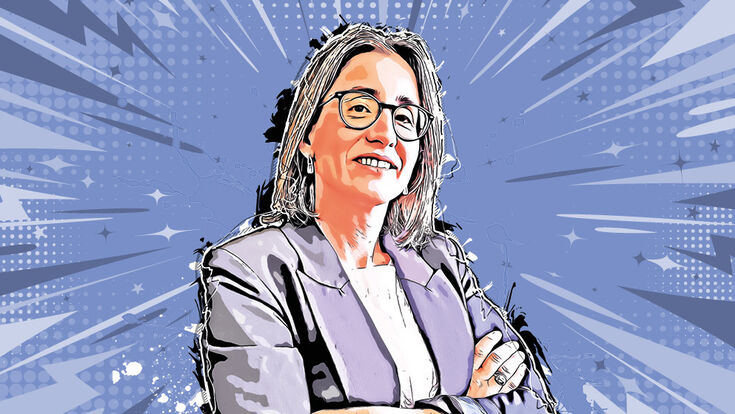
Sometimes a good book can change your life. This is certainly true for Stamatina Vouyiouka. When she read “Surely you’re joking, Mr Feynman!” by Nobel prize-winning physicist Richard Feynman, where he offers a humorous approach to science, focusing on the importance of curiosity, she was hooked. “I was already fascinated by chemistry and mathematics and how they can lead to practical solutions,” she explains. “But then I realised that knowledge is not everything. You need to be able to ask the right questions. And to be willing to just try things and have fun in the process.”
When it was time to choose her studies, she went for chemical engineering at the National Technical University of Athens (NTUA) because of its versatility – from energy and the environment to pharmaceutical materials – and the included societal impact. When she had to decide on her specialisation, she picked polymer engineering without hesitation. And she has stayed with it through all of her career now as a Professor at the School of Chemical Engineering at the NTUA, a position she assumed in 2009. “In our classes, we often joke that plastic is fantastic,” Stamatina says with a laugh. “But I honestly find polymers endlessly fascinating. They have a very high flexibility in what we call their structure-property relations. There is a wide range of plastics available today. That is because at a molecular level they are so flexible, which means you can tailor them exactly to a specific application.” Her enthusiasm is palpable when she talks about her chosen field. And when she speaks about teaching at her alma mater. “I enjoy it very much, and I feel lucky to have both the research part that also keeps my teaching up to date and the interaction with young people,” the 48-year-old says. The biggest challenge: Motivate the less interested ones. But, she explains, because of the current economy, the students are more engaged “because the environment is more competitive”.
She encourages all her students to go abroad, even for a short period of time. “I think this is particularly important if you want to remain in academia. Go to another university, work in the industry, leave the country if you can.” Stamatina went to Germany to work in the R&D department of the chemical company CIBA (now part of BASF) before she returned for her postdoc to Athens. “I liked it there, but I only learned enough German to order at a restaurant or to ask for directions,” she remembers, smiling.
I enjoy my work very much, and I feel lucky to have both the research part that also keeps my teaching up to date and the interaction with young people.
Researching sustainable plastics
Researching polymers nowadays also means diving deep into sustainability. This might sound strange but, as Stamatina explains, there are three very valid reasons why we need renewable resources for plastics. First of all, to fight plastic pollution, fossil-based materials need to be replaced by biodegradable ones. Second, fossil-based raw materials will be depleted, so it’s wise to find alternatives now. And third, the production and recycling of traditional plastics cause high GHG emissions which new, sustainable processes can help combat. And we cannot simply replace polymers altogether as they are essential to our daily lives. Think cables, for example.
So, what Stamatina does is try to find biobased materials that are compatible on a molecular level. Right now, she is involved in the Wood2Wood project, an EU-funded project that focuses on wood waste valorisation, from collection to recycling and recovery. Stamatina’s work is twofold. Find out if chemicals like additives and fillers derived from wood waste can be used in polymers. And combine the waste wood-derived chemicals lignin and cellulose with poly(lactic acid) (PLA), a well-known bioplastic from sugarcane or corn, creating sustainable biocomposites.
Working on such a big project that includes 25 partners from ten different countries is not always easy, Stamatina admits. Besides collaboration, a considerable amount of coordination is key to success. But all participants are extremely motivated. “It is also really enriching to work with people from many different disciplines,” Stamatina says.
Finding balance
The number of women in chemical engineering is growing. She estimates that about half of her students are female and – different perhaps to other industries – this is visible on the employment side as well. As for academia, she finds it a very supportive environment. “There is this active effort to be more inclusive,” Stamatina explains. Which is important, “especially in Greece where the role of the mother remains strong. In Greek families, women carry the biggest load when it comes to responsibilities at home”. Balancing both your professional and family life requires planning and support, says the mother of two teenage children, aged 15 and 12. And good communication with your partner. “We are constantly learning and evolving,” she explains. She and her husband can count on their parents to help. Nevertheless, it’s not easy. “The most important thing is to have the methodology,” Stamatina says, sounding very much like the university professor she is.
When she is not in the lab or the lecture hall inspiring her students about polymers, she can be found either cooking, which relaxes her, or going to a Pilates class to de-stress. “I also enjoy spending time with my friends and going for walks with my kids,” Stamatina elaborates. “And I make it a point to dedicate time to their study. As long as they let me,” she adds with a smile.
About: Stamatina Vouyiouka is a Professor in the School of Chemical Engineering at National Technical University of Athens (NTUA), Greece. She has received the Diploma Degree in Chemical Engineering and the Ph.D. Degree in Polymer Science and Technology from NTUA. Her research focuses on eco-friendly polymerisation processes, especially solid state polymerisation (SSP) and enzymatic polymerisation, with a focus on polyamides and polyesters, including biobased and biodegradable polymers. Her activities also deal with the sustainable management of polymeric materials, exploring material eco-design approaches and re/upcycling technologies towards value-added products. She lives in Athens, Greece, with her husband and their two children.