
Women in Waste Management : Julia Stadler: “Adapt and never stop learning!”
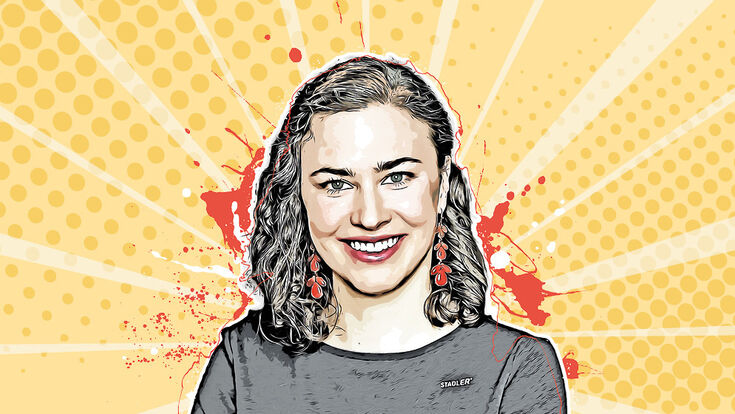
When your family owns one of the leading companies in the recycling industry, it is hard not to know at least a little bit about the sector. Inevitably, the topic comes up during family dinners. “It is impossible to not get a bit of an insight,” Julia Stadler says with a laugh. “During my last years at school, I also worked for the company twice a week and completed a longer internship while studying.” But there has never been any pressure on any of the three children – Julia has two younger brothers – to join the family business. And so, after completing her business studies, she started working at Boston Consulting Group (BCG). There, she mainly focused on strategy, innovation and digitalisation. “I learned a lot while working as a consultant. But as much as I enjoyed the work, I realised that what I really wanted was to be an entrepreneur,” Julia remembers. Thought and done: After several years in the consultancy business, she started her own company ‘Weitergründer’ together with another co-founder. It’s a company succession platform that operates similarly to a dating site. It uses value-based matching to suggest suitable successors to entrepreneurs. The company also provides support and counselling during the transition.
Changes ahead
Like for so many, the COVID-19 pandemic brought on some major changes in Julia’s life. Not right away, but when she left Berlin during the lockdowns to live close to the family headquarters in rural Altshausen, in Southern Germany, she not only enjoyed the country life but also found new appreciation for the family business. For the first time, she wanted to join the company. But it wasn’t until 2023 that she came to realise her plans. It was her wish to set up a Digital Solutions team to lead the company into the future. “As a consultant, I had supported various companies in setting up new digital business models, so I was able to put my experience and expertise to good use in this role. We developed customer-oriented software solutions for our sorting systems, which we now sell and install worldwide.” This team has been the greatest success she has had in her career so far, she says: “I loved building and leading it. We grew our digital turnover from nearly 0 to mid-seven-digit figures, and I am incredibly proud of that.”
>>> Katie Mallinson: "We need true diversity. Not just in terms of gender."
Change rarely ever goes from zero to 100 straight away. It's always a process. But if you have the right people in the team who want to help the company move forward — and fortunately, that's the case with us — then you can implement such developments.
The new Co-CEO
After two years as Chief Digital Officer (CDO) she took over the role of Co-CEO at the beginning of June at the age of 33. The management team of STADLER Anlagenbau now includes the two Managing Directors, Willi and Julia Stadler, as well as the Commercial Director, Claus Maier. “I am aware of the great responsibility,” she says. “We have around 600 employees in our company. And as a family business with a long history, I also feel a certain humility to work here. I see it as a great opportunity to be able to take on the responsibility to shape this company.”
One might think that within a traditional company it is harder to drive transformation. “Well, of course people are creatures of habit, and change is sometimes difficult,” Julia admits. “I think you have to weigh things up. Where would the shift make sense? I think it rarely ever goes from zero to 100 straight away. It's always a process. But if you have the right people in the team who want to help the company move forward — and fortunately, that's the case with us — then you can implement such developments.” If you take a look at the company’s history, it has repeatedly evolved its business models since it was founded over 230 years ago: “We started out as a blacksmith's workshop. Then, under my grandfather, we became a specialised metal construction company and then, under my father, we specialised in the construction of waste sorting systems. And there, too, evolution was always possible. That's why I'm optimistic that we have a very good basis for innovation.”
Family business
In her new role, Julia can rely on her father’s trust: “He gives me a lot of creative freedom. We complement each other. And I really see it as a gift to be able to spend so much time with my father.”
But being part of the family business also makes it harder to draw the line between work and spare time. To not discuss the business at the dinner table. “You have to make an effort, yes,” Julia admits. “Especially if some members of the family don’t work in the company.” She balances her stressful work life with sports. From yoga to going to the gym or skiing in winter: Julia likes to move. This allows her to be the leader she wants to be: “My management style is very people-oriented. I listen, challenge, encourage and demand personal responsibility and also try to create an environment in which innovation can develop.”
My management style is very people-oriented. I listen, challenge, encourage and demand personal responsibility and also try to create an environment in which innovation can develop.
More diversity
Julia Stadler remains one of the few women in leadership within the waste management sector. “Unfortunately, this isn’t unique to our industry. Unconscious and similarity biases still play a major role, with people often promoting those who resemble themselves,” she explains. “That’s why I think it’s all the more important to actively address this issue. In my experience, even a little diversity can make a big difference and really help open doors. I am optimistic, because more diversity has been proven to lead to more innovation and to higher profitability.” An argument every business-oriented mind should be able to agree with.
“I see growing female interest in the sector. While mechanical engineering still has low female enrolment, new process engineering and waste management programs are approaching 50:50 gender ratios. I'm confident we'll see greater industry diversity ahead.”
At STADLER, she aims to attract more female talent. With a female technical director, Julia Stadler encourages women to consider waste management careers: “The industry is incredibly exciting and also very practical. You can make a real environmental difference, and there's still much work ahead in the coming decades.”
This work will increasingly be AI-driven: “From predictive maintenance to self-controlling plants, there's huge potential, including robotics. I expect major changes in the coming years, especially for dangerous or monotonous tasks,” Julia believes. This, of course, also impacts STADLER’s workforce. “I think adaptability and a focus on lifelong learning will become increasingly important in the future.” She includes herself in this: “For me personally, it means constantly evolving, admitting what you don't know and staying motivated to learn new skills.”
About: Julia Stadler studied business administration at the University of Mannheim and the ESCP Business School in Paris, Madrid and Berlin. She worked as a consultant at BCG and philoneos and co-founded the succession-platform ‘Weitergründer’. She left the company to become Chief Digital Officer at STADLER Anlagenbau. As of June 2025, she is Co-CEO of the company.