WEEE : The Alchemy of Electronics: Extracting Gold from Waste
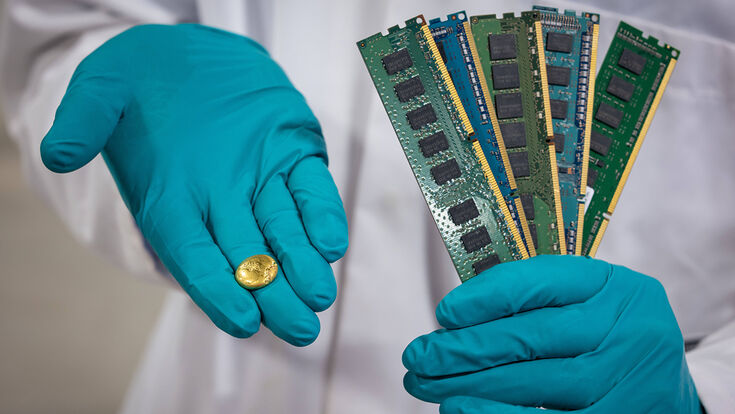
The Royal Mint, as you may know, is the official maker of coins in the UK. But the company with a 1,100-year heritage doesn’t just produce coins and medals. You can also get some pretty fine jewellery from the Royal Mint. And a not-so-small part of the jewellery collection is made from e-waste.
>>> Dutch researchers develop method to separate plastics from e-waste
WEEE: an enormous challenge for recyclers
As the fastest-growing domestic waste stream worldwide, expected to reach 82 million tonnes by 2030, Waste of Electrical and Electronic Equipment (WEEE) poses an enormous challenge to recyclers and a threat to the environment. The Royal Mint decided to do something about the problem.
Every discarded appliance contains valuable materials that should be put to good use. These materials include precious metals such as gold, silver and palladium. In fact, gold is found in much higher concentrations in e-waste than in raw ore. However, due to inefficient recycling processes, there is a risk that these materials remain 'trapped'.
So, the Royal Mint partnered with innovative companies to find a way to close the loop for e-waste. The result is a groundbreaking processing line built at the Royal Mint’s site in South Wales that extracts gold and other precious metals from printed circuit boards found in discarded electronics.
A groundbreaking process
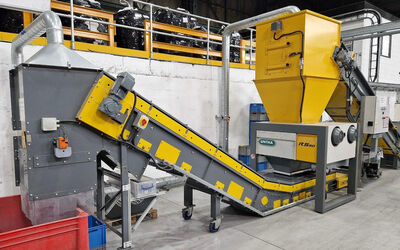
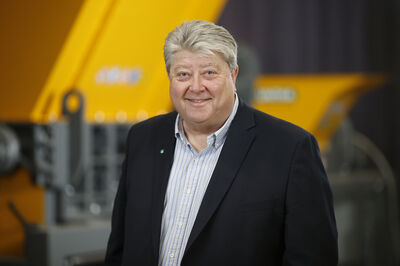
The process starts when circuit boards are put into a hopper. Then, a clever system of technologies, including conveyor belts, vats, ovens and three UNTHA RS30 shredders, takes over. The UNTHA machines break the circuit boards down into precise granulate particles, ensuring that the metals and non-metals are effectively separated for further treatment. The shredding specialist is excited to be part of this pioneering endeavour, as Gary Moore, sales director at UNTHA UK, enthusiastically explains: “What began as a single enquiry for an RS30 shredder quickly evolved into a game-changing collaboration with a number of engineering specialists. Now, three UNTHA machines lie at the heart of one of the most advanced e-waste processing facilities in the world.”
After shredding, the material is subjected to a succession of sophisticated procedures with the objective of optimising the level of recovery. Non-metallic components are further processed into building materials. Base metals are extracted and sold to refiners, while gold-laden fragments are treated with a patented chemical technology by Canadian clean-tech company, Excir.
A low-energy chemical solution
Conventional methods of gold extraction are extremely energy-intensive and rely on toxic chemicals or high-energy smelting. Excir, on the other hand, developed a recyclable, low-energy chemical solution that works at room temperature to quickly and efficiently extract gold from e-waste. In just minutes, the solution selectively leaches out more than 99% of the gold. The gold is then turned into a fine powder, filtered, dried and finally heated in a furnace to produce pure gold nuggets ready for reuse. Thanks to the new process, the Royal Mint can now recycle over 4,000 tonnes of circuit boards annually, extracting up to 450 kg of gold – worth about £33 million (€42 million, as of May 2025).
The Royal Mint is breaking new ground with this first-of-its-kind facility that is changing how sustainable precious metals are produced.
In cooperation with UNTHA.