
Waste-to-Energy : Turning waste into climate action: Kanadevia Inova bets big on carbon capture
Waste-to-Energy plants sit at an awkward intersection in the climate debate. They provide an outlet for non-recyclable waste that would otherwise need to go to landfill, but combustion means emissions, and in an era of net-zero commitments, emissions need answers. Governments across Europe and beyond have classified WtE as a hard-to-abate sector, as one that cannot be stopped and where no other technological solutions with lower climate impact are available. Carbon capture – separating CO₂ from combustion flue gas before it reaches the atmosphere – is increasingly the answer regulators and operators are settling on. When paired with geological storage, it holds out the possibility of a facility that removes more carbon than it releases.
This is the space where Kanadevia Inova, the Zurich-headquartered green tech and engineering specialist, is making its most ambitious move. With decades of experience in WtE plant design and a proprietary carbon capture technology already validated at pilot scale, the company is now pushing for full-scale deployment – and the UK is where it begins. “We’ve focused on an implementable solution based on proven technology, amending the Waste-to-Energy plant to not only capture CO₂ effectively but to do so with minimal impact on overall performance,” says Kai Lieball, Director Decarbonisation at Kanadevia Inova.
How amine scrubbing works
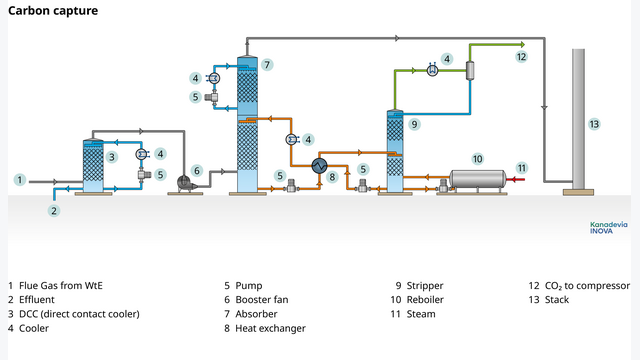
At the heart of Kanadevia Inova’s carbon capture innovation is amine scrubbing, a chemical absorption process well suited to WtE flue gas. The principle exploits the mildly acidic nature of CO₂: when cooled flue gas is passed through an absorber column containing an amine-based solvent, the CO₂ binds to the solvent and is stripped from the gas stream. The loaded solvent is then pumped to a stripper, heated to release a concentrated CO₂ stream, cooled and returned to the absorber. A closed loop that minimises solvent consumption and ensures continuous operation. The captured CO₂ can then be compressed, liquefied and purified for geological storage or industrial use.
A key advantage of the system is its compatibility with existing infrastructure. The carbon capture unit is designed to integrate into the WtE plant without forcing a wholesale redesign of the combustion and energy recovery systems already in place. “Each project comes with its own specific boundary conditions and challenges. Our system is designed to consider all points, including variability of flue gas emissions inherent in Waste-to-Energy plants. Thus, we ensure long-term stable capture performance,” Lieball explains.
Protos: from pilot to full scale
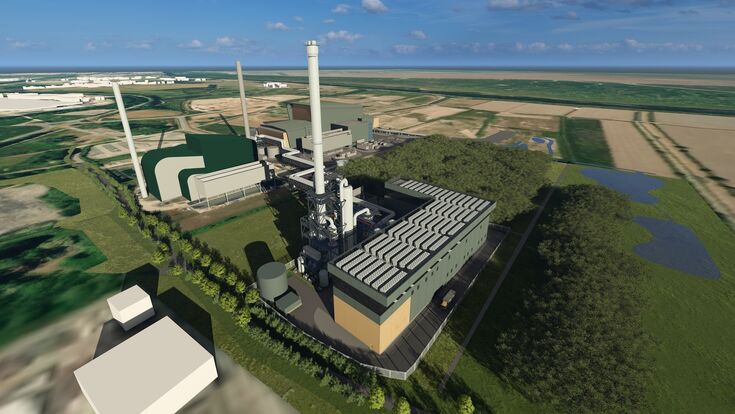
The clearest proof of Kanadevia Inova’s capabilities is taking shape near Ellesmere Port in Cheshire. In October 2025, the company received a Notice to Proceed from long-term partner Encyclis to design and build the first full-scale carbon capture system integrated into a UK Waste-to-Energy facility: Protos Energy Recovery Facility (ERF). Acting as Engineering, Procurement and Construction (EPC) contractor, Kanadevia Inova will install a two-line amine scrubbing system adjacent to the operational plant. Once commissioned, it is designed to capture around 370,000 tonnes of CO₂ per year – a mix of biogenic and fossil CO₂ released during the combustion of non-recyclable waste. The distinction between the two matters. Capturing fossil CO₂ prevents emissions that would otherwise be new additions to the atmosphere. Capturing biogenic CO₂ – derived from organic materials in the waste stream such as paper, food and wood – goes a step further, removing carbon that was already part of the natural cycle. It is that combination which allows Protos to move beyond net-zero and qualify as a genuinely carbon-negative facility.
The captured CO₂ will not simply be stored on site. It will flow via pipeline into the HyNet Northwest decarbonisation network and be permanently sequestered in depleted gas reservoirs beneath Liverpool Bay. This combination of active capture and secure storage is what will transform Protos from a low-emission plant into a carbon-negative one.
Protos did not emerge from nowhere. It builds on two earlier pilot projects: mobile, containerised capture units at Ferrybridge ERF and at Rookery South ERF, each capable of capturing around one tonne of CO₂ per day. Real operational data was gathered and process parameters refined ahead of full-scale deployment. These pilots were the foundation – generating the engineering confidence and client trust that a project of this scale demands. Construction is now underway, with handover to Encyclis scheduled for mid-2029.
From Cheshire to the world
As the first full-scale CCS project at a WtE facility in the UK, Protos is a reference point. It demonstrates that decarbonising hard-to-abate sectors is not just technically feasible but deliverable within realistic commercial and regulatory frameworks. As emissions regulations tighten and more WtE operators seek net-zero pathways, Kanadevia Inova’s model – proprietary amine scrubbing technology combined with full EPC delivery capability and a proven track record from pilot to full scale – positions it squarely to serve growing demand across multiple markets. “One of the most important lessons from the pilot plants was how critical operational flexibility is in real-world conditions. The data we gathered allowed us to fully understand system responsiveness that among other elements was crucial for the design of the Protos facility,” says Lieball.
Carbon capture was once considered a speculative future addition to WtE operations. At Protos, it is becoming infrastructure. And for Kanadevia Inova, it is becoming a defining business. One built on patient innovation, rigorous pilot work and the engineering confidence to go big.
In cooperation with Kanadevia Inova.