Circular Economy : Driving the circular transition: EU Projects unite at Ecomondo
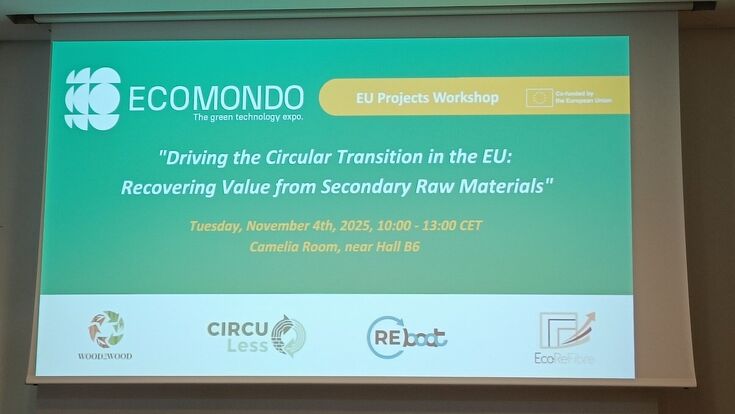
Every November, the Italian coastal city of Rimini transforms from a summer holiday destination into the epicentre of Europe's circular economy conversation. At this year's Ecomondo, five ambitious EU-funded projects gathered to demonstrate that the future of waste management isn't about disposal, but transformation.
The session "Driving the Circular Transition in the EU: Recovering Value from Secondary Raw Materials" brought together researchers, industry leaders, and innovators behind Wood2Wood, CIRCULess, ReBoat, EcoReFibre, and Bio4EEB. Over three hours, these projects revealed a common mission: keeping materials in circulation for as long as possible, reducing Europe's dependence on virgin resources, and building resilience in the face of global supply chain uncertainties.
Tackling Europe's largest waste stream
Construction and demolition waste represents a staggering challenge—and opportunity. Accounting for 25-30 per cent of all waste generated in the EU, or roughly 450-500 million tonnes annually, it's the continent's single largest waste stream. Yet much of this material, particularly wood and mineral waste, ends up incinerated or sent to landfill rather than being recovered.
Wood2Wood is taking aim at this problem head-on. The project is developing a comprehensive framework to transform unused wood waste from construction, demolition, and furniture into valuable products. Alessandro Pracucci, representing the project, explained their multi-pronged approach: advanced automated sorting systems, innovative processing techniques that separate lignin and cellulose nanofibers, and the creation of new panel products, including solid and honeycomb panels suitable for use as façade materials.
"The key concepts are design for recycling," Pracucci emphasised during the panel discussion, noting that products today are "extremely complex, designed for comfort and safety. But we must keep thinking about this: can we reuse the panel once it is removed?"
The project has already demonstrated promising results. Performance benchmarking shows that Wood2Wood panels align with conventional products in terms of effective sound absorption. However, challenges remain in scaling up manufacturing processes and securing reliable material supplies. As Pracucci noted during the discussion, the issue isn't sorting—that works. The critical bottleneck is "material supplies. Establishing sustainable material supply chains with similar materials. And how to scale up the manufacturing process."
Making the invisible visible: MDF's untapped potential
While Wood2Wood tackles mixed construction waste, EcoReFibre has zeroed in on a specific, massive problem: medium-density fibreboard (MDF) waste. Represented by Duarte Carvalho of the European Panel Federation and Omar Degoli, the project confronts a stark reality: Over 60 million tonnes of fibreboard waste have been generated in Europe over the past five years, yet "until now mostly energy recovery" has been the fate of this material.
"MDF is not only renewable, it is recyclable. The recycling is technically viable and economically feasible," the presenters declared, challenging the waste management status quo. The project is developing cutting-edge sorting lines and extraction technologies to recover fibres and fines from post-consumer MDF, with the ambitious goal of substituting up to 25 per cent of virgin fibres currently used in European fibreboard manufacturing.
The numbers are compelling: with the MDF market in the EU standing at about 50 million tonnes annually, even reaching a 10 per cent recycled content target could mean 4-5 million tonnes of material diverted from incineration. "This is a contribution in terms of competitiveness, making better use of your resources—a boost for competitiveness," Degoli emphasised, noting the growing competition for wood resources. "We're facing a growing amount of post-consumer wood in the future, with upcoming regulations."
The barriers aren't trivial: regional disparities in collection systems, competition with energy recovery, and questions of economic viability all loom large. But EcoReFibre's lesson is clear: "We need reliable feedstock to scale up and we need to improve the waste stream quality," and crucially, "the policy alignment: to prioritise material reuse over premature energy recovery."
Beyond buildings: Rethinking mineral and timber together
CirculLess, presented by Sotirios Grammatikos, takes an even broader view, addressing both mineral (concrete) and timber-based waste from construction and manufacturing. The project stands out for its embrace of digitalisation as a key enabler of circularity.
"What direction should one take when faced with timber or concrete waste?" Grammatikos asked rhetorically, describing CirculLess's digital waste management platform as providing decision-making support for industry players navigating an increasingly complex landscape of materials and regulations.
Early highlights include impressive technological innovations: a pixel-level material sorting robot, robotic lines for defects identification, and reclaimed cross-laminated timber using finger-joined and block systems. But the project's ambitions extend beyond technology to market transformation.
"Materials need to be used as long as it took time for it to grow," Grammatikos noted, pointing out that in Scandinavia, where 90% of construction uses timber, the material eventually becomes waste but "needs to become material again." Yet paradoxically, "circularity of timber in northern countries is not a huge topic, because [it's] better available"—suggesting that abundance can breed complacency.
The Grammatikos emphasised that "digital tools enhance circularity but you need to know how to use them," and stressed that "cross collaboration is key as well as standardisation. The early involvement of end-users and designers improves outcomes."
Innovation afloat: Solving islands' seasonal waste crisis
Among the five projects, ReBoat stands out for its focus and ingenuity. Led by Omar Maschi and coordinated by Politecnico di Milano, this tourism-focused initiative addresses a problem familiar to anyone who's visited Mediterranean islands during peak season: waste management systems overwhelmed by visitor influxes.
Islands face unique challenges: peak times during tourist seasons, insufficient stability of waste volumes, illegal dumping, and limited land for waste management facilities. ReBoat's solution? A mobile, modular sorting, recycling, and reprocessing plant on a boat that can travel to islands during peak periods, handling waste where and when it's needed most.
The project is piloting in three locations—Greece's Ionian Islands, Italy's Aeolian Islands, and Portugal's Azores—with a strong emphasis on community engagement and co-creation with local stakeholders.
"The biggest stakeholders are the consumers, the citizens," Maschi noted with deliberate emphasis. "They have to understand what is happening to their waste; they need to help change the system." The project's replicability potential extends far beyond its pilot locations, offering a model for remote areas worldwide facing similar seasonal waste pressures.
Nature's insulation: From beach to building
Bio4EEB, represented by Eva Coscia, takes a fundamentally different approach from its sister projects. Rather than focusing on waste recovery, it promotes bio-based materials from natural sources, specifically Posidonia oceanica (Neptune seagrass) that accumulates on Mediterranean beaches.
The project is developing insulation panels from this seagrass to reduce energy demand in building renovations. Real-life demonstration cases across Europe are feeding data into a comprehensive platform, while Life Cycle Assessment analysis compares these new materials with traditional insulation options.
"We're not focusing on waste but reusing materials from nature," Coscia explained. "These materials will also become waste. Our aim is to be able to reuse as much as possible. If that does not work, recycle. You have to have a holistic approach." The project aims to "increase circularity and reduce the carbon footprint" through this nature-based strategy.
However, Bio4EEB faces unique stakeholder challenges. "Stakeholders are oftentimes reluctant to switch to new materials," Coscia acknowledged. Sometimes, even environmental NGOs create obstacles: "They don’t want us to use Posidonia, because it is part of the ecosystem,"says Coscia, despite the project using only beached material that municipalities would otherwise dispose of. The lesson: " the need to engage local operators, communities, and governments."
The panel discussion: Charting a path forward
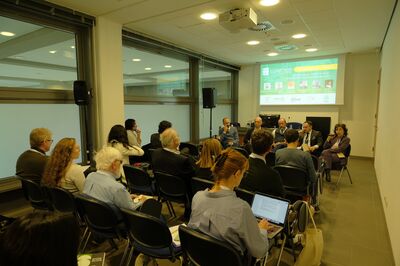
When moderator Abhimanyu Chakravorty brought the presenters together for a panel discussion, the conversation quickly moved beyond individual projects to address systemic challenges facing Europe's circular economy transition.
The standardisation puzzle
Asked how harmonised standards could help create a sustainable market in the EU, the panelists expressed unanimous agreement on their importance—along with considerable frustration about current gaps.
The CirculLess’s Sotirikos Grammatikos emphasised that standardisation is absolutely critical to scaling circular solutions. Eva Coscia from Bio4EEB explained they're actively working on standardisation and certifications to create clear knowledge about testing protocols. "We need these so that new materials can be easily compared to traditional materials," she noted, adding that significant gaps remain and the sector is still waiting for new standards to emerge.
The ReBoat’s Omar Maschi highlighted that textiles remain poorly structured in terms of waste management, requiring clearer standards for both collection and performance. A key concern was that EU countries aren't aligned on these issues, making homogeneous standardisation across borders essential.
Omar Degoli from EcoReFibre offered a nuanced perspective from the wood sector. While there's considerable talk about harmonisation, he argued attention should focus on making it easier to recycle products in the first place. "We need to ban materials that make recycling difficult," he suggested, "and create clear divisions between what should be burned and what should be recycled." The goal is to establish a market that can function seamlessly across borders.
Alessandro Pracucci from Wood2Wood added a practitioner's frustration: many companies simply don't know which standards apply to their situation. Part of the solution lies in terminology—shifting from "waste" to "post-consumer materials" or "discarded materials" could help improve how standards are understood and applied. But the proliferation of standards creates its own problems. When different materials are governed by different standards, comparing them becomes nearly impossible. He added: "There are just a lot of standards out there."
Engaging stakeholders: Change management at scale
The question of who drives project impact and how to create genuine engagement revealed the deeply human dimension of circular economy transformation.
Coscia acknowledged that stakeholders are often reluctant to switch to new materials. The key is encouraging them to explore something different while recognising that true sustainability requires sourcing materials locally. This means engaging not just businesses but local operators, communities, and governments in the process.
Grammatikos struck a pragmatic note: while opening innovation to the public has value, what matters most is getting stakeholders to actually take technologies to market. This requires convincing timber and cement producers to adopt recycled materials, building collaborations with waste management companies, and understanding that solutions must be tailored to different countries—one-size-fits-all approaches simply won't work. He emphasised thinking ahead about what policies will be needed to support these transitions.
Pracucci highlighted the challenge of change management. "How do we inform stakeholders about the achievable results?" he asked. "We need to explain the opportunities and advantages of new processes and products." The reality that construction companies are often small operations adds another layer of complexity. The lesson that resonated across all projects was clear: local solutions matter, and there's no universal template for success.
Maschi put it most directly: "The biggest stakeholder is the individual citizen. They have to understand what is happening to their waste, and they need to help change the system."
Money, markets, and mandates
As the discussion turned to economics and policy, the energy in the room intensified. Multiple speakers emphasised that for secondary raw materials to drive real change, they must be profitable, not just environmentally sound.
Coscia urged that public authorities must demonstrate commitment by preferring solutions that use secondary raw materials. "We need to make this more normal," she argued. Another suggestion that gained visible support was adding Extended Producer Responsibility (EPR) as a tool to help finance solutions that are almost—but not quite—economically viable on their own.
The conversation about textiles revealed how mandatory recycled content requirements could facilitate market transformation. The underlying message was clear: voluntary approaches have their limits. Sometimes regulation provides the necessary push to overcome market inertia and level the playing field.
Looking five to ten years ahead
Asked about the legacy they hoped to leave and how to scale for the future, the projects balanced ambition with realism.
Pracucci emphasised thinking beyond individual initiatives. "We cannot think only about our own project," he noted. "Success means scaling up to the market level and establishing best practices that others can follow."
Grammatikos focused on the accessibility of CIRCULess’ digital infrastructure. Building the platform is challenging work, he acknowledged, but once complete, it will be easy to use. Their vision is ambitious: "All wastes should be found there"—a single digital hub for waste management decision-making across Europe.
Bio4EEB’s Eva Coscia raised a fundamental question: how do we effectively engage the public and municipalities in this transition? Her concern highlighted that technological solutions are only part of the equation—behavioural and institutional change matter just as much.
The vision that emerged from these exchanges was of an interconnected ecosystem where materials flow seamlessly through multiple life cycles. Achieving it will require not just technology but digital infrastructure, clear standards, supportive policies, and deeply engaged communities working together.
The bigger picture
As the session concluded, participants Alessandro Pracucci, Omar Degoli, Sotirios Grammatikos, Omar Maschi, and Eva Coscia found common ground in a fundamental principle: materials must remain in the loop as long as possible. This means not just a second life, but a third, a fourth, indefinitely if possible.
Yet achieving this vision requires more than technology. It demands creating sustainable value chains from production through multiple life cycles. It requires policies that prioritise material reuse over energy recovery. It needs standardisation that enables rather than hinders innovation. And it depends on engaging everyone from municipal authorities to individual citizens.
One phrase kept recurring throughout the afternoon: "design for recycling." Whether discussing wood panels, MDF, concrete, or bio-based insulation, the imperative was the same—products must be conceived from the outset with their next life in mind.
Europe's circular economy transition is happening, project by project, innovation by innovation. But as these five initiatives demonstrate, the technical solutions are increasingly ready. What's needed now is the political will, market structures, and cultural shift to deploy them at scale.
The conversations in Rimini's Camelia Room on that November day weren't just about waste management—they were about reimagining our relationship with materials, resources, and the planet. In that sense, Ecomondo delivered exactly what its name promises: a vision of an eco-world, one recoverable material at a time.