
Artificial Intelligence : Remote waste challenge gets AI-powered solution
Kefalonia is an idyllic island in the Ionian Sea, just west of the Greek mainland. Its inhabitants love its sandy bays and dry, rugged landscape. And in summer, so do quite a few tourists – although the island is lucky enough to have been spared mass tourism. In recent years, the number of permanent inhabitants has also grown. Thanks to the extensive digital connectivity of our modern world, long-term digital nomads settle on the biggest Ionian island.
But, as we all know, people generate waste, and so even the most picturesque island has to deal with mundane tasks such as waste management. However, in such decentralised settings, the traditional "centralised" waste management systems become less efficient due to increased transportation costs.
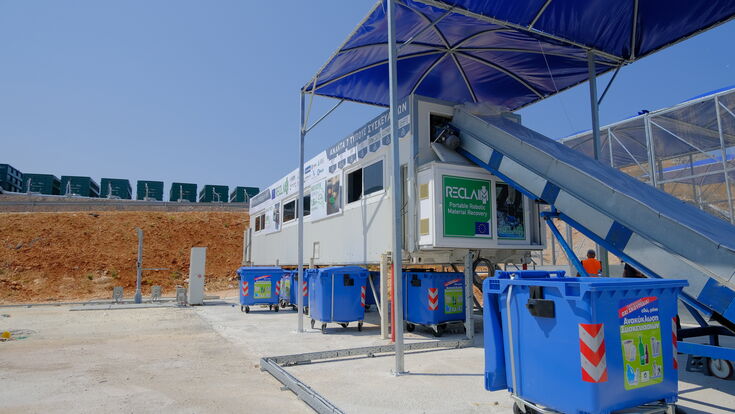
This challenge became the catalyst for one of Europe's most innovative waste management solutions. The EU-funded RECLAIM project has developed a revolutionary portable, high-tech Material Recovery Facility (prMRF) that has been tested in real-world conditions on Kefalonia. Today, this Greek island is not just a tourist destination – it's the testing ground for technology that could transform how remote communities worldwide handle their recyclable waste.
>>> Using AI to boost Europe's critical raw materials supply
AI robotics transform waste sorting
The RECLAIM project's prMRF represents a paradigm shift from the "collect, transport, sort centrally" model that has dominated waste management for decades. Instead, this cutting-edge system brings the sorting facility directly to where the waste is generated, employing artificial intelligence and robotics to achieve what was once thought impossible: industrial-grade waste sorting in a compact, portable format.
Picture a standard shipping container that can be transported by truck, positioned at a local waste collection point, and immediately begin processing mixed recyclables with the precision of a full-scale industrial facility. This isn't science fiction – it's the reality being tested daily on Kefalonia, where tourists and locals alike contribute to the waste stream that feeds this remarkable machine.
"The Greek state is keenly anticipating the results of prMRF's deployment in Kefalonia, aiming to leverage its success in shaping effective policies for managing municipal recyclable waste in island regions," explains Manolis Grafakos, Secretary General for Waste Management Coordination of the Ministry of Environment and Energy.
The numbers speak for themselves. The integrated prMRF system can recover seven distinct types of materials – PET, PE, PP, PS, aluminium, carton packaging and ferrous metals – achieving an impressive 120 picks per minute. This performance level means the system can meet the daily waste sorting needs of a community of approximately 20,000 people, making it perfectly suited for island municipalities and other decentralised locations.
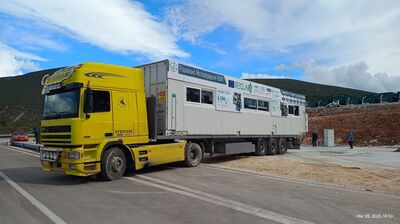
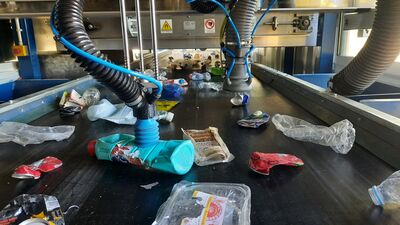
What makes this achievement even more remarkable is the challenging environment in which it operates. Island waste streams are notoriously variable – pristine recyclables mix with sandy containers from beach visits, while seasonal tourism creates dramatic fluctuations in both volume and contamination levels. Traditional centralised sorting facilities struggle with such inconsistency, yet the prMRF maintains its high performance standards regardless of these real-world complications.
The technology behind the revolution
"AIMPLAS brings a holistic view to the project, with a strong focus on circularity and sustainability," explains Javier Grau Forner, Recycled Mechanical Researcher at AIMPLAS. The technological institute's expertise in plastic recycling and separation technologies has been crucial in defining the prMRF's requirements and monitoring its performance against key indicators throughout the project.
At the heart of this innovation lies a sophisticated dual-vision system that combines AI-powered computer vision with hyperspectral imaging (HSI) technology. The development of this system was coordinated by FORTH-ICS, with Project Coordinator Michalis Maniadakis explaining: "FORTH developed an innovative technique that combines categorisation results from both the visible and infrared (HSI) spectrum, significantly improving the accuracy of waste classification. This included the introduction of a novel method for generating synthetic waste images to enhance the performance of deep learning models."
"HSI technology works by analysing materials' chemical composition stored in hypercube image structures, rather than the image itself," explains Poojan Timisilna, Innovation Manager at IRIS Technology Solutions. "The system achieved over 94% waste material classification accuracy, ensuring efficient recycling of waste in remote locations with accuracy levels equal to or better than conventional industrial recycling plants."
This remarkable accuracy is achieved even under challenging real-world conditions – variable conveyor speeds, temperature changes and dirty surfaces that would typically compromise sorting performance. The secret lies in the system's robust training: chemometric models were developed using waste samples from different countries and locations, then validated on realistic waste flows with mixed materials and surface contamination.
Low-cost robots improve ROI
The prMRF's game-changing economics come from its five custom-built Robotic Recycling Workers, designed specifically for waste sorting applications. "These purpose-built robots not only help keep the overall implementation cost of the prMRF at an affordable level, but also significantly enhance its waste sorting capacity," notes Fredy Raptopoulos, Robotics Engineer at ROBENSO.
Unlike expensive industrial robots designed for delicate manufacturing tasks, these low-cost sorters are optimised for one thing: picking waste efficiently. Equipped with pneumatic actuators and interchangeable grippers, they deliver what the industry desperately needs – a high number of successful waste picks per euro invested.
KU Leuven's research team took this efficiency even further by developing novel scheduling algorithms that help robots intelligently decide which piece of waste to target next. "This leads to a much lower time required to pick a sequence of objects while maximising the grasp success rate, which leads to higher system performance," explains Jef Peeters from KU Leuven's Manufacturing Processes and Systems department.
Real-world validation
The prMRF's development wasn't conducted in isolation. The Hellenic Recovery Recycling Corporation (HERRCO), as Greece's accredited Producer Responsibility Organisation for packaging waste, provided crucial real-world validation. "Throughout the pilot deployment phase, HERRCO conducted a series of structured on-site inspections to evaluate key aspects of the unit's performance, including material purity, composition accuracy and sorting efficiency," reports Vasilis Makridis, HERRCO's COO.
This end-user perspective proved invaluable, particularly in understanding how the system performs under the seasonal pressure observed on Kefalonia during summer months when tourist populations surge.
Portable MRF applications beyond islands
While Kefalonia serves as the perfect testing ground, the prMRF's applications extend far beyond island communities. Its portability and compact design make it ideal for transportation hubs like airports and train stations, as well as venues for large-scale social or athletic events – enabling practical Zero Waste strategies in these demanding settings. Consider the logistical nightmare of managing recyclables at a major sporting event or music festival. Traditional approaches involve collecting mixed waste and transporting it hundreds of kilometres to central facilities, often resulting in contamination and reduced recovery rates. The prMRF could be positioned on site, processing recyclables immediately while maintaining the quality standards that make recovered materials truly valuable to secondary markets.
"The deployment of state-of-the-art, fully automated robotic sorting systems for recyclables can captivate citizens, inspiring greater engagement and participation in recycling efforts," observes Yiannis Razis, General Manager of HERRCO.
The potential for broader deployment is already generating interest. Discussions are underway with mountain municipalities in Italy and stakeholders at the new Heraklion Airport, suggesting the technology's appeal extends well beyond its island origins.
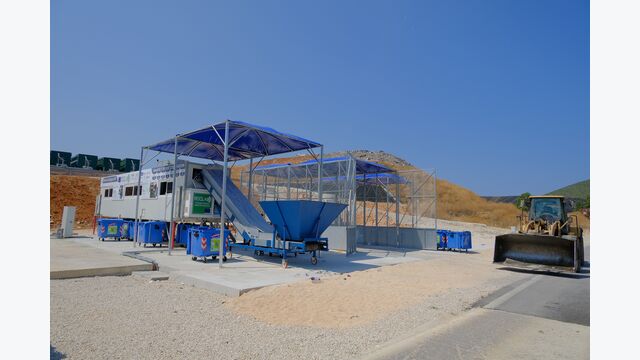
The prMRF is suitable for many remote locations.
- © Abhimanyu Chakravorty/ISWAGamification engages citizens in recycling
Innovation in the RECLAIM project extends beyond hardware. The Institute of Digital Games from the University of Malta developed the Recycling Data Game, a gamified application that not only teaches users about recycling but also crowdsources valuable training data for the AI systems. "The game shows facts and questions about recycling but also shows the actual conveyor belt images that RECLAIM's waste sorting robots see," explains Antonios Liapis, Associate Professor at the Institute of Digital Games, and the game's developer.
This citizen science approach allows every participant to create new data for AI systems to become smarter and better at sorting waste items specific to their local area – a brilliant example of how technology can democratise environmental action.
Business case for decentralised recycling
From a business perspective, the prMRF addresses a critical gap in the waste management market. Myrto Pelopida, Business Innovation Manager at AXIA Innovation, conducted a comprehensive financial analysis demonstrating the system's cost-effectiveness and market potential. The modular approach also opens up opportunities for commercialising individual innovations, such as the bi-modal waste classification technology and the low-cost robotic sorters.
George Iliopoulos, President of the Hellenic Solid Waste Management Association, sees broader implications: "Integrating fully automated waste sorting units with cutting-edge smart bin technology creates a highly efficient system that maximises recovered material purity and significantly enhances the value of recyclables."
Commercial deployment plans underway
As the prMRF continues its real-world evaluation on Kefalonia, the project team is already identifying areas for improvement in the system's next version. The results will offer valuable insights into deploying upgraded versions in alternative locations, with commercialisation efforts potentially extending to individual innovations within the integrated system.
For Kostas Komninos, Managing Director of local government development organisation DAFNI, which represents 52 island municipalities, the significance is clear: "It's remarkable how the unique geographical characteristics of islands and the specific needs of small communities shaped the RECLAIM research direction, ultimately inspiring the creation of prMRF."
The RECLAIM project demonstrates how European research excellence can address daily challenges while delivering benefits for the environment, society and economy. By bringing industrial-grade waste sorting to remote and decentralised locations, the prMRF doesn't just solve a logistical problem – it opens up new possibilities for local circular economy development, job creation and sustainable waste management practices.
In an industry often characterised by incremental improvements, the prMRF represents a genuine breakthrough. From the beaches of Kefalonia to airports worldwide, this technology promises to make efficient, high-quality material recovery accessible wherever it's needed most. For waste management professionals, the message is clear: the future of decentralised material recovery isn't coming – it's already here, being tested under the Mediterranean sun.