Business Talk : SWANA CEO Amy Burke on RCon's launch, PFAS solutions, and why the industry is more than just waste collection
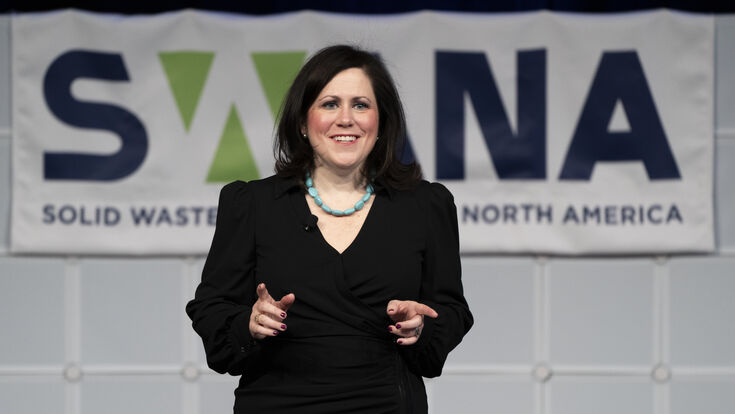
Can you share one specific achievement from your tenure as CEO that has had the most measurable impact on SWANA members?
We have been focused on updating and enhancing our education offerings. SWANA courses and certifications are respected throughout the industry, giving professionals the expertise they need to excel in their daily work. Many job descriptions will actually include a SWANA certification as a required or preferred qualification.
We are in the process of reviewing and updating SWANA’s most popular courses to keep them current and include the latest insights. I’m proud of our newest course, Essential Leachate PFAS Treatment and Management Training for Landfill Professionals, which was developed in response to member demand for more education on PFAS treatment and regulations. The new course gives landfill personnel insights into leachate management and treatment options and requirements. It provides in-depth information on PFAS destruction technologies, leachate treatment system selection, and emerging regulations on PFAS.
First debuting in October, the PFAS course has now been held several times and has been providing valuable information to course attendees. We look forward to holding it in person at RCon in November.
How have SWANA's membership composition or engagement patterns changed during your leadership, and what does this tell us about the industry's evolution?
It’s important to get out and engage with members to hear how SWANA currently benefits them and what opportunities we have to provide further support. Since I started as CEO, I have been traveling to chapter conferences throughout North America. While each chapter is unique in its culture and areas of focus, one thing they all have in common is there is no substitute for the in-person connections. While virtual events and webinars certainly continue to play a key role, members want to engage in person. You never know who you will meet by attending an event, and the conversations you may have to give you new ideas or solutions. Having a place for in-person engagement is critical. At the same time, members are connecting through online trainings, committee and workgroup meetings, MySWANA, an online community, and webinars, which allows year-round engagement. The bonus of online events is you engage with the same individuals across different workgroups, so once you do come together in person, you already have those connections, and they become even stronger.
I have also met many young professionals who are entering this industry because they care about the environment, and they want to play a role in supporting sustainability and environmental protection. This reflects how waste management itself is evolving into resource management. Our members are environmental stewards, even if they might not always think of themselves that way. We have long been focused on supporting young professionals and new professionals entering the industry, and we will continue to do so.
>>> Critical decisions ahead: New SWANA report addresses aging WtE infrastructure crisis
What makes SWANA uniquely valuable compared to other waste industry associations, and how do you communicate that differentiation to potential members?
SWANA is unique because we bring together so many diverse stakeholders. This includes public and private sectors, as well as nonprofits and academic. Anyone can join SWANA, so we have a really diverse and unique mix of professions, representing all sectors of the industry. The wide range of SWANA’s Technical Divisions, groups organized around industry sectors, exemplify the many different jobs and skillsets of our members.
When members engage in SWANA committees or events, they interact with people they might not normally meet, across functional areas, giving them the opportunity to learn from one another and to expand their own professional networks.
For example, last year we created the SWANA Lithium-Ion Battery Workgroup in response to concerns about batteries starting fires. Lithium-ion batteries in the household trash and recycling streams are causing fires, creating a huge safety risk for our workforce, who we want to make sure returns home at the end of every day, causing costly property damage, and resulting in rising insurance rates. In order to bring members together on this issue, we created the workgroup, which has three sub-workgroups, with the goal of looking holistically at the issue.
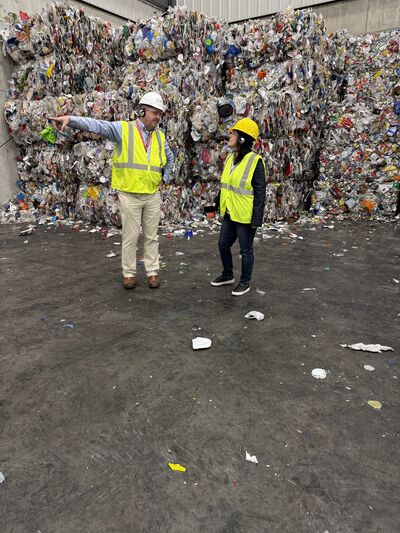
Members of the workgroup come together virtually each month to share their challenges and solutions, and to compile and create resources to support the industry. So, someone in Florida who is interested in advocating for battery EPR in their state can learn from someone in Illinois who has already carried out this successfully. Or someone in Texas can compare their safety protocols with someone in Maine, so they can both gain ideas and learn.
SWANA combines subject matter expertise, safety leadership, and professional development in one place. When members join SWANA they have the opportunity to advance their own careers and to influence the entire industry’s direction. If you want to make the industry safer, more efficient, and more sustainable, you can’t do it alone. SWANA provides that community and forum for sharing ideas.
How do you balance advocating for industry interests while also pushing members toward more sustainable practices?
Our members work every day to manage waste safely and responsibly, whether that means collecting recycling, designing an engineered landfill, setting up a landfill gas-to-energy system, establishing food waste collection, or operating a waste-to-energy facility. SWANA provides the resources to help our members excel at what they do, through training, networks, and knowledge of new equipment and technologies to advance sustainable practices, as well as supporting policies to enable their work.
We advocate for policies to recognize the realities of our operations and allow efficient and effective processes. For example, we are advocating for legislation that would grant a narrow exemption under CERCLA for the operations we refer to as passive receivers, entities that do not create PFAS, but do accept waste that contains it. In order for landfills and other facilities to continue operating effectively, they need assurances that they will be protected from liability as long as they are operating responsibly and within their permits.
SWANA has advocated for policies that would provide funding support for recycling and composting infrastructure and resources, fire detection and suppression systems, and safe collection of batteries and electronics.
It’s important to get out and engage with members to hear how SWANA currently benefits them and what opportunities we have to provide further support.
Regarding PFAS regulations: What's the most practical advice SWANA is giving members right now, and where are you seeing the biggest compliance gaps?
Start learning about PFAS treatment technologies today, and start budgeting. If facilities wait too long to start financial planning, they may have difficulty implementing solutions once mandates are in effect.
First you need to understand the treatment options available, then you need to decide what is the best fit for your situation and start planning for it, financially and operationally. SWANA’s new course, Essential Leachate PFAS Treatment and Management Training for Landfill Professionals, is a good place to start.
Many SWANA members are proactively implementing PFAS treatment technologies, and that allows them to pilot different options and see the effects.
I wouldn’t necessarily say there is a compliance gap. The gap is more in that we need more research and data to measure amounts of PFAS and understand their impacts.
>>> PFAS in Waste-to-Energy facilities: A burning question
Are there specific EPR models SWANA supports or opposes, and what evidence drives those positions?
We were proud to release new guiding principles and a technical policy on EPR this past October. SWANA sought feedback from many different stakeholders through SWANA’s Sustainable Materials Management Advocacy Committee to prepare the documents to cover all types of material management. The EPR guiding principles prioritize advancing safety, bringing all stakeholders to the table, striving for commonality, being based in data, having dedicated funding, protecting current systems, and prioritizing sustainability in covered materials.
Our joint policy statement with the National Waste and Recycling Association (NWRA) on battery EPR speaks to the need to have policies that support the safe collection and management of batteries. SWANA has advocated for battery EPR and other supportive policies at the state level, in coordination with our chapters.
Beyond traditional recruitment, what unconventional strategies is SWANA testing to address workforce shortages?
Part of our strategic plan is to promote professional development opportunities, and we recently led a great workshop with key association leaders to come up with ideas to attract individuals to the industry, which includes raising awareness of all the important work we do. SWANA has been highlighting the work of our members, including in aspects like natural disaster recovery, community relations, and innovative safety programs. These stories help foster pride in the industry. Learning from other industries and associations on best practices and ideas for workforce recruitment has been helpful. We are focusing on opportunities for women, veterans, and youth.
How is SWANA helping smaller operators access and evaluate new technologies without getting overwhelmed by vendor promises?
There are many technologies and services available, so we make sure our conference trade show provides a variety of solutions for our members to explore. We offer the opportunity for service providers to hold catalyst sessions during RCon, where they discuss and demonstrate their solution in an educational low-pressure environment. In addition, our webinars and technical division meetings offer the opportunity to learn about technologies and to engage with colleagues to hear about what solutions they are trying.
The rebrand from WASTECON to RCon represents more than just a name change. What specific programming or format changes will attendees notice, and what member feedback drove these decisions?
I am so excited about our new conference, RCon. In less than a year, we conceived, built, and launched RCon, our new flagship experience debuting this November in Columbus, Ohio. Member input directly informed the change, even down to the name. Our board of directors took time during board retreats to envision the goals for RCon, young professionals provided their recommendations for a new conference name, and we had several member focus groups to further brainstorm experience, structure, and design.
Members told us they wanted more choice, more collaboration, and a bigger ‘wow factor.’ At RCon, attendees can build their own schedule from technical deep dives to leadership sessions, SWANA courses, peer roundtables, facility tours, and co-located partner events. For the first time, we will hold tours throughout the week so attendees can get out and about to experience state-of-the-art facilities in Columbus. There will also be ‘surprise and delights,’ unexpected, thoughtful experiences provided to attendees to create memorable, positive, long-lasting impressions.
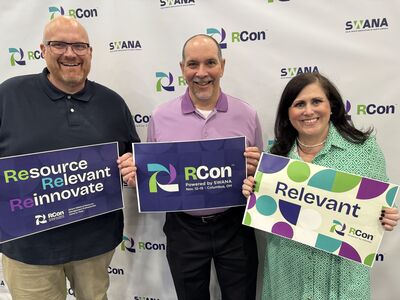
In order to provide the opportunity to attend SWANA training courses, we will be offering two of our longer courses as hybrid options at RCon. The hybrid format allows course participants to complete some of the work in advance, followed by in-person learnings and facility tours, allowing enough time to still attend all of RCon.
Registration for RCon opened earlier this year, and we’re already seeing greater registration and exhibitor numbers than we have for past events. RCon is designed to give each attendee the experience they are seeking, full of opportunities to expand their knowledge and community. It’s the first time everyone will be a first-time attendee, which changes the energy and levels the playing field.
Which emerging technology do you think is overhyped in waste management right now, and which is underappreciated?
If you don’t have the training and capacity to fully use the technology, it will not reach its promise. Sometimes an organization will start using a new technology, thinking it will solve all their challenges, but if it is not fully developed, or if you do not have the data or in-house capacity in place, its potential will be limited.
Underappreciated technologies relate to batteries and fires. We are at a point where every vehicle and facility needs protection from fires. Fire detection and suppression systems are very effective but not all facilities have been able to afford them. In addition, technologies that detect lithium-ion batteries are becoming more efficient. More funding opportunities are needed to help facilities invest in systems that detect batteries and detect and suppress fires. Fire prevention technologies are proven to save lives, reduce insurance costs, and prevent catastrophic facility damage, yet they’re often seen as optional upgrades, when they should be seen as another piece of essential equipment.
>>> The Hidden Danger: Li-ion Batteries as Fire Hazards in Waste Management Facilities
Our future workforce will need to interpret data, manage technology vendors, work with regulators and legislators, and communicate with the public about sustainability.
Describe the waste management professional of 2035: What will their typical day look like, and what skills will be most critical?
As I speak with members and go on site visits to see their daily work, I’ve observed how things are always changing in this industry. It’s important to stay humble and not assume you know it all, and to be open to new technologies and new ways of doing things. Ten years from now, AI will be an even more integral component in our daily work, and we’ll be utilizing newer technologies for MRF sortation, for landfill gas systems, for curbside collections, and every other part of the industry. We need to leverage these technologies to improve industry safety.
It will be important to have a multi-faceted skillset, with the ability to have strong technical skills along with strong communications skills. Our future workforce will need to interpret data, manage technology vendors, work with regulators and legislators, and communicate with the public about sustainability.
What aspect of waste management do most people misunderstand, and how do you explain it to sceptics?
This industry is so dynamic and there is always more to learn. Many people only see the truck that comes to collect materials from their home, and they don’t think beyond that, but there is so much that goes on behind the scenes. The industry is supported by many different roles, from planners to public outreach, to engineers, to operators. We need to tell the story that this is an interesting and very technical industry.
Our work keeps communities safe, protects public health, provides energy, and drives circular economies. Without this industry, society literally stops functioning.
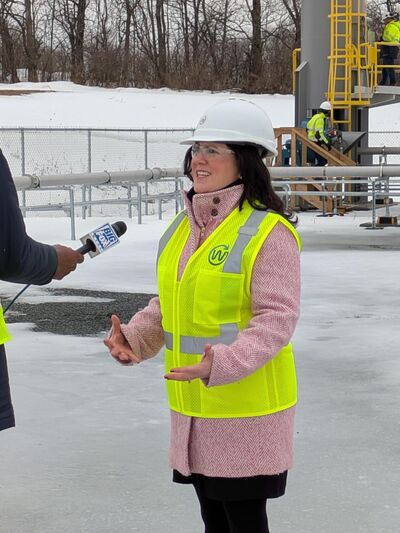
Our work keeps communities safe, protects public health, provides energy, and drives circular economies. Without this industry, society literally stops functioning.
Looking back, what's one decision as CEO you'd handle differently, and what did you learn from it?
In a previous executive director role (before joining SWANA), I underestimated how critical it was to bring key stakeholders along the way when I initially introduced a major cultural transformation across the organization. My intent was to shift from a risk-averse, siloed mindset to a more agile, collaborative, and innovation-driven culture. I moved quickly, thinking bold top-down direction would inspire momentum. But without enough early alignment and ownership at multiple levels, we experienced resistance that slowed progress.
What I learned and applied as CEO at SWANA is that sustainable change doesn’t happen just through vision—it happens through engagement. As a change leader, it is not only about challenging norms but also about building coalitions, listening deeply, connecting with chapters, and creating space for people to adapt at their pace. Since then, I’ve prioritized more co-creation, clearer communication of the ‘why,’ and building steps along the journey to show the value of transformation. That shift in approach has made our change efforts at SWANA more inclusive, resilient, and successful.