
Waste-to-Energy : Putting CCUS on the map
High-emission industries are currently focusing on carbon capture, usage and storage, CCUS for short, as a key technology. No wonder, given that decarbonisation technologies are seen as essential to achieving net-zero.
Here’s a quick overview of how carbon capture works: Conventional post-combustion technology uses a solvent that traps the CO₂ contained in the WtE flue gas within its molecular structure in the absorber column. The CO₂-rich solvent then enters the desorber (or stripper) column, where it is subsequently heated. This stage of the process requires the most energy. Here, the CO₂ is boiled off and released at the top of the column, where it is trapped separately. Finally, the lean solvent is returned to the absorber column to repeat the CO₂ capture process.
But the capturing process is only just the beginning. CO2 can be stored underground in various types of deep geological formations, whether onshore or offshore. This method involves converting CO2 into a liquid by putting it under high pressure and injecting it into rock formations.
As for CO2 utilisation, the market is currently small and limited but has potential for growth. It is mostly employed for the production of synthetic fuels but can also be used as a feedstock to produce chemicals such as methanol and urea, for carbonated beverages, building materials or as a growth enhancer for algae, to name a few.
Carbon capture is gaining ground globally, with 669 CCS facilities now in operation – 275 in the U.S., according to the Global CCS Institute. While Waste-to-Energy (WtE) ranks tenth among industries exploring the tech, it's moving fast to catch up.
In Europe, CCUS is becoming a cornerstone of climate strategy, with targets to capture 50 million tonnes of CO₂ annually by 2030 and 280 million by 2040. WtE is now in the spotlight alongside heavy emitters like steel, cement and chemicals, as policymakers and industry players push for shared CCUS hubs that link capture sites with pipelines and storage.
Early success stories highlight the benefits of clustering and scale. Financial tools like Carbon Contracts for Difference and modular capture tech are helping lower risks. The message is clear: WtE + CCUS is no longer fringe – it’s a key part of Europe’s climate playbook.
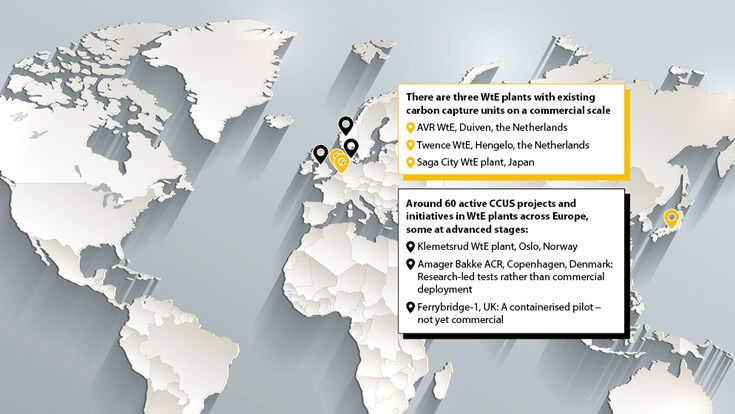
There are three WtE plants with existing carbon capture units on a commercial scale
- AVR WtE, Duiven, the Netherlands
- Twence WtE, Hengelo, the Netherlands
- Saga City WtE plant, Japan
Around 60 active CCUS projects and initiatives in WtE plants across Europe, some at advanced stages:
- Klemetsrud WtE plant, Oslo, Norway
- Amager Bakke ACR, Copenhagen, Denmark: Research-led tests rather than commercial deployment
- Ferrybridge‑1, UK: A containerised pilot – not yet commercial
- Oslo retrofit: A planned, Frontier-funded CCS retrofit aiming for ~350 kt/year from around 2029