
Plastic Waste : Flexible plastics: Recycling's hardest problem finally has some answers
Why has flexible plastic become such a critical waste challenge, given that it represents over 50 per cent of global plastic packaging?
Flexible plastics are woven into the fabric of modern life. From the pouch that keeps coffee fresh to the stretch film that secures pallets for shipping, these lightweight, versatile materials serve functions that rigid alternatives often cannot. They extend food shelf life, protect goods in shipment and offer a highly convenient packaging option for consumers.
Yet these same benefits create significant challenges for managing flexible plastic waste. As a result, the vast majority of flexible plastics currently end up in landfills, incinerators, or leak into the environment.
What makes flexible plastics particularly difficult to recycle compared to rigid plastics?
Unlike rigid plastics, which are typically made from a single type of polymer, flexible plastics such as films, wraps, and pouches are typically constructed from multiple layers of different polymers, adhesives, inks, and barrier coatings. This multi-material, multi-layer structure makes it extremely difficult to separate and process the individual components effectively, creating challenges for all recycling technologies.
Recycling flexible plastic waste back into higher-value film applications also requires feedstock of exceptional quality and consistency, which mechanical recycling struggles to provide. While chemical recycling offers a pathway to better-quality outputs, it is hampered by greater production costs and regulatory uncertainties.
The current cost advantages of producing virgin resin over recycled flexibles present a significant hurdle, limiting investment and capacity expansion of flexibles recycling. Consequently, recycling of flexibles today is primarily channelled into applications such as plastic lumber, other construction materials, or trash bags and bin-liners.

The report emphasises "segregated waste collection and granular secondary sorting" as critical enablers. Can you explain how digital watermarking and AI-based recognition technologies are changing the sorting landscape?
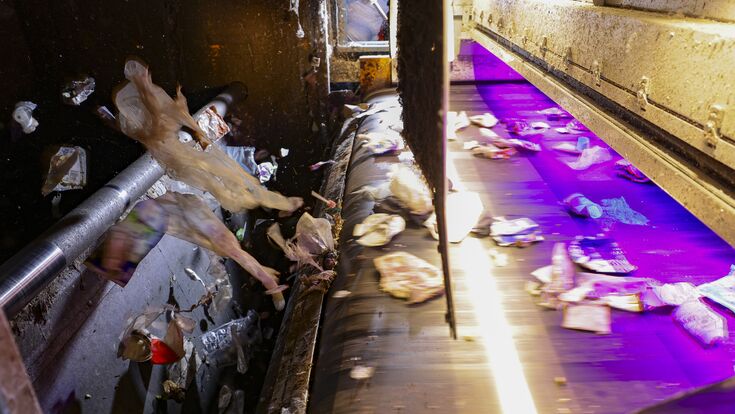
Currently, automated sorting in Materials Recovery Facilities (MRFs) and Plastics Recovery Facilities (PRFs) heavily depends on near-infrared (NIR) spectroscopy for identifying polymers and optical systems for detecting colors. These technologies are paired with high-speed pneumatic systems that use bursts of air to redirect materials on conveyor belts.
While NIR has been an invaluable tool for the industry since the 1990s, it has notable limitations. For example, it can identify polymers but cannot quantify their composition, detect additives, or distinguish packaging types. Additionally, it lacks the ability to access databases for product-specific characteristics, such as melt flow properties.
Digital watermarking and AI-based recognition technologies are fundamentally changing the way we sort and recycle flexible plastic packaging. Digital watermarking works by embedding invisible codes into packaging, which can be detected by specialised scanners in sorting facilities. This allows for highly accurate identification of packaging types, including details such as polymer composition and food contact status, enabling more granular and effective sorting than ever before.
Our HolyGrail 2.0 trials for flexible plastics in late 2023 and early 2024 demonstrated that digital watermarks enabled consistently high detection and sorting performance, even when materials were aged, baled, or heavily contaminated. In the trials, a detection and sorting rate of 95% and 85% respectively were achieved on the first pass. The technology’s commercial viability is now being validated in carefully selected market demonstrations in Belgium and Germany.
AI-based recognition leverages advanced computer vision and machine learning to identify packaging based on visible features like shape, colour, and brand logos. This technology is particularly valuable for sorting complex or contaminated waste streams. It can be integrated into existing sorting infrastructure, placing the cost burden on recyclers rather than brand owners, which has the advantage of easing adoption.
To use a simple metaphor, AI-based recognition has given us better glasses so that we are able to actually see what plastic we’re dealing with. Digital watermarking on the other hand has enabled plastics to speak, so that they can tell us about their composition and quality.
Together, AI-based recognition and digital watermarking technologies offer a clear pathway to increased sorting rates and higher recyclate quality for flexible plastics, unlocking greater end market value and investment viability.
Together, AI-based recognition and digital watermarking technologies offer a clear pathway to increased sorting rates and higher recyclate quality for flexible plastics, unlocking greater end market value and investment viability.
How significant is the cost gap between recycled flexible plastic and virgin feedstock, and what policy mechanisms are proving most effective at closing it? Can that gap ever really close?
The cost gap between recycled flexible plastic and virgin feedstock is substantial, primarily because virgin resin is produced at a massive scale – over 500,000 tonnes per year - while recycling operations for flexible plastics are still relatively small (at just 5,000-50,000 tonnes per year), fragmented, and more expensive. This disparity means that recycled flexible plastics consistently struggle to compete on price with virgin materials, which in turn limits investment and slows the growth of recycling infrastructure.
Economics alone, therefore, cannot sustain a circular economy for flexible plastic packaging, and policy interventions are needed. Mandated post-consumer recycled (PCR) content targets have a critical role to play in narrowing the cost gap by stimulating demand for high-quality recyclates and justifying further investment in flexible recycling infrastructure. As investment flows, scale increases and recycled materials can become increasingly cost competitive with virgin plastics. Extended Producer Responsibility (EPR) schemes - which make producers responsible for the full collection, sorting and disposal of their products and packaging - are also important in levelling the playing field. Through EPR fees, virgin polymer packaging ultimately faces higher, more realistic lifecycle costs.
Although it will be challenging, we believe that with the necessary policy interventions and co-ordinated action across the entire waste management ecosystem, the cost gap between recycled flexible plastic and virgin feedstock can be significantly narrowed.
What specific policy mechanisms would most effectively de-risk investment in recycling infrastructure?
Creating stable and predictable policy frameworks is crucial. Recycling infrastructure requires long-term capital commitments and investors need confidence that the regulatory environment will not shift unexpectedly.
In addition, fair competition with imported products is vital to protect domestic recyclers from being undercut by lower‑cost alternatives that do not meet comparable regulatory requirements. Creating a level playing field reduces market uncertainty and strengthens long-term investor confidence.
Specific policy levers also have a part to play. For investors, direct financial incentives such as corporation tax relief, land use subsidies, energy and labour subsidies, and concessional loans can reduce upfront risk and make recycling projects more attractive investment propositions.
Creating stable and predictable policy frameworks is crucial. Recycling infrastructure requires long-term capital commitments and investors need confidence that the regulatory environment will not shift unexpectedly.
The Alliance is supporting Nextek's COtooCLEAN project. Can you explain how this project works and why CO2 is effective at removing contaminants from plastic film? How scalable is this technology, and what role could it play in the broader flexible films ecosystem?
The COtooCLEAN project supports technology that removes contaminants from post-consumer plastic films using carbon dioxide (CO₂) that has been heated and pressurised to a point where it behaves like a gas and a liquid at the same time – known as super-critical CO₂. This unique state allows super-critical CO₂ to penetrate deeply into the molecular structure of plastic films, dissolving and dislodging a wide range of contaminants including oils, inks, adhesives, and food residues that conventional washing methods often leave behind. In simpler terms, the technology allows us to clean the inside of plastic films as well as the outside. The process is particularly suitable for producing recycled materials that meet stringent food-contact safety standards, such as those set by the European Food Safety Authority (EFSA).
The scalability of this technology is promising, with super-critical CO₂ cleaning already being established in other industries, such as coffee decaffeination and flavor extraction. The COtooCLEAN project is currently at the semi-commercial demonstration stage, which is a critical step toward broader industrial adoption. Its success could be transformative for the flexible films ecosystem as it addresses one of the main barriers to circularity: achieving high-purity, food-grade recycled films from post-consumer waste. By enabling the production of high-quality recyclates suitable for demanding applications, COtooCLEAN has the potential to open new markets, improve the economics of flexible film recycling, and support the transition to a more circular and sustainable packaging system.
Your Flexibles Programme focuses on Europe and North America where "foundational elements" already exist. What's missing in other regions, and how do your Country-Specific Programmes differ in approach?
Many regions, particularly in the Global South, either lack or have basic waste management systems. This could involve an absence of reliable and segregated waste collection, underinvestment in sorting and recycling infrastructure, or unenforced regulatory frameworks.
Our Country-Specific Programmes – currently taking place in Brazil, India, Indonesia, South Africa and states of the GCC – are designed to strengthen many of these elements from the ground up. The programmes are tailored to local contexts and aim to help countries move up the plastic recycling maturity curve in line with their national priorities.
Design-for-recyclability guidelines are listed as a key enabler. What's the one change brands could make tomorrow that would have the biggest impact?
Reducing packaging design complexity is essential for systems change. Brands can play a major role in advancing circularity, as design-for-recyclability guidelines already exist. By applying these guidelines, companies can converge around best practices that balance packaging performance with recyclability, supporting systems that are more consistent, scalable and circular.
The frameworks are already in place. The CEFLEX design guidelines, the Association of Plastic Recyclers (APR) protocols in the United States, and RecyClass standards all provide practical pathways to improving recyclability and reducing complexity across packaging formats.
If you had to pick one bottleneck in the whole system right now—collection, sorting, processing, or end markets—which would you fix first and why?
Addressing the challenge of flexible plastic waste on a global scale will not come through isolated fixes, but through coordinated system change. Efforts must align across the entire value chain - technology, policy, design, and investment - so that progress happens in parallel and at scale across regions.
Similarly, no single entity - whether a recycler, brand, government, or NGO - can drive circularity alone. This challenge demands deep collaboration. All stakeholders across the waste management system must work together across borders to unlock investment, harmonise design-for-recyclability standards, and cultivate robust global end markets for recycled content.
With UK kerbside collection of flexible plastics mandatory from March 2027, what infrastructure gaps must be urgently addressed?
Mandatory kerbside collection of flexible plastics substantially increases the volume of material entering a country’s waste system. This presents a significant opportunity for advancing circularity as long as sufficient infrastructure is in place.
Ensuring adequate secondary sorting capacity is a crucial factor. The current challenge is that Materials Recovery Facilities (MRFs) - the first stage of sorting for kerbside-collected waste - provide only basic separation of incoming waste streams. Since MRF operations prioritise the recovery of established, high-value streams like paper and cardboard, the granular sorting of flexibles that is needed for mechanical recycling – or the elimination of problematic materials for chemical recycling – typically occurs as a secondary step at the recycler. The advanced technologies required to sort flexible packaging into usable fractions, however, are expensive, restricting widespread use by individual recyclers.
We believe a more effective approach is to use dedicated Plastics Recovery Facilities (PRFs) - large-scale operations that aggregate mixed plastic waste from multiple MRFs. PRFs - which would ideally process at least 100,000 tonnes per year - can deploy advanced sorting technologies in a cost-effective manner and focus solely on providing high-quality feedstock to recyclers. Without investment in this secondary sorting infrastructure, there is a real risk that collected flexible plastics will lack viable processing routes, preventing countries from reaping the potential rewards on offer from mandatory collection.