
Circular Economy : Paradigm shift in waste management: Austria on the path to a circular economy
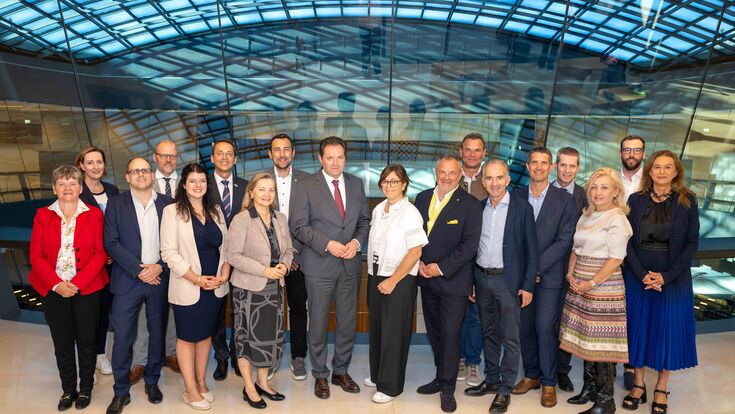
Federal Minister Norbert Totschnig (centre) with the managing directors of leading Austrian environmental technology companies.
- © BMLUK/HemerkaThe Austrian environmental technology industry is facing a historic turning point. While the sector accounts for a remarkable 4.2% of GDP with only 0.57% of businesses, a fundamental shift is taking place from traditional waste management to a circular economy. Despite the challenging economic environment, the industry is proving robust: employment growth of over 2% and the creation of over 900 new green jobs in 2024 underscore the sector's sustainability.
Political dialogue as a trailblazer
Federal Minister Norbert Totschnig recognised the importance of this transformation process and invited the managing directors of leading environmental technology companies to a fireside chat in parliament. "Environmental technology is a key driver of climate protection and sustainable growth in Austria. The fact that these companies are not only securing jobs but even creating new ones in a difficult environment impressively demonstrates their strength and resilience," emphasises the minister.
As part of this ongoing dialogue process, concrete measures to strengthen the location were discussed, including increasing the efficiency of approval procedures, restructuring subsidies, but also bringing in private capital and, last but not least, the transition of the waste industry to a circular economy.
National Circular Economy Strategy: Roadmap to 2050
The national circular economy strategy forms the foundation for Austria's transformation to a climate-neutral, sustainable economy by 2050. This comprehensive strategy aims to replace the linear ‘take-make-waste’ approach with closed material cycles. The focus is on extending product life cycles, reusing materials and minimising waste. The waste management industry is evolving from waste disposal to resource management and is making a significant contribution to supply security.
Secondary raw materials market: independence through recycling
The expansion of the secondary raw materials market is at the heart of Austria's circular economy strategy. Through the systematic recovery and processing of materials from waste streams, Austria aims to become less dependent on raw material imports and act as a pioneer in the European circular economy.
According to the 2025 government programme, secondary raw materials should no longer be at a disadvantage. The aim is to establish a level playing field for primary and secondary raw materials both in Austria and in the EU. Among other things, this requires the adaptation of norms and standards, the development of quality criteria for secondary raw materials and the creation of trust among consumers.
Innovative recycling technologies that enable even complex material composites to be converted back into high-quality raw materials are particularly promising in this regard.
Circular Economy Act and end-of-waste definition
European initiatives are giving additional momentum to Austrian waste management. The European Commission is currently preparing a comprehensive Circular Economy Act, which is intended to create the legal framework for the transition to a circular economy.
A key focus of this act is the revision of the Waste Framework Directive. In particular, the term ‘end-of-waste’ is to be redefined – a crucial point for waste management. A clear definition of when waste becomes a product again is essential for functioning secondary raw material markets. Only when recycled materials have a clear legal status can they compete on an equal footing with primary raw materials.
This redefinition could remove bureaucratic hurdles and facilitate cross-border trade in secondary raw materials. This opens up new export opportunities and business areas for Austrian companies.
Innovation as a success factor
"Austrian companies combine innovation with ecological responsibility and sustainable solutions on the path to climate-neutral circularity. This is a successful model that we want to continue to strengthen," emphasises Totschnig. Promoting groundbreaking innovations and demonstration projects is therefore at the heart of strengthening the location.
The industry's optimism is also reflected in the employment forecasts: 54 per cent of the companies surveyed expect further growth in 2025. This positive development underlines that the transformation to a circular economy is not only ecologically necessary, but also economically promising.
Austrian waste management is thus on the threshold of a new era – an era in which waste is no longer a problem, but a raw material of the future.