
Sustainability : ReTHINKing the Circular Economy – A new focus on transitioning from wastefulness

I developed a new model of the Circular Economy (CE) because it’s clear all nations are experiencing severe environmental challenges due to unsustainable resource use such as deforestation, water shortages, biodiversity loss and climate change…a shift is needed, and the RETHINK Model can help facilitate it. According to the Planetary Boundaries Science Partnership’s 2024 Planetary Health Check reports, we have crossed six of our nine planetary boundaries due to human disruption of vital earth system processes. Of note is the newly assessed and already crossed Novel Entity boundary, which represents entities that without man would not be present on earth, such as plastics and persistent organic pollutants, among other man-made materials and modifications. Novel Entities is the planetary boundary that waste management can influence most, and this is important to understand since Novel Entities disturb and act on other core boundaries, especially Biosphere Integrity.
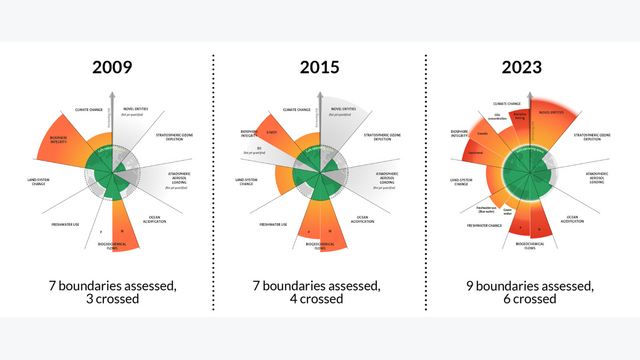
Plastic pollution is now altering some major processes at the scale of the entire Earth system.
- © Azote for Stockholm Resilience Centre, Stockholm University. Based on Richardson et al. 2023, Steffen et al. 2015, and Rockström et al. 2009We know many things must change yet do not seem to know how or have a cohesive path forward. It’s time to ReTHINK what a Circular Economy (CE) truly means. It goes far beyond managing the production and movement of waste, it’s about redefining how we interact as a society, what we value, and how we envision wellbeing. CE is not solely about the economy, environmental protection or social progress, it’s the integration of all three, working in synergy. We must begin to view the economy as a network of social relationships rooted within an ecological system. Caring for nature is, ultimately, caring for ourselves. Achieving this requires a paradigm shift, one that integrates societal needs with ecological wellbeing through systems thinking to foster regenerative ecosystems. We must align our values with not only what we produce, but also with where, how, and for how long what we produce is used. And above all, this is a shared responsibility.
What is missing is focus on a unified vision and collaborative model for transformation that also includes energy and information flows. It begins with the most important yet overlooked R, to ReTHINK. To ReTHINK in new focus areas; Design; Energy & Resource Use; and Governance & Communication, and collectively shift our inefficient and wasteful behaviours both upstream and downstream of production. Essentially, we have to ReTHINK our definition of waste and transition from a materials flow focus to an expanded viewpoint that includes wastefulness; behaviours and processes that are inefficient and create environmental impacts during production, product use and at end of life. We need a new model; one that shows the Pathways to Transition – it is the ReTHINK Model of Circular Economy which is illustrated below. The ReTHINK Model offers a wider context of the CE, a transformative system to normalize more positive human interaction with nature while increasing the market value of social capital and outputs, resulting in an overall reduction in the pressures we have been placing on ecosystems.

Notes: Government: First Nations/ Indigenous, International, National, Provincial/ State & Local; Industry: Resource Extraction Industry; Business: Commercial Manufacturing; Society: Citizens, Stakeholders & Non-Government Organisations (NGOs); and Waste Management: Landfills, Material Recovery Facilities, Salvage Yards, Recyclers
- © Jane HamiltonThe leadership demonstrated in Nanaimo in climate change and waste management inspired my development of the ReTHINK Model. The model illustrates with arrows how all sectors either feed in or learn from these focus areas, except Governance & Communication, which is a two-way street for everyone. Although the ReTHINK Model has not yet been implemented in its totality, there are several examples of how aspects of it are working today. They are provided below with the description of the elements of the model.
ReTHINK Design
ReTHINKing Design can change the outcome of a product, and the process to create it, through considering the end of life and waste minimization as explicit design criteria. We can ReTHINK the
concept of ‘waste’ and consider it as ‘food’, or a feedstock to another production process and how to incorporate this at the design stage. With this in mind, products can be designed for dismantling or repair, extended lifecycles, with more sortable shapes or to keep embedded inputs.
Governments can design guidelines, projects, standards and policy to target the elimination of waste, require the recirculation of materials and support the regeneration of ecosystems. For example, extended producer responsibility (EPR) programs, the right to repair, and supply chain legislation can be formulated. Governments can use the ReTHINK model and wellbeing indicators to help shift the behaviour and structure of the economy.
Canada’s Federal Plastics Registry requires companies to report annually on the quantity and types of plastic they manufacture, import, and place on the market, to initiate control over material flow.
Design can influence the resource extraction industry in the form of eco-recovery concepts for land reclamation, sustainable forestry, fishery management, agriculture and wastewater treatment and reuse. Processes can be designed that use renewable resources and decarbonization technologies.
Manufacturers must ReTHINK not only the recovery potential of materials while designing products, but also the consequences of negative externalities from not recovering materials. Considering this, products can be designed with material purity, to last longer or to incorporate the ease of remanufacturing, dismantling, reassembling, refurbishing or repairs.
Society can inform design on how to improve the use of products, what hinders lifespan and the challenges in repair. Society can voice preferences for products that are repairable, that have a long lifespan and are made with cradle-to-cradle thinking. Society can also choose to purchase items that have been designed with eco-responsibility in mind.
Designers can hear from the waste management industry what hinders the recovery of complex products or what could improve disassembly and reverse assembly. Landfill operators can share intelligence on what impacts environmental quality, and what materials are hard to process, start fires, or are a hazard. Material recovery facilities could provide feedback on form factor geometries, the shape of products that make mechanical or manual sorting effective. Therefore, communication and knowledge-sharing networks must be established between product designers and waste managers.
A good example of this is how the Regional District of Nanaimo (RDN) is running a circular explicit trial project to evaluate the effect of shredding waste on compaction efficiency to extend the life of the landfill. The project has achieved the highest compaction in our landfill history with an apparent waste density of 1.13 metric tonnes/cubic meter reported in 2024, which is approximately 40% higher than industry-standard un-shredded compaction rates of 0.80 mt/m3.
>>> The future of recycled material availability: Challenges and opportunities to 2030
ReTHINK Resource & Energy Efficiency
A CE reduces resource use and improves energy and material cycles at all levels, from individual consumers to governments, by focusing on local economies and nearby value chains. Producing other value-added goods resultsin the effective use of resources, less embedded carbon, lowers the cost of waste management and generates employment.
It is key for governments to influence control over material and energy flow. Governments can support eco-parks and value chains by encouraging industrial or manufacturing operations to cluster together, enabling resource sharing where one facility’s by-products become inputs for another. Governments also have authority to harmonize and simplify packaging.
Cities, like San Francisco and Paris, offer programs to switch from disposable to reusable packaging with optional deposit and non-deposit, sanitation, and governance strategies.
Evaluating first fuel and hidden fuels and tracking energy per unit of activity are practical initial steps for industry. An efficiency target can be to focus on improving the per-unit consumption of energy or resources. Technology improvements may identify methods to convert CO2 or reprocess by-products. Industry can ReTHINK processes to reclaim and improve the refinery of secondary raw materials to be reintroduced into manufacturing cycles.
Scrap metal, paper products, glass and even materials like agricultural biomass can be reprocessed or refined into new products, supplemental ingredients or, in the case of biomass, energy sources.
When manufacturing processes and products are designed to recognize material recovery potential or the beneficial use of by-products, ways to transfer or capture the value can be efficiently coordinated and staged. Business can focus on reducing emissions using the efficiency of reverse logistics or blockchain technology to enable fast and cost-efficient delivery of products and improve coordination between partners. Business can provide longer lasting products, spare parts, minimize waste through intensifying and dematerialization, as well as refine processes and energy sources to increase energy and resource efficiency.
Essential to the CE is a shift towards a culture of collaboration and social enterprise for innovation to repair, recover or transform products. Society can build this capacity when people are upskilled in reuse, adept in repair, or have creative talent to transform materials. Housing can be constructed or retrofitted with energy-saving technologies. Communities and households can learn to share tools and machinery, for example. Households can also strongly influence resource efficiency through the reduction of food waste and the source separation of their waste and organics.
Community share-sheds, free-swaps and repair cafés are a thing!
Waste handlers can offer insight to reduce cost and improve the efficiency of recovering materials from disassembling complex products. Biorefineries can be constructed to utilize methane from landfills or anaerobic digesters. Residual solid waste can undergo thermal processes to generate heat and electricity as well as retrieve metals and produce cement from the residue. Circular processes that intensify the value of waste and create circulating materials are more economical, resource and energy efficient than solely exporting excess energy produced.
A good example of this is how the RDN Landfill applies a surcharge on mattresses and redirects that money to pay for recycling at a local social enterprise that supports a diverse workforce who learn to disassemble mattresses and recycle 90-95% of the material such as metals and wood that is made into reusable crates. This creative approach emphasizes resource use efficiency and also builds social capital at the same time.
ReTHINK Governance & Communication
ReTHINKing Governance and Communication can define the path and accelerate the transition to a CE by being a conduit for the exchange of information and urging transparency, collaboration, and connectivity. Governments can set regulatory structures that are co-created to reflect societal values and will persist regardless of changes in government. They can measure progress by endorsing indicators that are recognized, easy to adopt and represent our new understanding of a CE. Governments can acknowledge negative externalities through taxation, polluter pay directives or lack of subsidies, adopt policy from international examples, or implement product stewardship programs.
Industry can ReTHINK its practices through internal shareholder governance focused on the sustainable use of natural capital. This could mean governing product design such that it evaluates a product’s lifecycle, committing to primary recycling of their product, or incorporating a closed loop supply chain within processes. Industry can communicate its governance to improve public perception and market value.

The level of circularity a business adopts is determined by its shareholders, the ethos of its corporate vision and willingness to collaborate with stakeholders. Governance determines internal policy and procedures and how they complete procurement. Is the business going to facilitate recovery at the design stage or adopt a waste = food design philosophy? Will it communicate means of reverse assembly or repair of its products? How connected is it with markets and logistics for recovered materials? All are questions governance and communication can answer.
A successful CE requires citizen-focused leadership in planning, monitoring and decision-making processes to help define and create community and national contexts of wellbeing and propel it forward. Society can voice social pressures in waste separation practices and convenient diversion and recovery options. Awareness campaigns will improve education among consumers, clarify confusion and promote behavioural change to ReTHINK and reduce wastefulness. Our individual governance in decision-making exerts influence toward outcomes we value, determines self-sufficiency, gauges needs versus wants and guides our perception of second-hand products.
A good example of this is the Nanaimo Climate Action Hub, which is a non-profit organization working in the community to advance solutions that reflect of the urgency of the climate emergency through advocacy, local initiatives and collaboration with other organizations. Social action such as this is imperative to the collective change that the ReTHINK Model will help bring.
Waste management can offer well-designed solid waste management plans, identify the hazardous materials and components that need better regulation to liberate. Waste management can communicate barriers to recovery, the embedded value in products, sources of contamination in diverted materials, and the true cost of materials that take volume over time in disposal.
Closing
We are all in this together. Wasting capital, of any kind, must be addressed with circularity and ReTHINKing Pathways to Transition as part of our shared responsibility to start repairing our relationship with nature and living within planetary boundaries.