
Refused Derived Fuels : Non-compostable doesn’t mean non-combustible: Exploring the hidden potential of Uganda’s composting plants
Introduction
Within the UN Clean Development Mechanism (CDM) framework, 12 industrial-scale composting plants were established in different municipalities in Uganda in order to reduce the greenhouse gas (GHG) emissions of the waste management sector, while simultaneously producing compost for the local agriculture sector1. Since the waste is not separated at the source in Uganda, a lot of non-compostable materials end up in said plants and, further, in the sieving residuals after the final sieving step. These residuals are currently dumped into the plants’ surroundings or landfilled, leading to high levels of pollution in these areas. It was previously reported that only between 1 and 5% of the input is processed into compost2. Figure 1 shows the dumped residuals at the plant in Mukono.
To lower the environmental pollution and the related risks for humans, flora and fauna, the residuals need to be appropriately handled. In this article, we describe the utilisation potentials which we found by sampling and thoroughly characterising composting residues from two CDM composting plants in Uganda.
Investigating the composition of the residuals showed that most of them could be used either for recycling purposes or for energy recovery. Treated wastes that are used for energy recovery in industrial plants are known as refuse-derived fuels (RDF).
>>> Refuse Derived Fuel for the cement industry: the sorting challenge
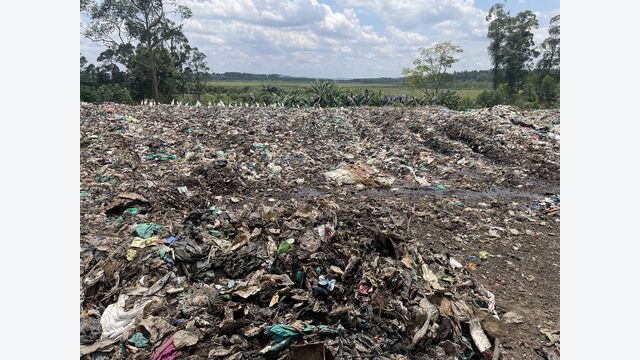
Figure 1: Sieving residuals dumped next to the composting plant in Mukono, Uganda; picture taken in September 2023
- © Sara NeuburgEnergy recovery via refuse-derived fuels
One industrial sector in which RDFs are broadly applied in many countries already is the cement industry. In Europe, for example, the utilisation of RDFs in the cement industry is very common. In 2020, on average 52% of the thermal energy demand in the European cement industry was met by alternative fuels, which include RDFs3. In some countries, even up to 80% or higher substitution rates are reported (e.g. in Austria almost 85%)4, with single plants even reporting a 100% substitution via alternative fuels5. Utilising RDFs not only helps with managing high amounts of mostly non-recyclable waste, but it can also have a positive effect on cement plant GHG emissions. RDFs typically contain biogenic materials, such as paper, wood and textiles, whose CO2 emissions when combusted are considered climate-neutral. Thus, the substitution of fossil fuels can lead to a reduction in fossil CO2 emissions. In Austria, for example, the fossil CO2 emissions per metric ton clinker produced were 30% in 2013 and decreased to 28% in 202346, which is due to energy recovery via RDFs.
The main energy source in Uganda’s cement industry are primary fossil fuels, such as coal7. This not only has a negative influence on the climate in the form of fossil CO2 emissions, but it also leads to a dependency on imports, since Uganda does not have any significant coal, natural gas or fossil fuel reserves8. There are already some companies in Uganda that have made significant strides in substituting their traditional energy supply with alternative fuels derived from agricultural residues, like Hima Cement, but there are still opportunities for further substitution. To branch out into alternatives generated from municipal solid waste (MSW), like RDFs, would be one such opportunity. Unprepared MSW is typically unsuitable for industrial energy supply due to a low heating value (approx. 6–9 MJ/kg9) caused by wet organic content. Appropriate treatment can concentrate and homogenise the dry, high-calorific fractions to provide fuel10.
Theoretically, within Uganda’s composting plants, much of the “RDF pre-prep” work is done in advance, as the vast majority of the organic material in the waste should be decomposed by the process. What’s left over then, can be assumed to be the materials with a lower moisture content and a higher heating value. Based on previous observations made by the authors and other researchers at different plants, it was assumed that one major part of the residuals are plastics (e.g. also reported in Tumuhairwe, 201111; Lederer et al., 201812).
Within the APPEAR III project, “Clean and Prosperous Uganda – Fecal Sludge and Solid Waste Management for Improved Livelihoods”, orchestrated by TU Wien and Makerere University together with the Ugandan Red Cross Society and Mbarara University of Science and Technology, the hidden potential in the sieving residuals of Uganda’s CDM composting plants is investigated. The scope is to examine their energetic and recycling potentials.
The plants in Mukono (Central Uganda) and Masindi (Western Uganda) were selected for investigation following a thorough examination of plant performance of all 12 plants built within the CDM. Figure 2 shows a map of Uganda with the municipalities marked in which a CDM plant was built. The investigated plants are further marked.
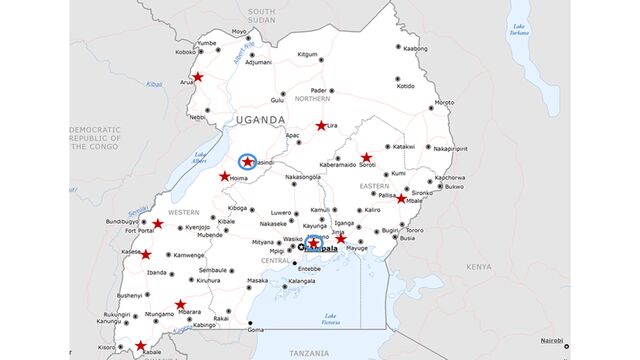
Figure 2: Map of Uganda with municipalities marked in which a CDM composting plant was built. The sampled plants are marked with a blue circle.
- © zVgComposition of composting residues
Figure 3 shows the mass share of the fractions found in the sieving residuals for both investigated plants. A share of plastics between 29 and 31% in mass was determined, confirming expectations of high plastics content based on visual observations of the authors and e.g. by Lederer et al. (2018)12. We discovered that the main components of the sieving residuals are not fully decomposed biogenic materials (36–43% in mass), followed by plastics (29–31% in mass) and textiles (10–12% in mass).
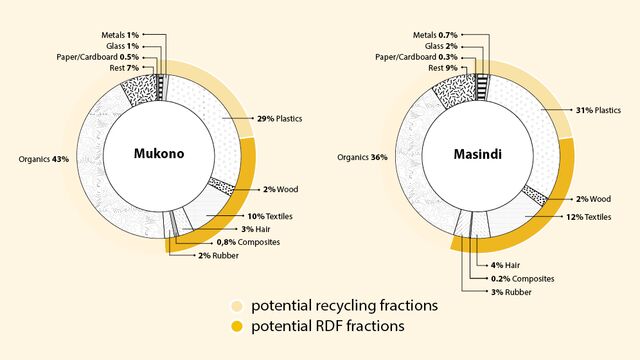
Figure 3: Found composition of the sieving residuals at the CDM composting plants in Mukono and Masindi in terms of mass ("Rest" includes material such as medical waste, electronic waste, non-definable materials and stones).
- © zVgFact box: It’s very common for women in Uganda to style their hair with artificial extensions. As such, it was interesting to observe that “Hair” was a rather large component of the overall residuals (3–4% in mass).
The organic fraction contains a large share of not fully decomposed materials, such as pineapple stems, leaves and mango kernels. This suggests that this fraction could potentially be re-entered into the windrows for further composting. The high share of organic fraction also suggests that an improvement of the composting process itself could be a good approach to increase the utilisation potential of the output streams. The necessity of improving the composting process in these plants was also e.g. found by Lederer et al. (2017)13 and by Okori et al (in press)14, who looked into knowledge gaps of local stakeholders and macro pollutants in the composts of the CDM composting plants, respectively.
Utilisation potential
The following fractions were identified to be potentially recoverable via recycling paths or via thermal recovery as RDF: plastic fractions, “Textiles”, “Metals”, “Wood”, “Hair”, “Composites”, “Rubber”, “Glass” and “Paper/Cardboard”. The “Rest” fraction (7–9% in mass), which includes medical/hazardous waste, electronic waste, batteries, stones and non-definable objects, is assumed to be neither useable for recycling nor for energy recovery – and thus would ideally need to be removed from the stream (either at the input or at the output of the plant).
Some of the incoming materials are removed by the workers for sale to recyclers. The most valuable materials are PET bottles (100–200 UGX/kg), cardboard (200 UGX/kg) and metals (1200 UGX/kg). This leads to a very low share of these materials in the sieving residuals (<4% in mass).
Overall, it was found that more than 90% of both plants’ residuals could be valorised. Approximately 260 t and 180 t of sieving residuals arise in the Mukono and Masindi plants per year, respectively. Thus, a recovery of the identified materials could lead to a major reduction of the materials that are otherwise dumped at present.
Composition of plastics and recovery
As recycling has a higher priority in the waste hierarchy than energy recovery, we investigated the recycling potential of the composting residues, in particular the potential recyclables amongst the plastics fraction. The plastics consist mostly of so-called Kaveeras (thin polythene bags) and films with 79% in terms of mass in both plants (Figure 4). Thus, the main polymer type found is expected to be low-density polyethylene, and the recycling of this polymer type is theoretically possible. However, it has to be considered that the adherence of soil and dirt on the recyclables after the composting process is limiting their recycling usability. Thus, if recycling is pursued, then a removal of the recyclables before the composting process (best by source separation or by enhanced sorting) would be advisable.
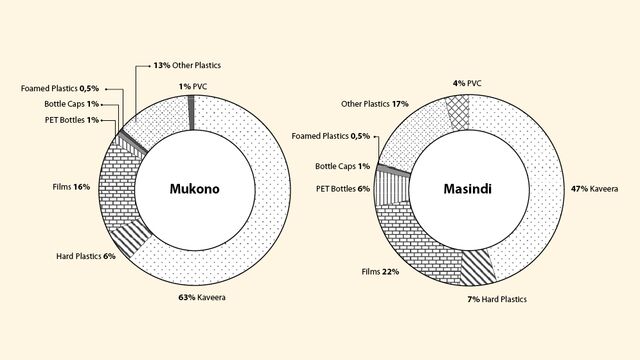
Figure 4: Shares of plastic types within the plastics fraction (in terms of mass).
- © zVgFact box: Plastic bags with a thickness below 30 microns were officially banned in Uganda in 2008; however, as also the figures show, they are still pervasive.
Properties of potential RDFs from composting residues
In Europe, RDFs are classified according to three key properties: lower heating value (LHV) – as economic information, chlorine content – as technical information, and mercury content – as environmental information. Based on these three categories the RDFs are classified into five quality classes (Table 1)15.
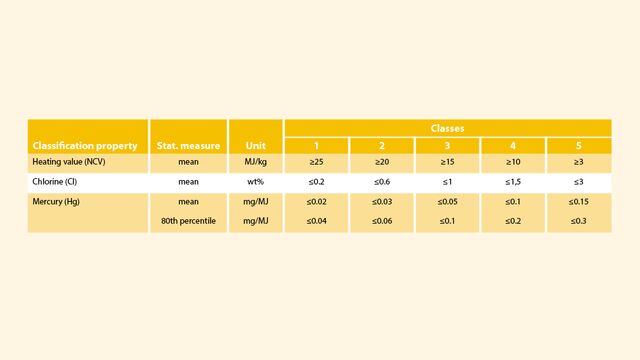
Table 1: RDF classification according to DIN EN ISO 21460 15
- © zVgIn the case of the cement industry, the LHV should be at least 11 MJ/kg for utilisation in the pre-heater. If the LHV is above 20 MJ/kg, the fuel can be used in the main burner16.
The potential RDF fractions from the composting residues have a high share of plastics (20–60%), because of which a high LHV is expected (LHV of plastics is around 32 MJ/kg17). However, other materials with a lower heating value are also present, such as wood and textiles. Additionally, the water content of the RDFs was found to be up to 37%, depending on the season. Finally, a LHV of the potential RDF fractions of 13–19 MJ/kg was estimated, making them potentially suitable for the pre-heater of a cement plant (class 3 to 4 according to Table 115).
Another very critical parameter is the chlorine (Cl) content. The consequences if there are elevated levels of Cl in the fuel include corrosion in the plant and changes to the raw materials, making them sticky, which can further lead to blockages within the plant. These blockages lead to high maintenance needs and subsequent costs18. In general, the Cl content of the cement industry’s fuels should be below 1%19.
Chlorine content in the potential RDF fractions was estimated to be 1% at the Mukono plant and 1.6% at the Masindi plant (class 3 to 4 according to Table 115). Thus, the chlorine content would need to be reduced if a higher quality is required. The results also show that most of the Cl in the RDF stems from the “Other Plastics” fraction, which have a PVC-content up to 25%. Thus, removal of PVC during RDF production appears necessary, which could e.g. be realised by near-infrared spectroscopy.
Information on the heavy metal content in RDFs can be crucial, especially if taking the potential health hazards caused by some heavy metals into account. No Ugandan standards were identified by or presented to the authors upon request. When compared to the Austrian heavy metal limits for RDFs produced from MSW for utilisation in clinker production20, we found them to be all below the limits (chromium, lead, cobalt, antimony, cadmium, arsenic, nickel and mercury). Based on mercury the RDF fractions would fall into class 1 according to Table 115.
Fossil CO2 emissions from RDFs
When using RDFs, the fossil CO2 emissions of the production process are lowered due to the biogenic materials, such as wood and textiles made from natural fibres, in the mix. To gain information on the fossil and biogenic share of the fuel and further be able to calculate fossil CO2 emission factors, we used the TU Wien-developed adapted Balance Method (aBM)21,22.
The results show that utilisation of the composting residuals as RDF potentially leads to up to 30% less direct fossil CO2 emissions, compared to coal. Not only does this have positive impacts on the GHG emissions of the cement industry and the environment, but it can also have economic advantages for the companies in terms of CO2 certificates, potentially saving them money.
However, there are also investment costs implied with the production of RDFs. These include the costs for setting up a production plant, operations, logistics, staff, etc. Furthermore, the cement plant itself needs to invest in retrofitting its kilns in order to be able to use RDFs (appropriate storage, transport and dosing system, chlorine resistance adaptations). It is also possible that the energy efficiency of the plant is reduced once RDFs are used, as e.g. reported for some plants in Germany23.
A short recap
In terms of quality, the sieving residuals of Uganda’s CDM composting plants could be prepared as RDF for use in the cement industry. But there are some limitations. An appropriate RDF production process would need to be established first, including shredding, secondary sieving and drying. Also, improvement of the composting process would be advisable to reduce the organic share in the residuals. The removal of PVC at the beginning of the process is crucial to keep the Cl-content low during cement production. Further processes might be necessary, depending on possible specific plant demands. In terms of quantity, a consistent supply must be ensured, for which more centralised RDF production may be advisable, where a balance between the locations and density of the composting facilities and the actual clinker-producing cement plants needs to be taken into consideration.
Even though it requires a lot of work, engagement, investment and know-how, the positive side of this is job creation. The sorting and further processing needed for the utilisation of RDFs needs a lot of manpower, leading to economic benefits for the communities surrounding the RDF processing plants 24.
Having standards on RDFs specifically for the Ugandan industry would be an advantage, especially if RDFs should be applied broadly with consistent quality assurance across the whole sector.
This study shows that the potential for recycling and thermal recovery within the CDM composting residuals is significant. The advantages of using the residuals include lowering the cement industry’s CO2 emissions, costs for fuel and coal import dependencies. Also, if the potential recyclables are recycled, the circularity of Uganda’s waste management sector would be enhanced and the land surrounding the plants can finally breathe again when it is no longer covered with waste.
Acknowledgements
This work is part of a study financed by the Austrian Partnership Programme in Higher Education and Research for Development – APPEAR, a Programme of the Austrian Development Corporation (ADC) and implemented by Austria’s Agency for Education and Internationalisation (OeAD)-GmbH. The study is under the Project Clean and Prosperous Uganda – Fecal Sludge and Solid Waste Management for Improved Livelihoods (CPUg) (project #256, 2022).
Bibliography
1. Kabasiita, J. K., Opolot, E. & Malinga, G. M. Quality and Fertility Assessments of Municipal Solid Waste Compost Produced from Cleaner Development Mechanism Compost Projects: A Case Study from Uganda. Agriculture (Switzerland) 12, (2022).
2. NEMA. Monitoring Report Uganda Municipal Waste Compost Programme. (2015).
3. European Investment Bank. Managing Refuse-Derived and Solid Recovered Fuels Best Practice Options for EU Countries. https://www.eib.org/attachments/lucalli/20230376_managing_refuse_derived_and_solid_recovered_fuels_en.pdf (2024).
4. Mauschitz, G. Emissionen Aus Anlagen Der Österreichischen Zementindustrie Berichtsjahr 2023. (2024).
5. Marmier, A. Decarbonisation Options for the Cement Industry. https://joint-research-centre.ec.europa.eu (2023) doi:10.2760/174037.
6. Mauschitz, G. Emissionen Aus Anlagen Der Österreichischen Zementindustrie Berichtsjahr 2013. (2014).
7. Lee, R. D. Evaluating Uganda’s Waste Management System for the Production of Refuse-Derived Fuel (RDF) and Its Potential Implementation in the Country’s Growing Cement Industry. (Wien, 2019). doi:10.34726/hss.2019.66871.
8. International Energy Agency. Energy System of Uganda. https://www.iea.org/countries/uganda# (2025).
9. Vlaskin, M. S. Municipal solid waste as an alternative energy source. Proceedings of the Institution of Mechanical Engineers, Part A: Journal of Power and Energy232, 961–970 (2018).
10. Shovon, S. M. et al. Strategies of managing solid waste and energy recovery for a developing country – A review. Heliyon 10, e24736 (2024).
11. Tumuhairwe, J. B. Fresh Waste Characterisation and Chemical Analysis, Leachate Analysis and Rejects Characterisation for the Municipal Solid Waste Composting Project in Uganda. (2011).
12. Lederer, J., Schwarzboeck, T. & Fellner, J. The Potential Of Composting Residues As Refuse-Derived Fuel For The Ugandan Cement industry. in ISWA 2018 World Congress (ed. Pariatamby, A.) 426–431 (Kuala Lumpur, 2018).
13. Lederer, J., Ogwang, F. & Karungi, J. Knowledge identification and creation among local stakeholders in CDM waste composting projects: A case study from Uganda. Resour Conserv Recycl 122, 339–352 (2017).
14. Okori, F. et al. Macro- and microplastics in composts from municipal solid waste industrial composting Plants in Uganda. Waste Management 204, 114942 (2025)
15. DIN Deutsches Institut für Normen. Solid recovered fuels - Specifications and classes (ISO 21640:2021). Preprint at (2021).
16. Sarc, R., Seidler, I. M., Kandlbauer, L., Lorber, K. E. & Pomberger, R. Design, quality and quality assurance of solid recovered fuels for the substitution of fossil feedstock in the cement industry – Update 2019. Waste Management and Research 37, 885–897 (2019).
17. Beckmann, M., Pohl, M. & Ncube, S. Charakterisierung von Ersatzbrennstoffen hinsichtlich brennstofftechnischer Eigenschaften. in Energie aus Abfall - Band 3 203–218 (TK Verlag Karl Thomé-Kozmiensky, Neuruppin, 2007).
18. Del Mar, M. et al. Review: Circulation of Inorganic Elements in Combustion of Alternative Fuels in Cement Plants. (2015) doi:10.1021/ef502633u.
19. Rotter, V. S. et al. New techniques for the characterization of refuse-derived fuels and solid recovered fuels. Waste Management & Research 29, 229–236 (2011).
20. BMLFUW & BMWFJ. Verordnung Des Bundesministers Für Land- Und Forstwirtschaft, Umwelt Und Wasserwirtschaft Und Des Bundesministers Für Wirtschaft, Familie Und Jugend Über Die Verbrennung von Abfällen (Abfallverbrennungsverordnung - AVV). (Österreich, 2023).
21. Fellner, J., Aschenbrenner, P., Cencic, O. & Rechberger, H. Determination of the biogenic and fossil organic matter content of refuse-derived fuels based on elementary analyses. Fuel 90, 3164–3171 (2011).
22. Schwarzböck, T. et al. An alternative method to determine the share of fossil carbon in solid refuse-derived fuels – Validation and comparison with three standardized methods. Fuel 220, 916–930 (2018).
23. Schönberger, H. & Waltisberg, J. Einfluss der Mitverbrennung in deutschen Zementwerken auf die Abgasemission Einfluss der Mitverbrennung von Abfällen in deutschen Zementwerken auf die Abgasemission. in Energie auf Abfall (eds. Thomé-Kozmiensky, K. J. & Beckmann, M.) 871–927 (TK Verlag Karl Thomé-Kozmiensky, Neuruppin, 2014).
24. Khan, I., Chowdhury, S. & Techato, K. Waste to Energy in Developing Countries-A Rapid Review: Opportunities, Challenges, and Policies in Selected Countries of Sub-Saharan Africa and South Asia towards Sustainability. Sustainability (Basel, Switzerland) 14, 3740 (2022).