
Waste to Energy : Getting hot: Will the revised EU ETS combat climate change while saving the environment?

Summer 2026 marks a pivotal moment for European climate policy. As the European Union launches the review of its Emissions Trading System (EU ETS) for the post-2030 period, policymakers face a delicate balancing act: maintaining the integrity of Europe’s flagship carbon market while responding to growing concerns over industrial competitiveness, energy affordability and geopolitical uncertainty. The review comes at a time when the EU has reaffirmed its long-term commitment to climate neutrality and adopted a legally binding target to reduce net greenhouse gas emissions by 90% by 2040.
Over the past two decades, the EU ETS has evolved into the cornerstone of the Union’s climate architecture, covering power generation, energy-intensive industries, aviation and maritime transport. The 2023 reform aligned the system with the EU’s 2030 climate target by tightening the emissions cap, accelerating the phase-out of free allowances and strengthening market mechanisms. Yet the context in which the next revision is taking place is markedly different. The debate is no longer solely about increasing ambition; it is increasingly about how to sustain decarbonisation while preserving Europe’s industrial base and economic resilience. Recent stakeholder consultations organised by the EU Commission have highlighted broad support for the ETS as a market-based instrument, but also calls for greater investment certainty, stronger protection against carbon leakage and a clearer alignment between carbon pricing and industrial policy. Yet the politics of carbon pricing are no longer confined to heavy industry and power generation. The decision to postpone ETS2 – the new carbon market for buildings and road transport – from 2027 to 2028 underscores how sensitive the next phase of EU climate policy has become. Both the Council and Parliament have pushed for extra safeguards to contain price shocks and protect households, even as they defend the logic of carbon pricing as a central tool for decarbonisation.
The 2026 review therefore represents more than a technical adjustment of market rules. It is a strategic test of whether the EU can reconcile climate leadership with competitiveness in an increasingly fragmented global economy. Decisions taken over the coming months will shape the trajectory of the carbon market throughout the 2030s and determine whether the ETS can continue to serve as the primary engine of Europe's transition towards climate neutrality.
>>> "The entire waste management sector should fall under the same legislation."
The inclusion of the waste sector in the EU ETS is just a piece of a bigger puzzle that will be put on the table this summer.Fabio Poretti, CEWEP
Many eyes in Brussels will be focused on a major review that the European Commission is expected to present in mid-July and which will provide an interlinked assessment of the expansion of the EU ETS to new sectors such as waste management (mainly Waste-to-Energy plants and landfills), the inclusion of non-permanent CCU products, the integration of carbon removals, the revision of the Market Stability Reserve, the revision of free allowance benchmarks, the revision of the Carbon Border Adjustment Mechanism (CBAM) and carbon leakage protection measures for non-CBAM sectors, the links between the EU ETS and other carbon markets (in particular the UK ETS), the feasibility of lowering the 20 MW total rated thermal input thresholds, plus other topics.
In summary, considering the magnitude of the topics on the table, the 2026 impact assessment will lay the foundation for a major revision of the EU ETS.
Looking at the WtE sector, there are around 500 plants in Europe treating around 100 million tonnes of residual waste every year, from municipal but also commercial and industrial activities. The EU ETS revision could bring about one of the most substantial changes in the history of the sector.
This article explores the key questions facing policymakers, industry and market participants. It will try to provide guidance around this complex issue on what role carbon pricing could play in Europe's industrial strategy and, most of all, how the EU ETS evolution could safeguard both environmental integrity and economic competitiveness in the decade ahead.
WtE basics: scope, fossil CO2 emissions volumes and existing carbon pricing measures
As a rule of thumb, the combustion of 1 tonne of residual waste in a conventional WtE plant generates approximately 1 tonne of total CO2 emissions at the stack. However, the CO2 generated by WtE needs to be divided into two categories, depending on its origin:
- Fossil CO2, mainly from the incineration of fossil-based waste, such as residual plastics, synthetic materials, textiles of fossil origin, etc.
- Biogenic CO2, which comes from the biodegradable fraction of various waste streams, such as paper and cardboard waste, wood, leather, kitchen waste and green waste that escaped separate collection or is not suitable for recycling.
Ultimately, the exact share of fossil and biogenic CO2 depends case by case on the composition of the residual waste delivered to the WtE plant.
According to the latest data released by the European Commission within the 2024 monitoring and reporting period, the fossil CO2 emissions for the WtE sector in the EEA (European Economic Area) accounted for around 40 Mt fossil CO2. The fossil share of CO2 corresponds to 47% of the WtE total (85 MtCO2), with the remaining share (53%) hence constituted by biogenic CO2 emissions (45.6 Mt bio-CO2).
Only the fossil CO2 component is under the scope of the EU ETS (or in general of any national CO2 pricing schemes) due to its climate impact and hence subject to the payment of allowances. The biogenic part of CO2 is considered “zero-rated”, or climate neutral, being part of the natural carbon cycle. The basic functioning principle of the EU ETS is that companies must surrender fossil CO2 allowances annually, operating on a “cap and trade” principle where the total supply is strictly limited and reduced over time. An EU ETS allowance represents the right to emit 1 tonne of carbon dioxide equivalent (CO₂e). The price of EU Allowances (EUAs) fluctuates dynamically on the European carbon market. Historically, they have traded around the €60 to €100 range, depending on market demand and regulatory changes. Currently the price of EUAs on the market is around €75–80 per tonne of CO2.
>>> "Emissions from other waste management activities should be treated in the same way as WtE."
In our race to fight climate change we should be prudent to not hamper our environment.Fabio Poretti, CEWEP
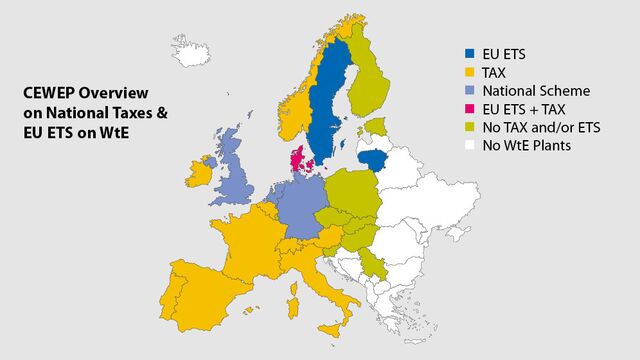
When it comes to applying a carbon price to fossil CO2 emissions from WtE, some Member States have already opted in their installations under the EU ETS, while others have applied CO2 taxes or national schemes. Also, some countries have incineration taxes in place. With the introduction of the EU ETS for all plants in Europe, the first dilemma is that the existing taxation schemes on incineration at national level could overlap with the EU system, introducing double (or even triple) taxation for WtE.
Three countries have already voluntarily included their WtE facilities in the EU ETS scheme: Sweden and Denmark in 2013 and Lithuania (for 2 plants out of 3) in 2016. Denmark also applies a national CO2 tax on top of the EU ETS. Two countries have instead developed a national trading scheme with a similar structure to the EU ETS: Germany included WtE facilities in its national trading system (BEHG) on 1 January 2024. On 1 January 2021, the Netherlands introduced a CO2 tax for WtE plants structured as a levy with a decreasing tax-free limit, similar to the concept of the EU ETS free allowances. Out of the 24 European countries (EU27 + Switzerland, Norway, UK, Serbia) with WtE plants, 9 other countries have in place an incineration tax and/or another form of CO2 tax.
A first glimpse from Figure 1 shows how waste management practices across Europe remain highly diverse, making it difficult to apply a one-size-fits-all solution at EU level. An initial assessment is that multiple taxation of WtE should be ideally avoided. Adding an EU ETS cost could have the effect of stacking additional financial charges for local communities and ultimately for taxpayers, raising also the question of social acceptability.
Waste & EU ETS – a delicate balance: Vademecum before pricing carbon in waste management
While the WtE sector is fully committed to decarbonisation and supports the reduction of GHG emissions in the waste sector, there are some major considerations in the ongoing discussion on the possible inclusion of WtE plants in the EU ETS. In our race to fight climate change we should be prudent to not hamper our environment. That’s why the EU ETS revision should incentivise high environmental performance in line with the waste hierarchy and avoid unintended collateral effects.
The first consideration would be to avoid waste leakage to unsustainable routes. If WtE were to become too expensive within the EU with the application of a carbon pricing signal, higher amounts of residual waste could:
a) be exported to other countries outside the EU with lower costs but also lower climate/environmental/social standards;
b) find cheaper but illegal routes favouring the infiltration of criminal activities;
c) be diverted to cheaper waste treatment options, but lower in the waste hierarchy than material and energy recovery. Landfills are still a big elephant in the room in Europe. Eight Member States still landfill more than half of their municipal waste and the EU Commission’s Waste Early Warning Report in 2023 identified 13 Member States at risk of missing the 2035 landfill reduction target set in the EU Landfill Directive.
Secondarily, as a domino effect, the inclusion of WtE could also make higher steps in the waste hierarchy, like recycling, more expensive. Material and energy recovery from waste are interconnected solutions. Recyclers rely on WtE for the treatment of the rejects from sorting and recycling processes, which can be up to 40–50% in the case of plastics. On average, the combustion of 1 tonne of plastic residues generates around 2.5 tonnes of fossil CO2 emissions at a WtE plant. Consequently, the thermal treatment of plastic residues via WtE could become 2.5 times more expensive due the carbon cost externality.
Given also the overall experience from WtE operators already covered by a CO2 price, there doesn’t seem to be empirical evidence that the inclusion of WtE in a carbon pricing scheme has a direct correlation with increasing recycling and separate collection rates.
Instead, as an unintended steering effect, the EU ETS may force WtE plants to limit waste acceptance, especially of those streams containing plastic waste (“blacklisting” effect): WtE operators could decide to stop accepting certain waste streams at the gate, when these contain a high concentration of fossil-based materials. This “blacklisting” risk raises the question of where these waste streams will go and how they will be treated instead. The role of WtE is to provide a hygienisation service by removing harmful substances from the circular economy and enabling high-quality recycling.
Ultimately, this unintended steering effect is linked to a fundamental principle: there is no possibility of a “fuel switch” for WtE. The EU ETS proved over the years to be an effective climate tool to reduce emissions in certain industries, in particular the power generation sector, which progressively switched from coal to natural gas to a higher penetration of renewables, such as wind and solar. Taxing carbon emissions can work well for those sectors that have alternatives and can choose to switch to electrification or low-carbon or renewable sources. However, WtE operators have very little direct influence over the waste input composition and so have limited possibilities for reducing the process emissions inevitably caused by the fossil carbon which crosses the WtE gate.
The fundamentals: WtE fossil CO2 emissions explained
When discussing CO2 emissions from WtE, we can only successfully create a permanent solution once we recognise the symptoms which address the cause.
Fossil CO2 emissions from WtE mainly originate from fossil-based carbon embedded in products and in particular from virgin, non-recyclable plastics contained in residual waste streams.
Non-recyclable waste is the focus: Despite all the efforts that we should pursue to steer recyclables to material recovery (by pushing upfront source separation or pre-sorting before WtE, where techno-economically feasible), too much unrecyclable plastic waste is (and will be) placed on the market. Our society still generates too much plastic waste that cannot be recycled or should not be recycled for environmental reasons. Many plastic products still contain additives e.g. phthalates, flame retardants, heavy metals and persistent organic pollutants which can only be thermally destroyed under well controlled conditions.
A message from the future: Even after 2050, WtE plants will have to treat non-recyclable plastics which were placed on the market in the past or are being generated right now, as we speak. Let’s think about the galaxy of non-recyclable fossil-based plastic junk in our lives: everyday objects, toys, electronics, textiles, furniture, etc. Consumer behaviour and producer responsibility upfront need to change because nothing is eternal and everything will become waste at some point.
How to approach this issue then? The discussions around carbon pricing for WtE should not be polarised into two teams: those in favour of ETS inclusion and those against. Instead, we should take a moment to reflect if we are looking at the problem from the right angle.
Apply the polluter pays principle where it works
WtE is not the origin of the problem when looking at its fossil carbon footprint. WtE is, on the contrary, one of the solutions that allows correct management and smart recovery of plastics, a growing dilemma in our global society.
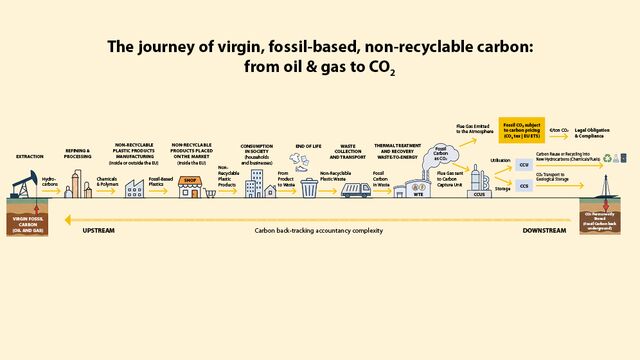
Carbon responsibility, in the form of a CO2 tax or an Emission Trading System, applied “at the WtE stack” (downstream approach) is too far from the source to show a real effect on the cause of the problem. Of course, the more we try to track back fossil carbon to its origin, the more complex it gets. Additionally, when tracing back the products’ value chain, a broader international picture emerges: many non-recyclable plastic products consumed in the EU are not even produced in the EU. An additional layer of complexity is added, and it is fundamental that EU competitiveness is safeguarded in the globalised market we live in.
Responsibility for the climate impacts associated with the thermal treatment via WtE of virgin, fossil-based, non-recyclable materials should therefore ideally be shared with those entities placing products on the market in the EU. This could be achieved, for example, by developing Extended Producer Responsibility (EPR) schemes for fossil-based non-recyclable plastics.
While fossil CO₂ emissions from waste could continue to be measured and reported at WtE facilities (downstream) according to the EU ETS requirements, the financial obligation of the carbon price payment could be shared upstream to actors with decision-making power over product design and material inputs, possibly including manufacturers and/or virgin fossil fuel suppliers (upstream).
As a positive side effect, this could also create incentives to reduce virgin fossil-based content in products and help EU recyclers, struggling today with low-priced virgin plastics flooding the market.
The journey of virgin, fossil-based, non-recyclable carbon: from oil & gas to CO2
- © Fabio Poretti/CEWEPThe role of CCUS to mitigate fossil CO2 emissions from WtE
There are essentially two ways to avoid the release of CO2 emissions from WtE into the atmosphere: closing the inlet or closing the outlet. Closing the inlet simply means stop treating residual waste. This, however, does not appear to be a wise solution as it goes exactly against the nature of WtE, which treats non-recyclable waste as a service to society. Closing the outlet instead would imply using post-combustion carbon capture technologies at the end of the waste incineration process to catch the CO2 molecules before they escape into the atmosphere. As described in a previous WMW article, carbon capture is a concrete vision in the long run, but it is not a silver bullet for the WtE sector. The WtE sector is actively looking into CCUS, and projects are being deployed across Europe. The sector currently has a number of projects close to reaching FID (Final Investment Decision), others have successfully completed the Front-End Engineering Design (FEED) phase, while some are now starting with pilot phases or in-depth studies on the technology. On the other hand, CCUS will not be applicable, especially at full scale, to all facilities in Europe. Its deployment is constrained by several factors, including space requirements, additional energy demand, long implementation timelines, the absence of mature business models, high costs, and the current lack of CO₂ transport and storage infrastructure supported by a robust policy framework.
The real challenge is therefore not just within the boundaries of the WtE plant itself and its carbon capture unit: it’s a matter of making carbon capture competitive, logistically viable and economically affordable over the whole value chain.
As financing remains the main bottleneck for CCUS implementation in WtE, an EPR scheme for residual, non-recyclable plastics could also be used to support decarbonisation measures for WtE. De facto, a WtE plant equipped with CCS (Carbon Capture and Storage), apart from performing an environmental task when removing pollutants, could provide a climate service by capturing the fossil carbon contained in products and sinking it back underground, where it used to be. In a complementary way, WtE equipped with CCU (Carbon Capture and Utilisation) can promote carbon circularity by recycling CO2 and thus avoiding the use of new fossil feedstock.
Within this novel business model, entities placing fossil carbon into consumption (upstream), would financially support the development of and investment in the CCUS value chain for WtE (downstream). This model recalls a similar policy concept developed by the University of Oxford called Carbon Take Back Obligation (CTBO).
Is the EU ETS today fit for purpose or are there any enabling conditions missing?
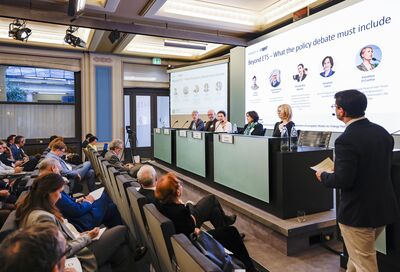
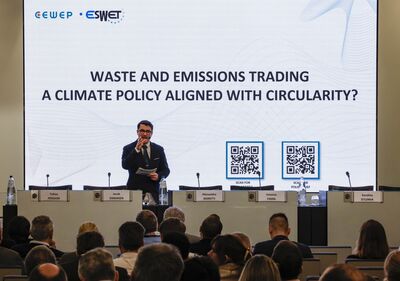
On 26 March 2026, CEWEP & ESWET organised a high-level conference in Brussels gathering stakeholders for a day of detailed exchanges on waste & EU ETS and on how climate policy should be aligned with circularity. All panellists converged to establish a strong link between climate and environmental legislation and agreed on the need to reinforce the concept of the polluter pays principle, looking more broadly at the value chain for waste and not just focusing at the WtE stack, where CO2 is emitted. From the discussions, this emerged not only as a complementary measure but as a fundamental condition to have the EU ETS eventually including waste. All panellists also agreed that landfills should not be seen as a carbon sink for non-recyclable fossil materials – not only due to environmental concerns and respect for the waste hierarchy, but also due to a loss of recoverable resources in a period of energy crisis and geopolitical tensions.
A common understanding in the European WtE sector is that the EU ETS alone in its current form won’t be enough. Including WtE installations, as the system is designed today, could create unintended environmental and economic impacts without delivering the expected climate or circularity gains. To ensure that the ETS can effectively contribute to a climate-neutral waste system, substantial adjustments are essential.
Some suggested conditions that policymakers should checklist before a possible inclusion of WtE into the EU ETS are:
- Define a dedicated category for Waste-to-Energy installations under Annex I of the EU ETS Directive, bearing in mind that waste should not be regarded as a fuel.
- Define an appropriate period covered by free allocation to prevent waste leakages. A definition of a suitable benchmark for WtE would be necessary.
- Align the EU waste targets such as the EU landfill diversion targets set for 2035 and 2040 with climate legislation, for example by considering a reasonable transition period.
- Define EPR schemes that can allocate part of the carbon signal where it bites in the value chain. Conventional “Extended Producer Responsibility” schemes could then be seen as “Extended Carbon Emissions Responsibility”, since the embedded fossil carbon in products will be covered for its transformation as CO2 at its end-of-life.
- Foster decarbonisation measures where ETS revenues are directly funnelled back to the WtE installations covered by the EU ETS.
- Define a price corridor to safeguard municipalities from sharp increases in gate fees, while ensuring price predictability.
The political Status Quo
During the CEWEP & ESWET event on 26 March, the EU Commission’s DG CLIMA listed the three main policy options that have been evaluated under the ongoing EU ETS impact assessment: 1. No inclusion of additional waste management processes, instead just improving legal clarity on the current scope; 2. Inclusion of municipal waste incineration installations only; 3. Inclusion of all waste incineration installations and landfills of non-hazardous waste.
On 15 July, the European Commission is expected to propose one of the three policy options above, accompanying it with a legislative proposal. This will then provide the basis for the discussions between the co-legislators (the European Parliament and the Council). It is therefore not yet decided that WtE will be included under the EU ETS. This will depend on the political outcomes of the trialogues. Considering also current sentiment among certain Member States on the current design of the EU ETS, all possibilities are still politically open regarding the fate of the waste sector in the EU ETS.
Another recent and crucial element publicly revealed by the EU Commission’s DG CLIMA is that the upcoming review of the EU ETS concerns the 2031–2040 ETS period. Therefore, if the political resolution finally opts for inclusion of all WtE plants in the EU ETS, this would take place from 2031 onwards.
The inclusion of carbon removals
As mentioned initially, the inclusion of the waste sector in the EU ETS is just a piece of a bigger puzzle that will be put on the table this summer. Another separate but interconnected piece of importance for the WtE sector is the integration of carbon removals into the EU ETS.
About half of the total CO2 emissions at the WtE stack are biogenic, which have a climate impact of zero. When biogenic CO2 is permanently stored via CCS, it can generate a negative emission, aka a carbon removal, since it is literally the same as removing CO2 from the atmosphere.
Carbon removals are a big family that can be divided into two macro categories: nature-based and industrial-based removals. WtE falls into the industrial-based category and more specifically into the BioCCS sub-category (bioenergy carbon capture and storage) under the EU Carbon Removal Certification Framework (CRCF). WtE in the future can be a potential provider of carbon removal, which will be essential for Europe to reach net-zero.
Using the EU ETS to trade carbon removals could further stimulate CCUS investment and may ultimately benefit the WTE sector more than a carbon price on fossil CO2 emissions.Fabio Poretti, CEWEP
At the moment, removals can essentially be bought and used by companies on a voluntary basis only. Given that the certification process for carbon removals is advancing successfully, the EU is now planning to boost the exchange of carbon removals from voluntary markets to compliance, using the EU ETS as a trading space for companies to sell & buy carbon removal certificates. The EU Commission’s DG CLIMA has already announced that permanent carbon removals from DAC (Direct Air Capture) and BioCCS will be the first to be integrated into the EU ETS after 2030.
The integration of carbon removals into the EU ETS is hence no longer a question of if and when, but a matter of how to do it. Integration could be achieved in a direct way using complementary measures such as CCfD (Carbon Contract for Difference) schemes to fill the price gap or indirectly by an intermediate entity. Within the impact assessment, the European Commission is expected to reveal the creation of an “EU Purchasing Facility” that could manage the cash flows between buyers and carbon removal providers, in an effort to avoid distortions of the ETS market price.
The possibility of using the EU ETS as a marketplace for carbon removals trading could further stimulate investment in CCUS and, eventually be even more effective for the WtE sector than a carbon price on fossil CO2 emissions.
The distribution of EU ETS revenues and the Industrial Decarbonisation Bank
To boost decarbonisation, something that the 2026 revision will try to solve is the redistribution of EU ETS revenues. Today around 78% of ETS revenues end up in national budgets and only 5% are sent to the EU Innovation Fund – the main funding program for net-zero technologies in Europe. Already since 2023, Member States should principally use 100% of EU ETS revenues for decarbonisation measures. However, in reality, this money ends up in the Member States’ general budgets, which report that the spending in industrial decarbonisation is very small.
The Commission has announced its intention to use the revision of the EU ETS to create an engine for investment and innovation in Europe. With the EU ETS revision, a broad consensus in Brussels already exists to set stricter implementation rules for the “recycling” of EU ETS revenues.
The European Commission is also expected to go beyond the Innovation Fund and in July it will reveal more details on the creation of the Industrial Decarbonisation Bank (IDB). This is a proposed €100 billion financial initiative designed to derisk and fund the green transition of European hard-to-abate and energy-intensive industries. In line with the Clean Industrial Deal, the European Commission recognised that a bankable business case for industrial decarbonisation requires public financial support.
The main challenge for Brussels will then be to convince Member States to sacrifice a part of the ETS budget for EU decarbonisation measures. Surely another politically hot topic to solve.
Conclusion
The 2026 EU ETS revision can be seen as a puzzle or a multivariable ecosystem where each camp has its own specificities and complexities, but at the same time all items are interconnected and can mutually influence each other.
Political ambition will also seem to be strong, with the goal already announced by the co-legislators to reach a compromise agreement in the first quarter of 2027. This further raises the temperature in the EU bubble.
This summer is therefore going to be a hotter one in Brussels due both to climate change effects and the ongoing EU ETS revision. The ultimate question is if the EU ETS will be able to combat climate change and serve as an example of climate action globally, while preserving the environmental integrity in the waste management world and the competitiveness of the European Union.
There are no simple solutions to complex problems. A higher climate ambition requires courageous, yet not easy, efforts at institutional and political level.
Bringing WtE into the EU ETS without structural adaptation risks higher GHG emissions, waste leakage and EU competitiveness concerns due to higher costs for citizens and business – without delivering tangible climate or circular economy benefits. To effectively reduce GHG emissions in WtE, the EU ETS would need a substantial reform by switching to a new carbon management paradigm as a leading example for our planet.