
End-of-Life Tyres : Turning tyres into treasures

We’ve come a long way since Scotsman John Dunlop patented the pneumatic bicycle tyre back in 1888 – 44 years after American Charles Goodyear secured a patent for the vulcanisation of rubber. In the nearly 140 years since, global demand for pneumatic tyres has exploded. But with this boom comes a huge challenge: the mountains of end-of-life tyres (ELT) piling up every year. Since 2020, the world has generated around 1.6 billion ELTs annually, equivalent to approximately 26 million tonnes of waste. Europe alone accounts for 3.5 million tonnes.
Many countries boast high recovery rates: 90% in Europe, 81% in the US; around 60% globally, leaving “only” 40% lost to landfilling, stockpiling or burning. Although that does not sound too bad at first glance, under closer inspection, the numbers reveal a not-so-rosy reality: 50% of the tyres collected in Europe are exported for processing elsewhere. Globally, fewer than 20% of ELTs are actually recycled. True material recycling – turning old tyres into new ones – remains the exception rather than the rule. Most ELTs are either incinerated or repurposed for low-value uses. Still, a shift is underway. Around the world, companies are stepping up with innovative solutions to challenge the status quo.
Trying for true material recycling
Tyres contain a variety of valuable materials such as rubber (75%), steel (15%) and textile fibres (10%) as well as carbon black and silica. But this material complexity makes true material recycling a challenge. Additionally, used tyres are contaminated with dirt, oil, road chemicals and wear products. There are different tyre types (passenger, truck, aircraft), that vary in material proportions and formulations, so standardised recycling is difficult. Also, unlike plastics, vulcanised rubber cannot be melted and reshaped. As a result, most recycled tyre material ends up as lower-value products like crumb rubber for playgrounds or asphalt or construction fill.
Innovative technologies take a different route:
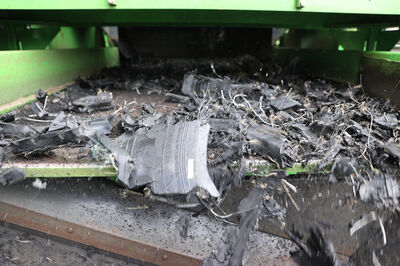
Pyrolysis involves heating tyres in the absence of oxygen, breaking them down into their base components: gas, oil, recovered carbon black (rCB) and steel
Outputs and applications:
- rCB (Recovered Carbon Black): Used in tyres, rubber products, plastics.
- Tyre pyrolysis oil (TPO): Used as fuel or upgraded to chemicals.
- Syngas: Used on-site for energy.
- Steel: Used in the metal industry.
Devulcanisation is the reversal of vulcanisation, the chemical process that makes rubber durable by cross-linking sulphur bonds between polymer chains. Tyres are vulcanised, so recycling them requires breaking these bonds without destroying the polymer backbone.
Outputs and applications:
- Devulcanised rubber (DR): Soft, reprocessable rubber compatible with new rubber compounds. Used for new tyres, rubber mats, sealing products, shock absorbers, adhesives.
Cryogenic grinding: Tyres are cooled using liquid nitrogen to make the rubber brittle, then shattered into fine particles with minimal degradation.
Outputs and applications:
- Fine rubber powders for adhesives, coatings, sealants, rubberised plastics.
- Bitumen modifiers for rubberised asphalt.
- Elastomer fillers or rubber compounds.
According to various studies, the theoretical recycling potential, pushed by these innovative technologies, lies between 80 to 95%. Market outlooks see an economic potential of USD 6.5 to 10 billion for the ELT recycling market.
>>> Dyntex launches first functional textiles made from recycled car tyres
EU projects researching ELT recycling
In the last few years, various EU-funded projects have looked to improve ELT recycling.
The LIFE Green Vulcan project, for example, set out to develop an environmentally friendly rubber devulcanisation process. The project partners, including Italian companies RubberConversion, Innovando, Bridgestone and the University of Trento, developed a low-temperature, selective mechano-chemical devulcanisation process and built a prototype plant for producing masterbatches of natural rubber and styrene-butadiene rubber (NR/SBR) from ELTs for the successful production of tyre treads and car spring pads with significant recycled content. The output materials can replace almost all the virgin rubber, even in high-performance applications, according to the project partners. This method has the potential for reprocessing 200,000 to 400,000 tonnes of ELT granules each year.
The BlackCycle project, on the other hand, focused on pyrolysis to convert ELTs into Secondary Raw materials (SRM) such as oils, resins and carbon black. The 13 project partners, including coordinator Michelin, Orion Engineered Carbons, Pyrum and INERIS, established a full circular value chain from collection to tyre production. The aim is nothing less than to transform the tyre mass-production ecosystem via pyrolysis-derived feedstocks, with ambitious recycling scale targets (The project partners claim to go for 50% of ELTs in Europe) and validated chain flows. “The project, with all the partners and their skills, has taken a systemic approach, taking into account the technical, economic, and environmental aspects of the value chain simultaneously”, explains Jean-Michel Douarre, BlackCycle Consortium Director and research program leader on sustainable raw materials at Michelin.
>>> How advanced innovation is driving circularity in the waste industry
“The Blackcycle project not only improved the pyrolysis process, it also introduced new transformation steps like tyre deconstruction machines; distillation, polymerization…Thanks to that new value chain, new raw materials for ELT were created: Sustainable CB (s-CB) , sustainable plasticizing resin (as good as their virgin version), and also Micronized Powder made of 100 per cent of inner liner compound. All those brand-new materials were validated in tyres”, he continues.
The project brings laboratory technology to industrial scale and is now poised for industrial expansion. “A joint venture - Infiniteria - between Antin, Enviro, and Michelin has been established to deploy several plants in Europe by 2030 with the goal of processing at least one million tonnes of ELT. We also support REGOM that has developed AI automated tire sorting at the beginning of the value chain to enhance the quality and efficiency of ELT feedstocks”, says Douarre. “Additionally, another European project is underway to support the DPP, or digital product passport, to improve value chain traceability. Within Michelin, a new operational division has been formed to manage the circularity transformation based on insights gained from this project. It even inspired the creation of a similar project in Korea.”
>>> The ConCirMy configurator informs about the sustainability aspects of products
Tackling tyres
In addition to these ambitious projects, there are a few other companies which rely on innovation to solve the tyre recycling problem.
Swiss company Tyre Recycling Solutions (TRS) was founded in 2013 with the mission of recycling materials in tyres in a sustainable way. With its innovative devulcanisation technology, TRS breaks down used tyres into high-quality rubber materials that can be reused in new products. TRS’s process is low-energy and water-efficient, using no harsh solvents. Combined with its licensing business model and modular technology platform, it allows decentralised, scalable recycling units worldwide. TRS’s collaborative network spans multiple continents and sectors.
Swedish company Enviro is one of the few companies worldwide focusing on pyrolysis. Founded over 30 years ago by Bengt-Sture Ershag, the initial focus was on the technology itself. After various tests and marketing research, the company concluded that ELT was the most promising input material. “Enviro’s pyrolysis technology renders about 50% recycled oil (TPO), 30% recovered carbon black, 15% steel and 5% gas,” explains Enviro’s CEO Fredrik Emilson. “Recovered carbon black, rCB, of the right quality could thus be sold directly to OEMs for circular reuse without further processing, and the same applies to the oil.” The demand for their SRM is very high, he adds: “Almost all of the world's major tyre manufacturers have communicated very ambitious sustainability goals for their products going forward. For example, Michelin and Bridgestone aim to have 100 per cent circular or renewable materials in their tyres by 2050. Several other major tyre manufacturers have set similar goals.” Enviro has an ambition to build one million tonnes of recycling capacity in Europe, which would generate equal to about 5 per cent of the global yearly demand for carbon black.

“Our technology proves that strong financial returns and environmental benefits can go hand in hand,” he elaborates. “We’ve demonstrated that a full-scale pyrolysis facility can deliver high profitability without relying on subsidies — it’s a robust financial case.”
To help push more sustainable solutions, Emilson advocates for better regulations: “If there is a proven circularity technology in the market, a ban on open-loop solutions such as landfills and incineration should apply. Equally, various sourcing directives should apply and make producers gravitate towards the more sustainable alternatives.”
He adds, “What’s exciting is seeing industries shift towards circular models on their own initiative. Enviro isn’t just talking about sustainability — we’re delivering it. Our process shows that recycling can meet climate goals and market demands without compromise. It’s a model we hope will inspire others across both policy and business.”
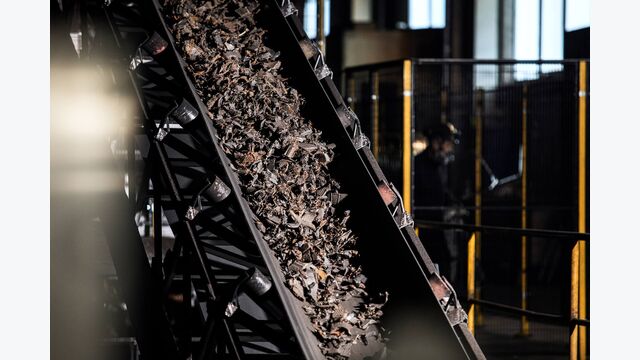
ELTs should not be wasted but turned into secondary raw materials.
- © EnviroThe same goes for German company Pyrum Innovations AG, which is also part of the BlackCycle project. Founded in 2008 by four young, ambitious friends with the conviction that they can accomplish what others have been unable to achieve: Build a pyrolysis plant self-sufficient in terms of energy. Today the patented technology can recycle ELT and plastics with virtually zero emissions, as CEO Pascal Klein explains: “The thermolysis process produces three main outputs: oil, carbon black, and gas. The recovered oil is supplied to our partner BASF, where it is integrated into their production processes via a mass balance approach. The resulting end products are used in high-quality applications, such as outdoor apparel by VAUDE or door handles in the Mercedes S-Class. The carbon black is currently purchased by Continental and Schwalbe, who use it to manufacture new tires. The gas generated during the process is used on-site to power our facility. We employ two technologies for this purpose: a combined heat and power (CHP) plant and microturbines. Both systems produce enough electricity to operate our reactors independently from the grid. When using microturbines, we additionally utilize the resulting waste heat for drying the rCB pellets.”
Fraunhofer UMSICHT's 2022 LCA found Pyrum’s pyrolysis process saved 72% more CO₂ than conventional recycling. This equates to a reduction of 965 kg CO₂ per tonne of end-of-life tyres, or 244% less than using tyres in cement plants.

But the road to success was not an easy one. First, they had to establish a market for their products. In 2018, Pyrum became the first company to be REACH registered for thermolysis oil. They then signed a supply agreement with BASF for 300,000 pyrolysis oil tonnes per year. However, they only operate one plant with more to come. Last year, Continental signed a framework agreement for the long-term supply of recovered carbon black over a ten-year period and this year a similar ten-year contract was signed with Schwalbe. Like Emilson, Klein sees a clear demand for sustainable raw materials and other manufacturers are approaching Pyrum about similar agreements.
In the next phase, Pyrum will begin recycling plastics using their innovative technology, for which a patent application is currently pending. When asked about the most rewarding aspect of working in the circular economy and recycling space, Klein explains: “We turn waste into something new, thereby solving many environmental problems.”